How to explain a hard concept with an analogy
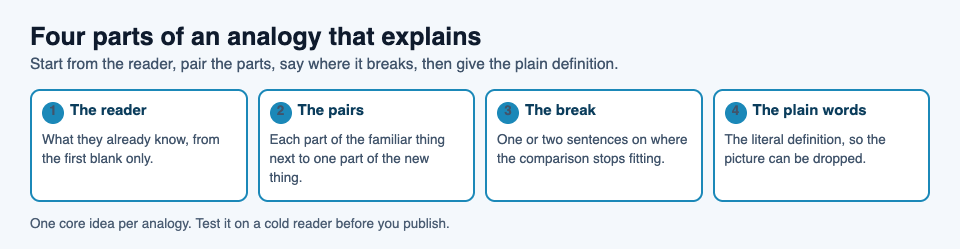
To explain a hard concept with an analogy, start with one rule: an analogy is a bridge, not a destination. It carries a reader from something they already know to something they do not. Done well, it saves pages of definitions. Done badly, it leaves a wrong picture that is harder to fix than no picture at all.
This guide gives you a four-step method you can use in an article, a note or a reply, a worked example about web feeds, and a short test to run before you publish.
Why explain a hard concept with an analogy
A concept is usually hard because the reader has nowhere to put it. The words are new, the parts are new and the links between the parts are new, so everything must be learned at once.
An analogy removes most of that load. It says: this new thing works like that old thing you already understand. The reader borrows a structure they trust and hangs the new facts on it.
That is also the risk. The reader borrows the whole structure, including the parts that do not apply. Your job is not only to pick a good comparison. It is to say which parts to keep and which to drop.
Start from what your reader already knows
Decide who is reading before you choose the comparison. The same concept needs a different bridge for different people. A cook knows recipes and timing, a driver knows lanes and junctions, a parent knows routines and rules.
Write one sentence at the top of your draft: "My reader knows about ___ but not ___." Pick your comparison from the first blank only. If you choose from your own interests, you get an analogy that makes sense to you and to nobody else.
Pick the one idea the reader must keep
A concept comes with many facts, and an analogy cannot carry all of them. Choose the one idea the reader must leave with.
Finish this sentence: "After reading this, the reader should understand that ___." Keep it to one clause. If you need "and" twice, you have two ideas, so you need two analogies or two sections.
This is the same discipline as explaining a new idea in one article: one idea per piece, and everything else serves it.
Pair the parts, one for one
Once you have a reader and a core idea, list two or three candidate comparisons. Test each by pairing parts. Write two columns: the parts of the familiar thing, and the parts of the new thing that match them.
A good comparison has a partner for every part that matters. If a part of the familiar thing has no partner, the reader may wonder what it means. If a part of the new thing has no partner, the analogy does not cover it, and the text must say so.
A worked example: explaining a web feed
Noor (a made-up writer for this example) wants to explain a web feed to friends who have never used one. Her reader knows a shop window with a noticeboard. The core idea she wants them to keep: a feed is a list of a writer's newest posts that a program can read for you, so you do not have to visit each page to check.
She pairs the parts. Electrified's feeds are real, so every match can be checked:
- The noticeboard matches the feed. Electrified has one for every post at
/feed.xml, and one per writer at/@handle/feed.xml. - One card on the board matches one entry. Each entry holds the title, the address, the dates, the author, a summary and the post in full.
- Newest cards on top matches newest first. Each feed holds the newest 100 posts.
- Walking past the window matches a feed reader, the program you give a feed to.
Then she writes it in plain words:
Picture a noticeboard in a shop window. Each card has a title, a date and a short note, and the newest card is on top. A feed is that noticeboard for a writer's posts, and a feed reader is you walking past it.
The paragraph names the familiar thing first, states the match and stops. It does not pile on detail.
Say where the comparison breaks
Every analogy fails somewhere. Say where, in the same section. One or two sentences is enough.
Noor adds: "The difference is that a real noticeboard stays where it is, and you must walk to it. A feed is read by a program, which can fetch the cards from many writers into one place. And each card carries the whole post, not only a note."
That protects the reader. Without it, they may think a feed is one place on one page. With it, they know exactly where to stop using the picture.
A pattern you can reuse every time:
- State the analogy in one or two sentences.
- Say what it matches in the new concept.
- Say where it stops matching.
- Give the plain, literal definition once, so the reader can drop the analogy when they are ready.
For Noor, step four reads: "In plain terms, a feed is a file of a writer's newest posts in a standard format, and a feed reader reads it." If a reader wants to try it, the post on following a blog with an RSS or Atom feed shows the steps.
When an analogy misleads
Some comparisons do more harm than good. Watch for these three.
- It carries a part you did not mean. Comparing a tool to a person can bring feelings, motives and memory that the tool does not have. If you use a human comparison, say what it does not claim.
- The term itself is disputed. When experts define a word differently, one analogy hides that. Use the analogy for one definition and say it is one definition.
- The reader does not know the familiar thing. A comparison to a game, a sport or a trade works only for people who play it. If you doubt it, pick a plainer one.
Test your analogy before you publish
Run four checks before you post.
- The one-sentence test. Can the reader say the core idea back in one sentence, without the analogy?
- The pairing test. Does every important part of the new concept have a partner? Write the pairs down.
- The wrong-conclusion test. Ask what a reader might wrongly assume if they follow the analogy too far. If the answer is serious, add a sentence that blocks it.
- The cold-read test. Give the paragraph to someone who does not know the topic and ask them to explain it back. Where they stumble is where your draft needs work.
On Electrified, the Preview tab in the editor shows the post as it will look when published, so you can read the section the way your reader will. You can also save it with Save draft first; a draft is seen only by you until you publish it, which gives you room to test the wording on someone else before it goes live.
Keep a bank of analogies as you learn. An analogy that worked once will work again for the next reader. When you learn something by writing about it, keep a short list: the concept, the comparison, and where it broke. Over time that list becomes a glossary of your own, and the pairs make good entries. The post on writing a glossary for a topic you are learning shows how to lay it out. Each post you publish can be filed under topics you choose, such as Knowledge building, so the explanations sit together.
Frequently asked questions
How many analogies should I use for one concept?
Usually one. If you need a second, use it for a different part of the concept and say so. Two analogies for the same part can pull the reader in different directions.
What if my analogy is not perfect?
No analogy is perfect. State where it stops working, then give the literal definition. The reader can use the picture for the first step and drop it afterward.
Should the analogy come before or after the definition?
For a reader new to the topic, put the analogy first and the definition after it. For a reader with some background, give the definition first and use the analogy to clear up one tricky part.
Can I use a well-known analogy?
You can, if it still fits your core idea. Check each pair again, and add one detail from your own example so it is not just a repeat of what the reader has seen.
How long should the analogy section be?
One short paragraph for the comparison and one for where it breaks is often enough. If it runs much longer, you may be explaining the analogy instead of the concept.
Get started
Pick one concept you find hard to explain, write down what your reader already knows, and draft the pairs before you write the article. Publish it on your own page, filed under topics you choose, and ask a reader to explain it back.
Make an account on Electrified: write about your product, topic or idea on your own page, one article at a time, and let readers follow along.
Comments
No comments yet.
Sign in or make an account to comment.