How to explain a new idea in one article
To explain a new idea in one article, open with the problem your reader already has, then name the idea in one plain sentence, then show one example worked from start to end, then answer the doubts the reader brings. Everything else waits for a later article. Below, you follow it step by step with one running example, so you can see each step applied to real text.
The running example is made up for this article: you want a volunteer club committee to stop tracking jobs in its group chat and keep one shared list instead. It is a small idea, but it is new to the committee, and it is easy to explain badly.
Why it is hard to explain a new idea in one article
A new idea has no place to land in the reader's head yet. When you wrap it in history, theory, edge cases and three related ideas, the reader cannot tell which part is the point. They can finish the article thinking it was interesting, with nothing they can act on.
Three habits make it worse:
- The idea arrives late. The reader has to get through five paragraphs of background before they meet it.
- The idea has too many names. You call it "the list", then "the tracker", then "the backlog", and the reader thinks these are three things.
- The idea competes with its own extras. Every side point pulls attention from the main one.
The fix is to give the article one job. The five parts below keep it on that job.
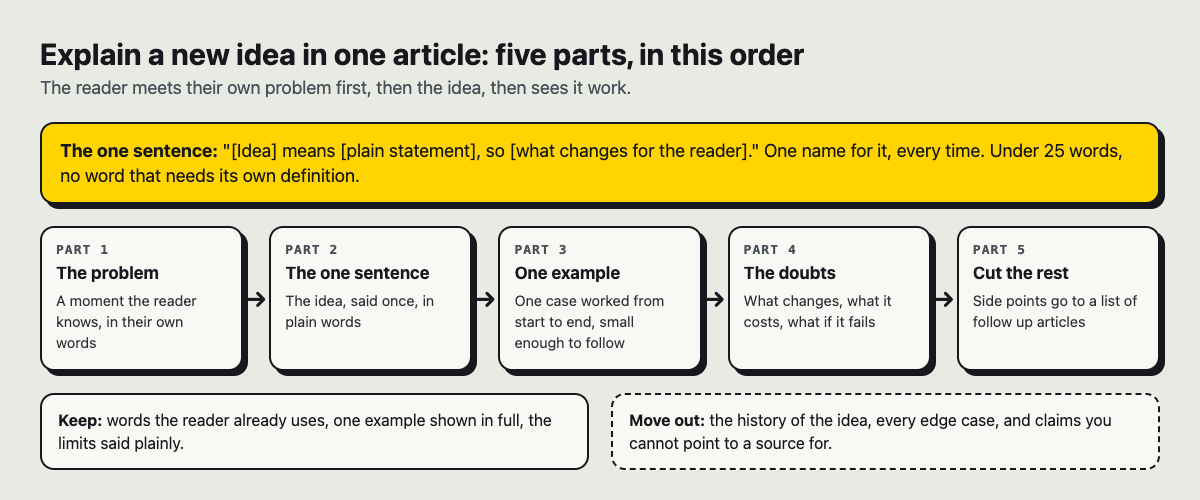
One shape for an article that explains a new idea. Your parts will follow your own idea.
Start with the problem your reader already has
Nobody wakes up wanting a new idea. They wake up with a problem. Your first paragraph describes that problem in words the reader would use, so they think "yes, that is us".
For the club committee, a weak opening sounds like this: "Shared task lists are a proven approach to coordination in volunteer groups." It is abstract, it makes a claim you cannot point to, and it starts with your answer instead of their problem.
A stronger opening: "Someone asks in the committee chat who is booking the hall. Forty messages later, nobody is sure, and the hall is not booked." The reader knows the scene. Now they want the answer.
A quick test: read your first two sentences to one person you are writing for. If they cannot say "that happens to me", rewrite them. If the idea is a product rather than a method, the same rule holds, and how to write an article that explains what your app does goes deeper on putting the user's problem before the feature list.
Name the idea in one plain sentence
Once the problem is on the table, give the idea a name and one sentence. No jargon, no hedging, no "in a sense".
For the example: "Keep one list of every open job, with one owner per job, and make the list the only place a job counts as tracked."
That sentence does three things. It says what the thing is (one list). It says the rule that makes it work (one owner, one place). And it is short enough to repeat. From here on, call it "the list" every time. New names for the same thing blur a new idea.
A size check: on Electrified, a note is a short post of up to 500 characters, with no title. If you cannot state your idea in less than a note's length, you do not have one sentence yet. Keep cutting until it fits, then build the article around it.
Show one example before any reasons
Right after the sentence, show the idea working. One example followed all the way through teaches more than five examples mentioned in passing.
For the club list, the example might read:
Monday: Sam adds "Book the hall for the June meeting" to the list and puts their own name as owner. Wednesday: someone asks in the chat whether the hall is booked. The answer is one link to the list, where the job says "Sam, booked, confirmation in email". Nobody else has to reply.
Look at what the example does. It uses a name, days and a real task. It shows the rule (one owner) paying off. It ends with a result anyone can see (nobody else has to reply).
Only after the example do you give reasons: why one owner matters, why the chat cannot be the record. Reasons are easier to follow once the reader can picture the thing they are about. If the theory comes first, you are asking the reader to agree with something they cannot yet see.
A useful habit when drafting: write the example first, before anything else in the article. If you cannot write it, the idea is not concrete enough to explain yet.
Answer the doubts your reader brings
Expect three doubts, and answer them in this order. Each one you leave open is a reason to close the tab.
- "Is this really different from what we do now?" Say plainly what changes. For the list: "You already talk about jobs in the chat. The change is that a job only counts once it is on the list with a name next to it."
- "What does it cost me?" Be honest about the effort. "Someone has to add jobs, and the list needs five minutes at each meeting." Hiding the cost makes the rest of the article harder to trust.
- "What if it fails for us?" Name the most likely failure and what to do about it. "If jobs go stale, the owner either updates them or hands them back at the next meeting."
Give each doubt its own short paragraph, or its own section. In the Electrified editor, an article has a title and as many sections as it needs, and you start a section with ## and a heading. A doubt written as a heading lets a doubtful reader jump straight to the one they hold.
Before you publish, open the Preview tab. The preview looks like the published page, so you can check that each doubt stands out and that your one plain sentence is still near the top.
Cut what belongs in a second article
Now read the draft and ask of every paragraph: does this help the reader understand the idea or try it? If not, cut it, even when it is true and interesting.
For the club list, these belong somewhere else:
- How to choose a tool to keep the list in.
- How to run the five minute review at meetings.
- How to bring the same habit to other groups you belong to.
Do not throw them away. Keep them in a list of follow ups. Each one is a good second article, and each is easier to write because the first article already did the explaining. How to plan a series of articles on one topic shows how to put those follow ups in an order a reader can use.
While you cut, keep the draft private. On Electrified, after the first save the editor says "Saved as a draft. Only you can see it until you publish it." A draft is never seen by a search engine, so you can leave it a day and reread it with fresh eyes. When it is ready, publish it, and the post keeps its address from then on.
Last, give the article its topics. Each post can carry up to 5 topics of your own choosing, and each topic links to a page of every post about it. Write the follow ups under the same topic and they sit together on one page, which is how one explainer grows into a body of work on the idea. The topics page lists what people write about, the biggest first.
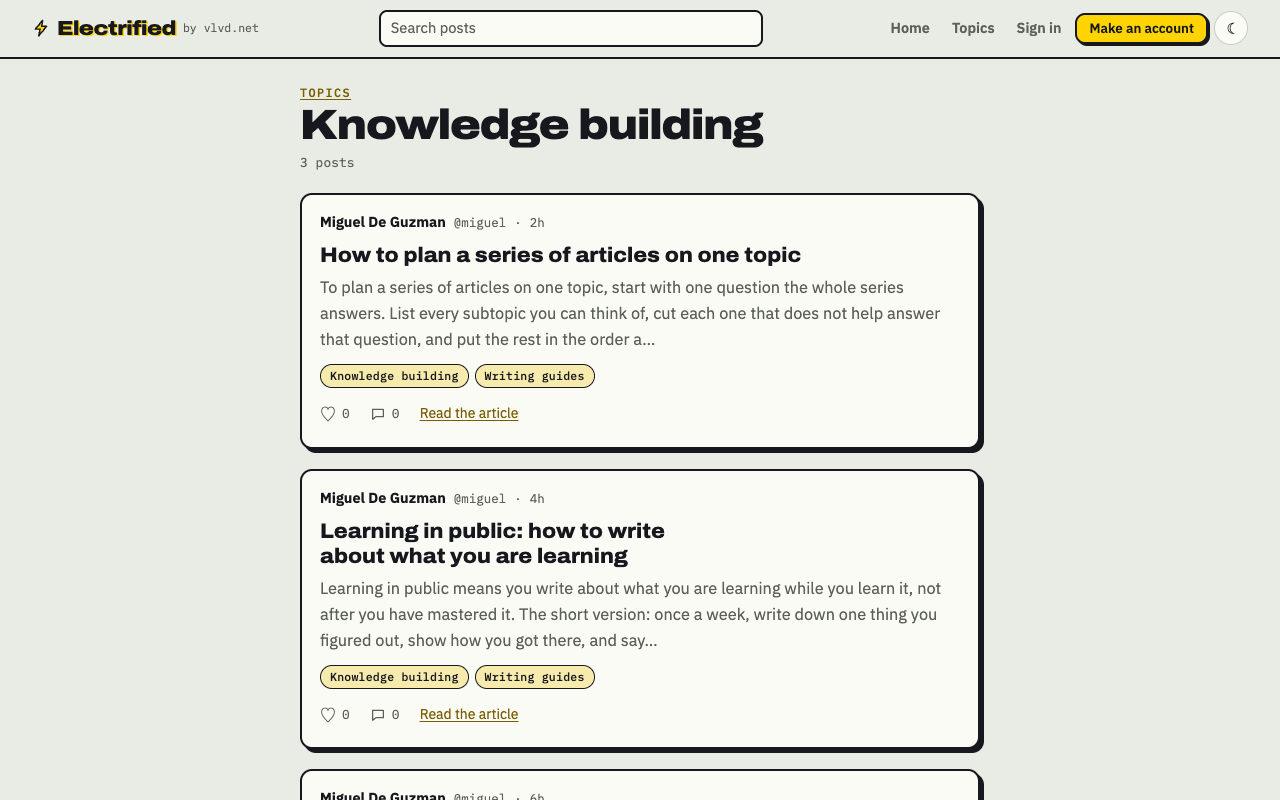
A topic page on Electrified gathers every post filed under that topic.
Frequently asked questions
How long should an article that explains a new idea be?
Long enough to cover the problem, the one sentence, one full example and the reader's doubts, and no longer. If it keeps growing, check whether you are explaining two ideas, and move the second one to its own article.
Should I explain the idea or the benefit first?
Start with the problem, which already points at the benefit, then name the idea. A benefit is hard to trust until the reader knows exactly what the idea is.
How do I know if readers understood the idea?
Ask one person you are writing for to say the idea back to you in one sentence after reading. On Electrified, published posts take comments of up to 1000 characters, so you can also end by asking readers how they would use the idea, and read what they say.
When should one idea become a series of articles?
When your cut list holds more than one useful follow up, or readers keep asking the same next question. Write the explainer first, then give each follow up its own post under a shared topic.
Get started
Pick an idea you have been meaning to explain. Write the one plain sentence and check it fits in a note's length. Then write the example, answer the doubts, move the extras to a follow up list and save the article as a draft. When it reads cleanly in Preview, publish it with up to 5 topics, and file the follow ups under the same ones. The Knowledge building topic gathers posts on building up what you know by writing.
Make an account on Electrified: write about your product, topic or idea on your own page, one article at a time, and let readers follow along.
Comments
No comments yet.
Sign in or make an account to comment.