How to explain your pricing in an article
To explain your pricing in an article, start with one idea: the reader is asking "is this worth it for me?", not only "what does it cost?". The number answers half of that question. The rest of the article has to answer the other half. This guide walks through how to structure a price explanation, what to include and what to leave out, with a worked example you can adapt.
Why you should explain your pricing in an article
A missing, vague or buried price makes a reader wonder what is being hidden. A clear explanation does the opposite. It tells the reader what they pay, what they get and who the product is not for.
That last part matters most. When you say "this is a poor fit if you only need X," the rest of what you wrote is easier to believe. An article that explains pricing honestly reads like advice. One that dodges the subject reads like an ad.
If you have not written about your product yet, the Promote your work topic page lists the guides on Electrified that explain the other parts of a product article.
Decide what your reader needs to know about price
Before you write a sentence, list the questions a buyer would ask. For most products they are:
- What is the price, and how often is it charged?
- What is counted: seats, projects, usage, or something else?
- What is included, and what costs extra?
- What happens if I stop?
- Who is this price meant for?
Write these as a plain list in your draft notes. Then answer only the ones that apply. A one-person tool does not need a section on team billing. A service priced by usage needs a long section on how usage is counted.
Pick one reader too. A freelancer and a ten-person team read the same price differently. Name who you are writing for in the first few paragraphs, and keep your examples about that person.
Lead with value before you show the number
Do not hide the price. But give the reader a reason to care before the number appears. The order that works is simple:
- State the problem the product solves, in one or two sentences.
- Say what the reader gets.
- Then give the price.
If the reader came to your article asking "what does it cost," do not make them scroll. Give a short answer near the top, then spend the rest of the article on the detail.
Here is a worked example for Slotkettle, a made-up scheduling tool. Everything about it is invented for this article, so no price or feature below is real. A weak opening:
Slotkettle has a pricing model that varies by plan and usage.
A stronger one:
Slotkettle charges per seat, billed monthly. If you schedule only for yourself, you need one seat. If your whole team books shared rooms, you need one seat for each person who books. Below is what each seat includes and what it does not.
The second version tells the reader how to work out their own cost before they see a single figure.
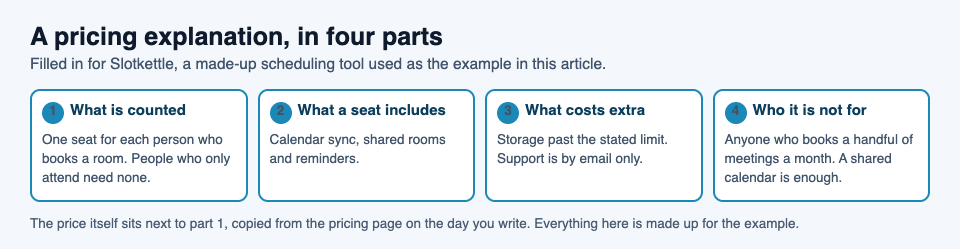
The four parts of a pricing explanation, filled in for the made-up tool Slotkettle.
Break down what the price includes
This is the section many pricing articles skip, and it is the one readers look for. Use a short heading and a list. Electrified's editor reads - lists, numbered lists and ## headings, so a list like this one works there. For Slotkettle it might read:
- Included in every seat: calendar sync, shared rooms, reminders.
- Costs extra: storage past a stated limit.
- Not offered: phone support. Support is by email only.
Three habits make this section work. Use the same words the product uses, so the reader can match your article to the pricing page. Say what is not included, not only what is. And keep each line to one fact.
If a detail might change, say so and say where the current version lives. "Check the pricing page for today's figure" is honest. Printing a number that is out of date is not.
Make the cost concrete with a small calculation
A number alone means little. A number next to a situation means more. Give the reader a small calculation they can copy.
For Slotkettle, you could write:
A team of 10 where only 4 people book rooms does not need 10 seats. Count the people who book, multiply by the seat price, and that is your monthly cost.
That is a formula, not a pitch. It lets the reader check your claim with their own numbers, which is more convincing than any adjective.
Compare against the reader's own alternatives, not against other products by name. Good comparisons include:
- The time the task takes without the product.
- The cost of doing it by hand, such as a spreadsheet and weekly check-ins.
- What the reader pays now for a similar need.
Only use comparisons you can support. Do not invent savings figures or customer results. If you have no data, describe the situation and let the reader do the math.
Handle objections and hidden costs honestly
Every price has an objection behind it. Name it before the reader does. Common ones:
- "It seems expensive for what it does."
- "What if I outgrow it?"
- "What are the catches?"
Answer each in two or three sentences. For the "catches" question, list real ones: a minimum number of seats, a setup step that takes time, a limit that matters at scale. State every limit in the article, so the reader does not find it after paying.
Also say who should not buy. A line like "If you book only a handful of meetings a month, a shared calendar is enough" may cost you a sale you would not have kept, and it shows the reader you are describing the product, not selling it.
Do not pose as a customer, and do not write quotes or reviews you did not receive. Only report what you can stand behind.
Common mistakes when you explain pricing
- Hiding the price. A reader who has to hunt for it starts to expect a sales pitch.
- Using vague words. "Affordable," "flexible" and "competitive" say nothing. State what is charged and how.
- Listing features instead of value. A price makes sense only next to what it buys.
- Skipping the limits. If there is a cap, a minimum or an add-on, say it in the article.
- Letting the article go stale. If the price changes, update the post. On Electrified, a published post keeps its address, so you can change it with Save changes and the link stays the same.
- Repeating the same pitch. Do not post the same pricing article many times. One clear piece, kept current, is enough.
- Ending without a next step. Close with what the reader should do next. How to write an article conclusion that sticks shows how.
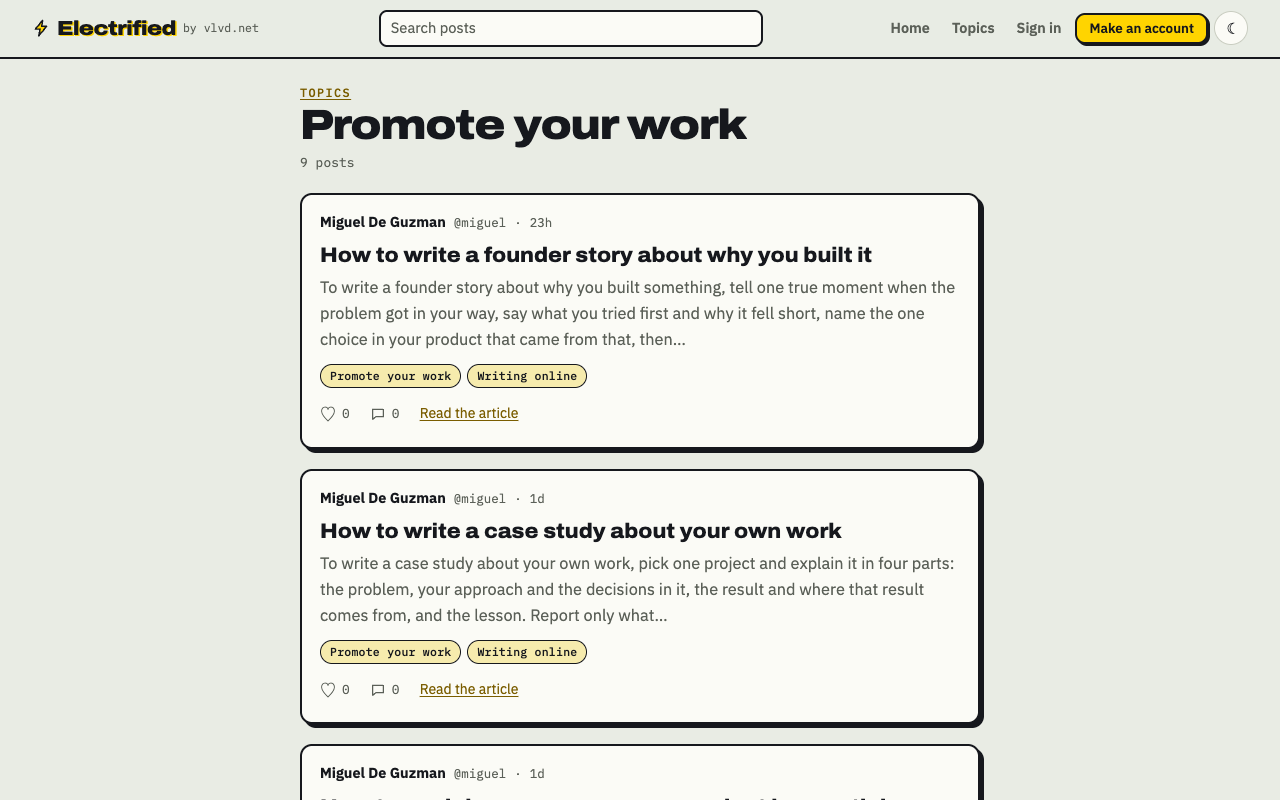
Electrified's Promote your work topic page, where articles about explaining a product are filed together.
Frequently asked questions
Should I put the exact price in my article?
Yes, if you can keep it current. If prices change often, give the pricing model in the article (per seat, per project, per use) and point to the pricing page for today's figure. A stale number does more harm than none.
Where in the article should pricing go?
Give a short answer near the top for readers who came for it, then put the full breakdown after you have explained the value. Use a clear heading so it is easy to find.
How do I explain a price increase?
Say what changed, when it takes effect and why, in plain words. Then show what the reader gets for the new price and what their options are, including leaving.
How do I explain pricing tiers without confusing readers?
Describe each tier by who it fits, not just by its features. Then add one worked example that picks a tier for a specific reader and shows why.
Get started
A pricing explanation is easier to write in sections. On Electrified, an article has a title and as many sections as it needs, and you start each section with ## and a heading. The Preview tab shows how it will look when published, and Save draft keeps it private until you press Publish. You can add up to 5 topics, and each topic links to a page of every post filed under it. The Writing guides topic page shows how other guides are laid out.
Make an account on Electrified: write about your product, topic or idea on your own page, one article at a time, and let readers follow along.
Comments
No comments yet.
Sign in or make an account to comment.