How to make a history timeline that sticks: 5 steps
A list of dates is hard to keep. A picture of lives that overlap is much easier. This guide shows you how to make a history timeline that sticks: one built around people, with each life drawn as a bar, a few events marked on it, and a short set of questions you answer from memory afterwards. You will follow one worked example from start to finish, using four famous Greeks whose lives were linked as teacher, student and king.
Why most history timelines do not stick
Most timelines are a row of years with a label under each one. You make it, you file it, and a week later you remember the effort more than the dates. There are three usual reasons.
- The years float alone. A year like 399 BCE means little until it is tied to a person doing something.
- The line covers too much. Five thousand years on one sheet leaves no room for anything but labels.
- You never use it. A timeline you only look at is a poster. A timeline you test yourself on becomes something you know.
Each step below fixes one of these.
How to make a history timeline in 5 steps
- Pick a short stretch and a small cast. Choose three to six people whose lives touched, over one or two centuries at most.
- Draw each life as a bar. One bar per person, from birth to death, stacked so you can see who was alive at the same time.
- Mark a few events across the bars. Three to six, each one a person doing something, written in a few words.
- Show uncertain dates honestly. If your source gives two possible years, write both.
- Turn the line into questions. Cover part of it and fill it in from memory, then check.
The rest of this post works through each step with one example, so you can copy the method for any period you study.
A worked example: four lives on one line
The example is a chain of teachers and students from ancient Greece. Every date here comes from World History Encyclopedia's articles on Socrates, Plato, Aristotle and Alexander the Great.
Step 1, the cast. Four people, about 150 years: Socrates, Plato, Aristotle and Alexander the Great. Three of them are in the same course on Learn 100 Influential People, The Greek Thinkers, and the fourth is in Empire Builders. That is the point of picking a small cast: each person leads to the next.
Step 2, the bars. Draw a line from 475 BCE to 320 BCE, with a tick every 25 years. Remember that BCE years count down, so the larger number is earlier. Then draw one bar for each life:
- Socrates, about 470/469 to 399 BCE.
- Plato, 424/423 to 348/347 BCE.
- Aristotle, 384 to 322 BCE.
- Alexander the Great, 356 to 323 BCE.
Look at what the bars already tell you. Plato's bar starts while Socrates is alive and runs on long after him. Aristotle's bar overlaps Plato's by more than thirty-five years. Alexander's bar sits entirely inside Aristotle's, and the two end a year apart.
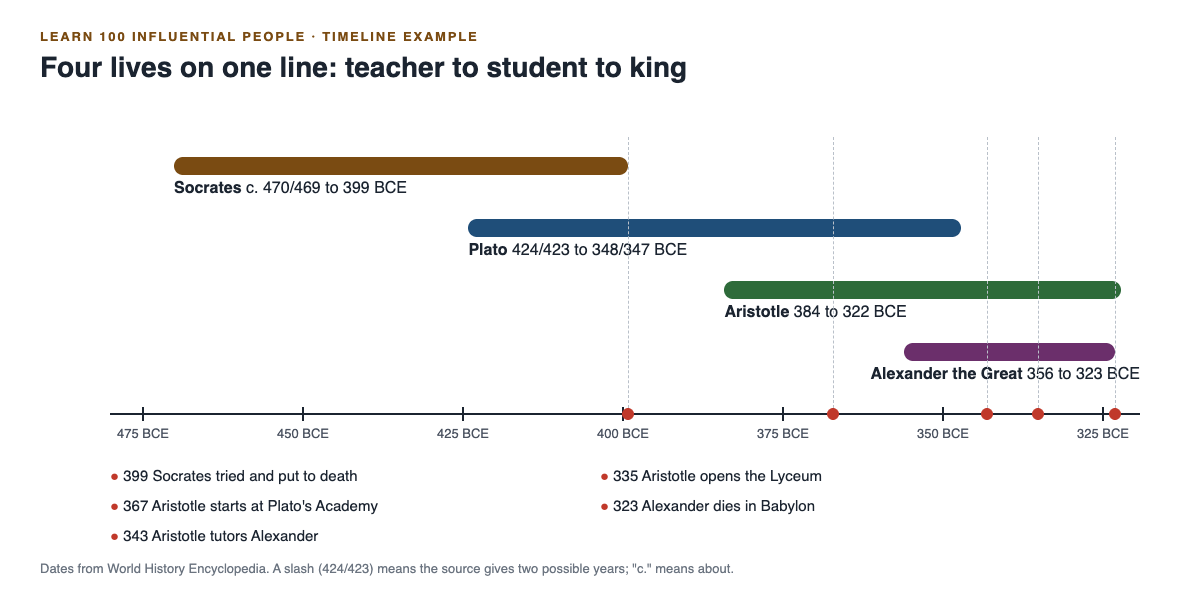
The worked example as one diagram: four lives, five events.
Step 3, the events. Mark five, each a person doing something:
- 399 BCE: Socrates is tried for impiety and put to death.
- 367 BCE: Aristotle begins his studies at Plato's Academy in Athens.
- 343 BCE: King Philip II of Macedon calls Aristotle to tutor his son Alexander.
- 335 BCE: Aristotle, back in Athens, opens his own school, the Lyceum, a rival to the Academy.
- 323 BCE: Alexander dies at Babylon, aged 32.
Now the line tells a story. Socrates teaches Plato. Plato's Academy trains Aristotle. Aristotle teaches the boy who becomes king in 336 BCE. When Alexander dies, Aristotle is charged with impiety in Athens, the same charge Socrates faced, and he dies the next year. You will remember that echo long after you forget the tick marks.
Show uncertain dates honestly
Ancient dates are often uncertain, and a good timeline shows it instead of hiding it. World History Encyclopedia writes Plato's life as 424/423 to 348/347 BCE. The slash means the source gives two possible years. Its Plato article also explains why: the scholar Robin Waterfield places Plato's birth at 424/423 BCE and rejects the traditional date of 428/427 BCE.
So on your timeline, write "424/423" and add a small note: "traditional date 428/427, disputed." That note does two jobs. It keeps you honest, and it gives you one more thing to recall. A question such as "why is Plato's birth year uncertain?" is easier to remember than a bare number.
Use "c." (about) the same way, as the source does for Socrates. Never round an uncertain date into a firm one just to make the line look tidy.
Turn the timeline into questions
This is the step that makes the line stick. Once it is drawn, stop looking at it and test yourself.
- Cover the years. Say the four lives in order, oldest first.
- Cover the names. For each event, say who did it.
- Draw the four bars from a blank page, then check the overlaps against your first version.
- Answer one "why" question in two or three sentences, such as "why does Alexander's death matter to Aristotle?"
Do this the next day, again a few days later, and again a week after that. Each time, fix only what you got wrong.
Learn 100 Influential People asks the same kinds of questions. Its 272 questions include ones where you choose, put in order, match, sort and estimate a number, and questions from lessons you finish come back, spaced out so they stick, up to 5 a day. Every attempt is graded, and you can retake a lesson any time. If you want a broader plan around this, the post on how to remember historical figures and what they did covers recall and review in more detail.
Common mistakes
- Too many people. Twenty names on one line turns back into a list. Make several small timelines instead, then link them by one shared person.
- Uneven spacing. If 50 years takes as much room as 5, the overlaps lie to you. Keep the tick marks evenly spaced.
- Events without people. "Founding of a school" is weaker than "Aristotle opens the Lyceum."
- Dates from memory. Take every date from a source you can name, and leave out any detail two sources give differently.
- Drawing it and never testing it. The questions are the part that does the work.
Once your four Greeks are on the line, you have a frame for reading about them. The posts comparing Socrates and Plato and Plato and Aristotle fill in what each one actually thought.
Frequently asked questions
How many people should a history timeline have?
Start with three to six people whose lives touched. That is enough to show overlaps and links, and few enough to recall without notes.
How do I show BCE dates on a timeline?
BCE years count down toward year 1, so 399 BCE comes before 323 BCE. Put the larger BCE number on the left, and keep the spacing even.
What if my sources give different dates?
Write what your source gives, including a slash for two possible years, and note the other date if a source explains the dispute. If two sources simply disagree with no explanation, leave that detail off.
Should I draw a timeline by hand or on a computer?
Either works. What matters is that you place each bar and event yourself, then test yourself on it from memory.
Get started
Pick one stretch of history and four people whose lives touched. Draw their bars, mark five events, and quiz yourself tomorrow. If you want lessons that give you the cast, the sources and the review questions, The Greek Thinkers is one of the Basic courses on Learn 100 Influential People, made for the best-known names with no background needed. The site has 15 courses and 46 lessons of about 9 minutes, and every lesson lists its sources. You sign in with your email and an emailed code.
Comments
No comments yet.
Sign in or make an account to comment.