How to plan a series of articles on one topic
To plan a series of articles on one topic, start with one question the whole series answers. List every subtopic you can think of, cut each one that does not help answer that question, and put the rest in the order a reader will need them. Then give each part one job, tie the parts together with links and shared topics, and choose a pace you can keep. This guide works through each step with one example, a made-up series on daily walking, so you can copy the method for your own subject.
The steps, in short:
- Write down the one question your series answers.
- List subtopics, then delete the ones that do not help answer it.
- Order the parts by what the reader needs first, second and last.
- Give each part one job and one search phrase.
- Link the parts together and give them the same topics.
- Pick a pace you can hold for the whole run.
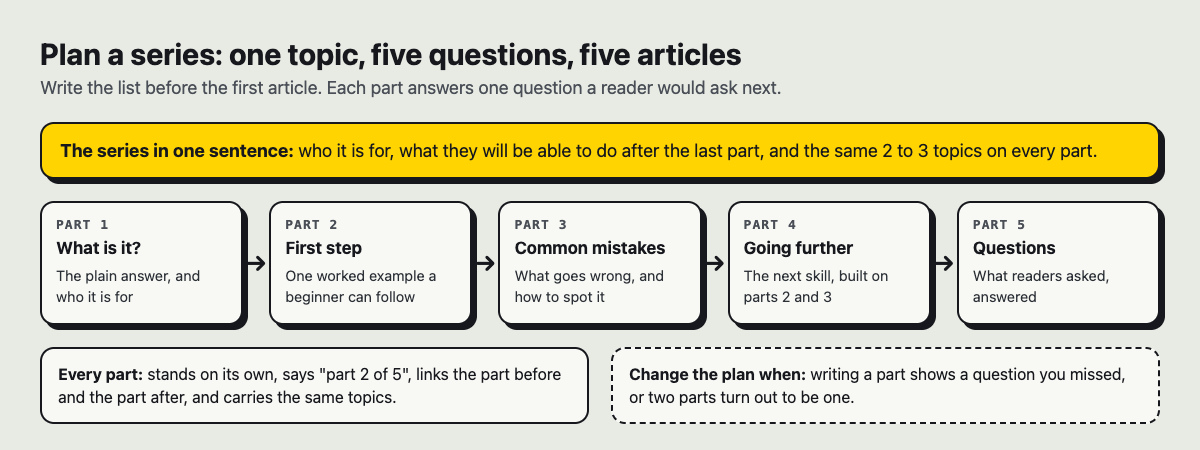
One general shape for a series. Your parts will follow your own question.
The running example is a made-up series for someone who keeps starting a daily walk and losing the habit. It is here to show the planning, not to give walking advice.
Why a series instead of one long article
One long article tries to answer every question at once. A reader who needs one part has to scroll past the others to find it. A series splits the subject so each piece answers one need well.
A series also gives you room. You can go deep on one narrow problem without the post turning into a wall of text. And a reader who found one part useful has a clear next step: the part that covers the next thing they are stuck on.
For you as the writer, a run of articles is a way to build up what you know about a subject. Each part forces you to work out one piece properly before you move on. The guide on how to build knowledge around a topic by writing about it goes further into that side.
Plan a series of articles around one question
Start with a single sentence, written as a question a real person would ask. Not a theme. A question.
A theme sounds like "walking". That is too wide to plan. A question sounds like "How do I keep walking every day when my schedule and the weather get in the way?" Now you know who the reader is and what they want.
Test your question with two checks:
- Could one person ask it? If it only makes sense as a category heading, narrow it.
- Does it need more than one article? If a single post can answer it fully, you do not need a series. Write the one post.
Write the question at the top of your planning notes. Every later decision gets checked against it.
List the subtopics, then cut what does not fit
Now list every subtopic you can think of. Do not filter yet. For the walking series, the list might be:
- Fitting a walk into a lunch break
- Walking when it rains
- Choosing shoes
- The history of step counters
- Keeping a streak
- What to do after you miss a day
- Walking for weight loss
Then hold each item up to the question. Does it help someone keep walking every day despite their schedule and the weather? Lunch breaks and rain do. So do streaks and missed days. The history of step counters may be interesting, but it does not help, so cut it. Weight loss is a different question for a different reader; save it for another series.
Cutting is the step that is easiest to skip. A short series where every part serves one question is easier to follow than a long one that wanders.
Order the parts the way a reader needs them
Ask what problem someone hits first, and what they hit once that is solved. That order is your table of contents.
In the walking example, a reader first needs a time slot, so finding a walk in the lunch break comes first. Once the habit starts, bad weather is the next thing that can break it. Then comes keeping a streak, and last, starting again after a missed day. Four parts, in the order the trouble arrives.
Other subjects have other orders. A study plan is ordered by day, because that is how the reader lives it. A guide to a tool is ordered by what you do first in it. Pick the order your reader lives in, not the order you happened to learn it.
Give each part one job and one search phrase
Each part should finish one task for the reader. Write that task as a single line before you draft:
- Part 1 job: give the reader a short walk that fits inside a lunch break. Search phrase: "how to fit a walk into your lunch break".
- Part 2 job: give the reader a wet-day plan so rain does not end the habit. Search phrase: "how to keep walking when it rains".
One job per part stops overlap. If you catch Part 3 explaining lunch-break timing again, that material belongs in Part 1. Link to it instead of repeating it.
One search phrase per part keeps titles clear. Put the phrase in the title and the opening paragraph, then answer it straight away. On Electrified an article title can be up to 140 characters, so there is room for a plain title that says what the part does.
Tie the parts together on Electrified
Readers can land on any part first, so each part needs to show where it sits. Three things do that.
A first article that maps the series. Make Part 1, or a short opening article, state the question and list every part in order with one line on what each does. On Electrified this is an ordinary article: start each section with ## and a heading, use [link text](https://...) for each part, and a numbered list for the order. Check it in the Preview tab, which looks like the published page. A published post keeps its address, so those links keep working as you add parts.
The same topics on every part. Each post can carry up to 5 topics, and each topic links to a page of every post about it. Give every part the same one to three topics, such as Daily walking, and that topic page collects the series in one place. You can see what people already write about on the topics page, and what a topic page looks like on Knowledge building.
A line at the top and bottom of each part. Say "Part 2 of 4" near the start. At the end, link the part before and the part after. A reader who lands in the middle can then find the start.
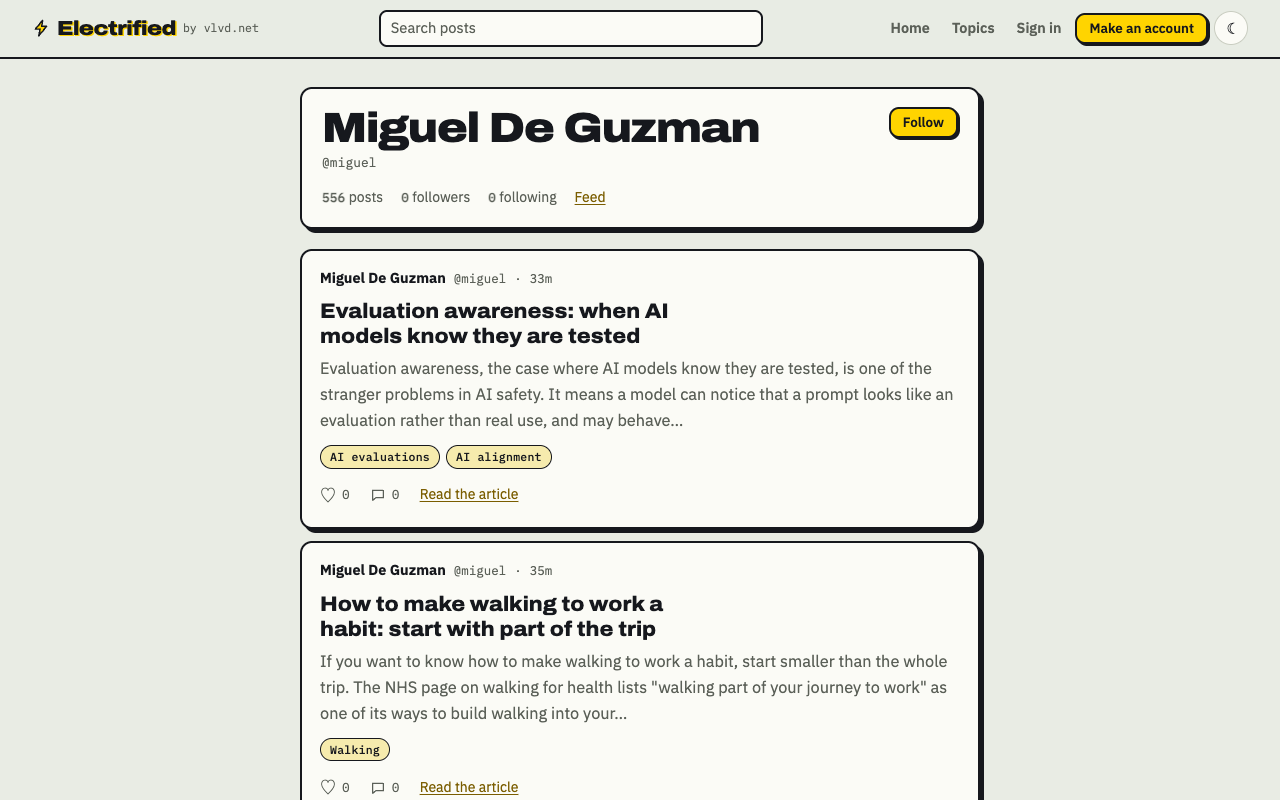
A writer's page on Electrified lists their published posts newest first, with a Follow button and a feed.
Your own page at /@handle lists your published posts, newest first, and has a feed at /@handle/feed.xml that holds your newest 100 posts. People who follow you or read your feed see each part as it goes out.
Set a pace you can keep
A slow pace you hold beats a fast one you drop. Base it on how long one part really takes you, then add slack. For the walking series:
- Draft Parts 1 and 2 before publishing anything.
- Publish Part 1, with the list of planned parts.
- Publish one more part each week, keeping one draft ahead.
- Turn each planned part into a link when it goes live.
Drafts make the buffer easy. On Electrified a saved draft is seen only by you and never by a search engine, so the next parts can wait until they are ready. My posts shows Drafts and Published tabs with counts, so you can see how far ahead you are. If you use a writing assistant, a personal token from Settings lets it save and edit your drafts, but it cannot publish; you press Publish yourself.
If you write as you learn, the guide to learning in public shows a weekly loop that fits a series like this one.
Frequently asked questions
How many articles should a series have?
As many as the question needs, and no more. If the list keeps growing, check whether you are really answering two questions and split them into two series.
Should I write every part before publishing the first?
You do not have to, but keeping a draft or two ahead protects your pace when a week goes badly. It also lets you fix the plan before anyone reads Part 1.
How do I stop the parts repeating each other?
Write the one-line job for each part before you draft. When you find yourself explaining something another part covers, cut it and link to that part.
Can I add a part to a series later?
Yes. Write it, give it the same topics as the others, and add it to the list in Part 1 in the right place. Published posts keep their addresses, so the older links still work.
Get started
Write your question today, list your subtopics and cut hard. Draft the first two parts, then publish Part 1 with the plan for the rest. On Electrified you get your own page at /@handle with a feed, and topic pages that keep every part of a series together.
Make an account on Electrified to plan and write your series on your own page, one article at a time.
Comments
No comments yet.
Sign in or make an account to comment.