How to Practise Reading Comprehension at Home With Your Child
If you are a parent wondering how to practise reading comprehension at home, you do not need worksheets or a tutor to start. You need 15 minutes, a book your child likes, and a habit of asking good questions. This guide gives you a simple daily routine, what research says about it, and a worked example you can try tonight with a child in primary or early secondary school.
What reading comprehension practice at home looks like
Reading comprehension is understanding what you read: who did what, why it happened, and what it means. A child can read every word aloud and still miss the story. Practice at home is about closing that gap.
The good news is that most of the work is conversation. You ask, your child thinks and answers, and you both go back to the page when an answer is shaky. A quiz can help at the end, but talking comes first.
What research says about questions, recall and reading together
Three findings are useful, each with its own limits.
- Recalling helps children remember. In three experiments with 88 children of about 10 years old, practising recall of what they had studied beat studying it again. The benefit held whatever the child's reading comprehension level. The studies used word lists, not stories, so treat this as support for recall, not proof about books.
- Testing beats rereading over days. With older students reading prose passages, Roediger and Karpicke (2006) found that recall tests led to much better memory two days and a week later, even though rereading did better after five minutes.
- Reading together is good for more than reading. A review of 19 randomized studies of parent-child book reading programmes found a small improvement in how children and parents got on emotionally and socially. Most of those studies involved young children.
Put together: read with your child, ask them to recall and explain, and come back to it a couple of days later. Keep it warm, because the time together counts too.
How to practise reading comprehension at home in 15 minutes
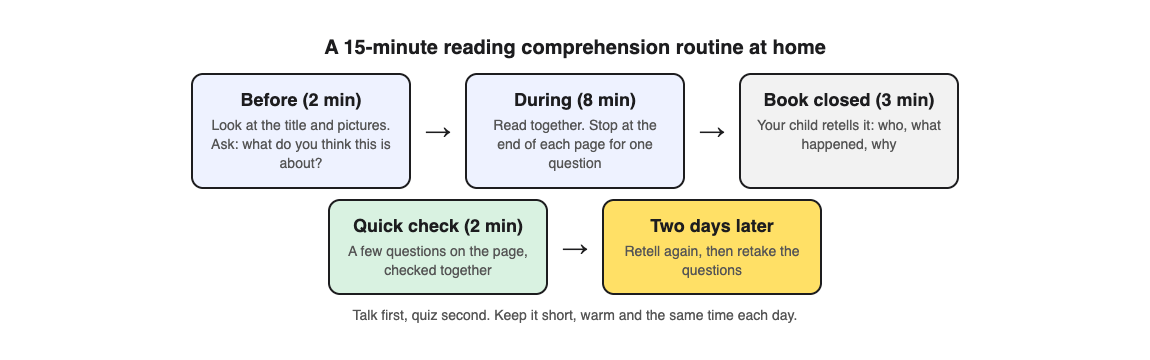
Before reading: predict (2 minutes)
Look at the title, the cover and any pictures together. Ask: "What do you think this is about?" A prediction gives your child a reason to read, because now they want to know if they were right.
During reading: one question per page (8 minutes)
Read together, taking turns if your child likes that. At the end of each page, ask one question. Mix the kinds:
- Remember: "Who found the key?"
- Explain: "Why did she hide it?"
- Think ahead: "What do you think happens next?"
If your child does not know, go back to the page together and find it. That is the skill you are building.
Keep the questions short and the tone curious, not like a test. One question per page is plenty; stopping every paragraph breaks the story and makes reading feel like work. For non-fiction, such as a science page or a news article for children, swap "What happens next?" for "What would you like to find out?" and see whether the next page answers it.
After reading: retell with the book closed (3 minutes)
Close the book and ask your child to tell you the story: who was in it, what happened, and why. This is recall, the step the research supports most, and it shows you quickly what stuck. Do not correct every detail. Ask "How do you know?" and let them open the book to check.
A quick check (2 minutes)
Once a few times a week, end with a short quiz on the page you read. The next section shows one way to do it.
A worked example: one chapter, two evenings
Say your 10-year-old is reading a chapter book for school.
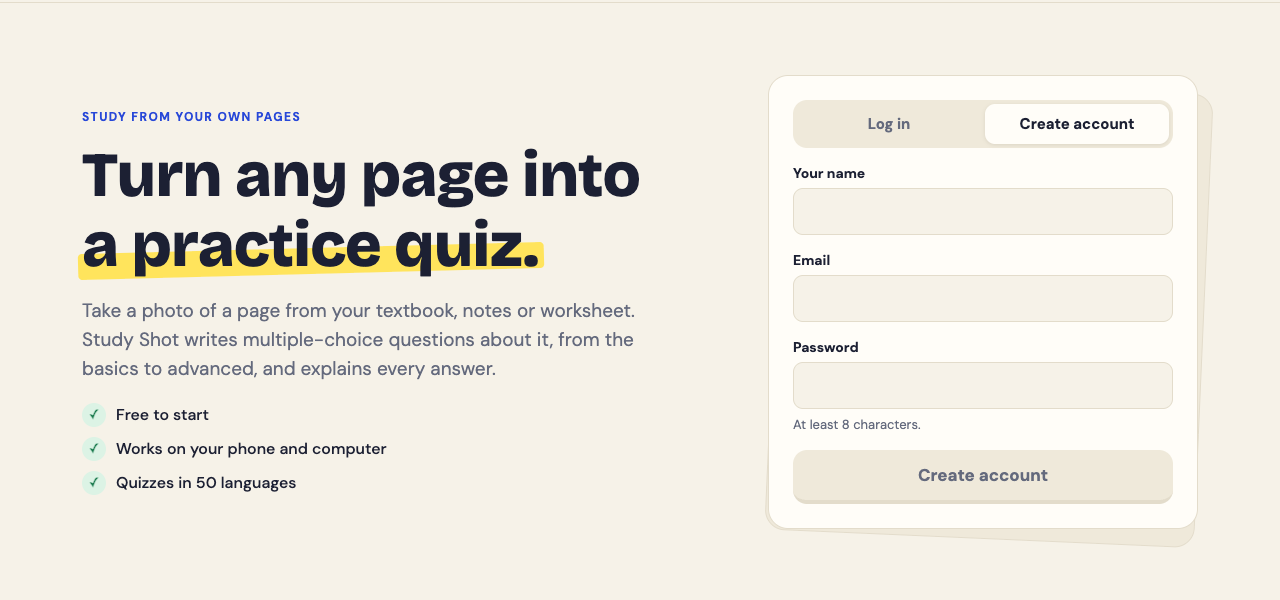
- Monday. Do the 15-minute routine on one chapter. After the retell, open Study Shot in your phone's browser, signed in to your account. Tap Make a new quiz, then Take photo, and photograph the page with the most happening. Hold the page flat and fill the frame.
- Choose 5 questions and the Basic level, which asks about key facts. For an older or confident reader, try Intermediate, which asks them to explain, compare and connect ideas. Press Create questions.
- Let your child answer one question at a time and press Check answer. They see Correct! or Not quite., the right answer, and a short explanation. Read the explanations together, even for right answers.
- If a question was missed, find the sentence in the book that answers it. The Look at these again list on the results screen shows each one.
- Wednesday. Before opening the book, ask for the retell again. Then open your library, where the quiz is saved with its page photo and best score, and tap Retake quiz.
The questions are written by an AI model and can contain mistakes. If one looks wrong or confusing, the book has the last word, and you can use Report a problem with this question. Multiple choice checks whether your child recognises the answer; the retell is where they have to produce it, so keep both.
If your family reads in another language, quizzes can be written in 50 languages, though the app's own screens stay in English.
Signs it is working, and when to get help
Over a few weeks, look for longer retells, more "because" answers, and fewer trips back to the page to find simple facts. Move to slightly harder books when the routine feels easy.
If your child still struggles to decode words, or reading is getting harder rather than easier, talk to their teacher. Comprehension practice works best once reading the words themselves is fairly smooth.
Frequently asked questions
How long should reading comprehension practice take each day?
About 15 minutes is enough for most children. A short, regular routine is easier to keep than a long session once a week.
What questions should I ask my child about a book?
Mix three kinds: who and what questions to check facts, why questions to check understanding, and what-next questions to get them thinking ahead.
Should I correct my child's mistakes while they read?
Gently, and not every one. Asking "How do you know?" and looking back at the page together teaches more than giving the answer.
Does this work for older students too?
Yes, with harder texts and fewer prompts. For school readings, see how to quiz yourself on a reading assignment, and for parents of test-takers, how to help your child study for a test.
Get started
Pick tonight's book, ask for a prediction, read one chapter together, and ask for a retell with the book closed.
Try Study Shot: it is free to start. Photograph the page you are studying tonight and get 10 practice questions on it, from basic to advanced.
Comments
No comments yet.
Sign in or make an account to comment.