How to Quiz Yourself on a Case Study Handout: A Simple Method
If you want to know how to quiz yourself on a case study handout, start here: stop rereading and start retrieving. A case study packs facts, a problem, a decision and an outcome onto one or two pages, and exam questions often ask you to use the case, not repeat it. The method below turns a handout into questions you answer from memory, then checks you against the page, then spaces the practice so it sticks.
Why rereading a case study handout is not enough
Rereading feels productive. The names look familiar and the numbers ring a bell. That feeling is recognition, not recall. In a classic study, rereading raised students' confidence, but students who tested themselves remembered far more after two days and a week. In the exam there is no page to recognise, only a prompt like "Using a case study you have studied, evaluate the response to..."
Case studies are also easy to blur together. After three handouts on flood management or three on company turnarounds, the details start to swap places. Pulling each case out of your head on purpose, getting some of it wrong and correcting it is how you keep them apart.
One honest note on cases themselves: a review of 104 studies of case-based teaching in health courses found that students enjoy it and think it helps, but the evidence on learning, compared with other methods, was inconclusive. The handout is your material; the quizzing is what this post adds.
How to quiz yourself on a case study handout: label it first
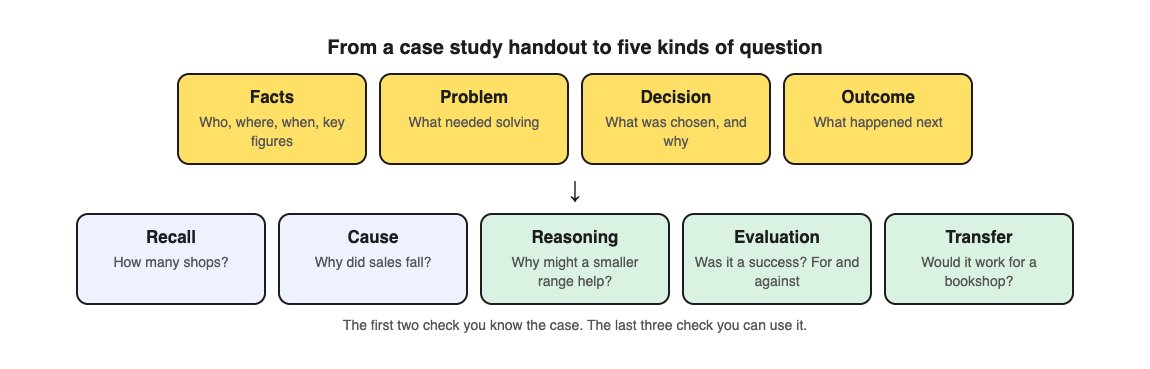
Before you write a single question, read the handout once with four labels in mind. Mark each part in the margin:
- Facts: who, where, when, and the key figures.
- Problem: what went wrong or what needed solving.
- Decision: what someone chose to do, and why.
- Outcome: what happened next, good and bad.
Here is a made-up example to work with for the rest of this post. Say your handout describes a small town bakery chain. Sales fell for two years as a supermarket opened nearby. The owner closed one of three shops, moved to early morning wholesale orders for cafes, and cut the product range from 40 items to 15. Within a year, profit recovered, but staff numbers fell.
Facts: three shops, a nearby supermarket, two years of falling sales. Problem: lost walk-in customers. Decision: close a shop, move to wholesale, cut the range. Outcome: profit up, jobs down. That is the skeleton. Every good question hangs off one of those four parts.
Turn the handout into five types of questions
Most people only write fact questions. Those are the easiest to write and the least useful on their own. Aim for a mix of five types:
- Recall. "How many shops did the bakery have before the changes?"
- Cause. "What was the main reason walk-in sales fell?"
- Reasoning. "Why might cutting the range from 40 items to 15 help a wholesale business?"
- Evaluation. "Was the response a success? Give one argument for and one against."
- Transfer. "A bookshop faces a new online rival. Which of the bakery's three decisions would work for it, and which would not?"
The first two check that you know the case. The last three check that you can use it, which is where practice tests carry over best: a review of 122 experiments found transfer was greatest to application and inference questions. Write at least one of each type for every handout.
Writing these by hand is worth doing for your most important cases. You can also photograph the handout and let Study Shot draft multiple-choice questions for you. You pick a level when you make the quiz. Basic covers key terms, facts and definitions, which lines up with recall. Intermediate asks you to explain, compare and connect ideas, which covers cause and reasoning. Advanced asks you to apply and predict in new situations, which is close to transfer. The default, Tiered, is a ladder that splits the questions as evenly as it can across all three, basic first.
Answer from memory first, then check against the handout
This is the step people skip. Turn the handout face down. Answer every question you wrote without looking. Write your answers out in full sentences, even short ones. "Supermarket" is not an answer. "A supermarket opened nearby and took walk-in customers" is.
Then flip the page over and mark yourself. Use three marks:
- A tick for correct and complete.
- A half mark for right idea, missing detail.
- A cross for wrong or blank.
Every half mark and cross goes on a short "fix list" at the bottom of the page. That list is what you study next, not the whole handout again.
If you used Study Shot, the checking is built in. You answer one question at a time, press Check answer, and the app tells you Correct! or Not quite., shows the right answer, and gives a short explanation. If you need to look back at the case mid-quiz, Show page brings up your photo. At the end, the results screen shows a score for each level and a Look at these again list of every question you missed, with your answer next to the right one. That list is your fix list, made for you.
One caution. The questions are written by an AI model and can contain mistakes. Read the explanation against your handout. If a question looks wrong, use Report a problem with this question underneath it. Checking the explanation against the page is itself good revision.
Practise applying the case to new scenarios and exam prompts
Knowing the bakery case well does not help if you freeze when the exam asks about "a business responding to competition." Practise moving from the case to the prompt. A multiple-choice quiz cannot mark a written paragraph, so this part stays on paper.
Try this for each case study:
- Write the case's name and four labels (facts, problem, decision, outcome) on a card.
- Find three different exam-style prompts it could answer. Use past papers, the syllabus, or your teacher's questions.
- For each prompt, write one opening sentence that names the case and links it to the question.
- Pick one prompt and write a full paragraph from memory in ten minutes.
For the bakery, prompts might be "Evaluate one strategy a small firm used to survive," "Explain how competition affects employment," or "Assess whether cutting costs is always the right response." The same case answers all three, but you lead with different parts of it each time.
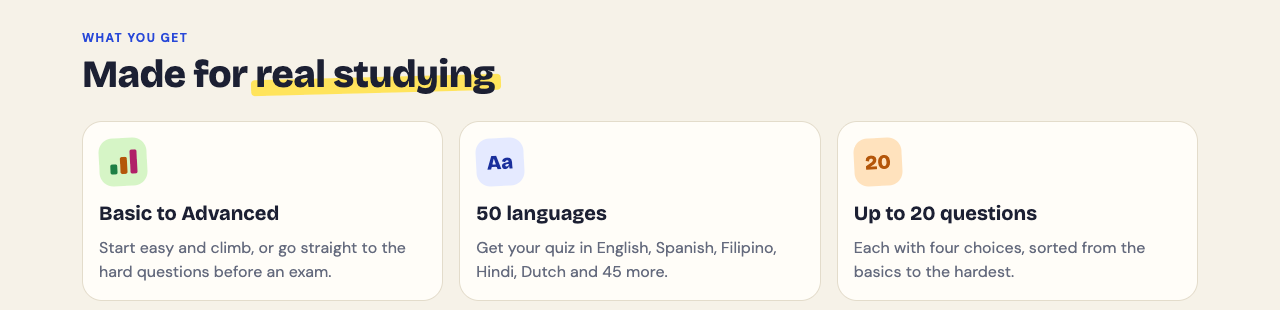
When you make a quiz to target this skill, choose Advanced and 15 or 20 questions. The landing page puts it plainly: start easy and climb, or go straight to the hard questions before an exam.
Space your quizzes: a review schedule for case studies
One good session is not enough; come back to each case with gaps in between. A simple schedule for each handout:
- Day 1: Read with the four labels. Write or create your quiz. Take it once.
- Day 2: Retake the quiz. Study only the fix list afterwards.
- Day 5: Retake. Write one exam paragraph from memory.
- Day 12: Retake. If you score well, move the case to monthly review.
- Before the exam: One final retake and one timed paragraph.
Study Shot saves every quiz to your library with a thumbnail of the page photo and your best score, so the retakes are one tap away. Each result gets a grade: Mastered at 90% and up, Good at 70% and up, Getting there at 50% and up, and Needs another try below that. A quick rule: anything below Good goes back to a two-day gap. Anything at Mastered can wait longer.
If your class shares the same handouts, Share this quiz makes a link. A classmate who opens it needs their own Study Shot account and gets their own copy of the questions, without your photo. You can stop sharing at any time.
Frequently asked questions
How many questions should I write per case study?
Ten is a good starting point: two of each of the five types. For a long or high-value case, go up to 20. Study Shot lets you choose 5, 10, 15 or 20 questions, with 10 as the default.
Should I memorise statistics and names from the handout?
Learn two or three key figures and the main names, so your answer is specific. Spend most of your effort on the problem, the decision and the outcome.
How do I quiz myself on several case studies at once?
Make a separate quiz for each handout, then mix them in one session so you have to keep the cases apart. Finish by writing one sentence that compares two of the cases on the same theme.
Can I use past exam papers alongside case study quizzes?
Yes. Case study quizzes build the knowledge, and past papers show you how it will be asked. Our guide on how to quiz yourself with a past exam paper walks through that side step by step.
Pick the handout you understand least. Hold it flat, fill the frame and photograph it, or pick a photo you already have. Leave the level on Tiered for your first go, take the quiz with the handout face down, and retake it in two days. The photo is sent to the AI model to write the questions and is not stored on Study Shot's server; it stays on your device so the quiz can show it again.
Get started
Try Study Shot: it is free to start. Photograph the page you are studying tonight and get 10 practice questions on it, from basic to advanced.
Comments
No comments yet.
Sign in or make an account to comment.