How to Quiz Yourself on a Grammar Page in a Language Textbook
If you want to know how to quiz yourself on a grammar page in a language textbook, the short answer is this: stop rereading the page and start making it ask you questions. A grammar page packs a rule, a set of forms, some examples and a few exceptions into one spread. Each of those parts needs its own kind of question. This guide shows you how to split the page up, build quizzes from tables and examples, and review the result over the next week. The running example is a Spanish page on the preterite tense of regular -ar verbs, but the same method works for the other languages you study.
Why rereading a grammar page does not stick
Rereading feels productive because the page looks familiar. You see hablé, hablaste, habló and think, "Yes, I know this." But recognising a form on the page is not the same as producing it from memory when you need it in a sentence.
In a test or a conversation, nobody shows you the table. You have to pull the right ending out of your head. In a 2006 study by Roediger and Karpicke, students who took recall tests on a passage remembered more of it two days and one week later than students who reread it, even though rereading made them feel more confident. A quiz makes you do that recall; rereading does not.
There is a second problem. A grammar page mixes easy and hard material. The regular endings are simple. The spelling changes and the accent marks are harder. When you reread, your eyes give every line the same weight. When you quiz, the gaps show up fast.
How to quiz yourself on a grammar page in a language textbook: sort it first
Before you write a single question, sort the page into four piles.
- The rule. What the grammar point is for. For the preterite: it describes completed actions in the past, often with a time marker like ayer (yesterday).
- The forms. The table or list of endings. For -ar verbs: -é, -aste, -ó, -amos, -asteis, -aron.
- The examples. Full sentences that show the rule in use, such as Ayer hablé con mi madre.
- The exceptions and warnings. The boxed notes, footnotes and "Watch out!" panels. For this page: verbs ending in -car, -gar, -zar change spelling in the first person (busqué, llegué, empecé).
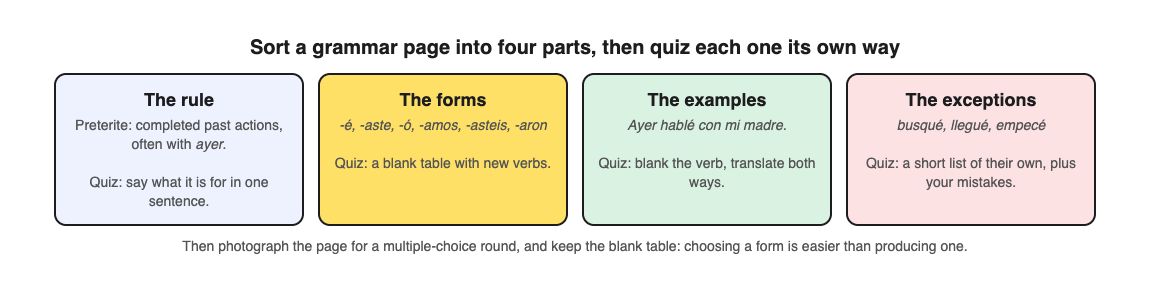
This sorting step is a small quiz in itself. If you cannot say in one sentence what the rule is for, you have found your first gap.
Turn conjugation and declension tables into blank-cell quizzes
Tables are the heart of most grammar pages, and they are the easiest part to turn into a quiz. Copy the table onto paper with the headers filled in and the cells empty. Then fill it in from memory.
For the preterite, your blank table has the pronouns down the side (yo, tú, él/ella, nosotros, vosotros, ellos) and three verbs across the top: hablar, trabajar, comprar. Fill all 18 cells without looking. Then check against the book and circle every miss.
A few tips that make this more useful:
- Use verbs the book did not use. If the table shows hablar, test yourself on cantar. That checks the pattern, not your memory of one row.
- Shuffle the order. Fill the ellos row first, then yo.
- Do one column at a time for declension tables. In languages with cases, cover the whole table and recall one case across all genders before moving on.
The same blank-cell idea works for any table in a textbook, not just grammar. If you want more ways to work with rows and columns, see how to quiz yourself on a data table from a textbook.
Write fill-in-the-blank and translation questions from the examples
The example sentences on the page are ready-made questions. You just need to remove one piece.
Fill-in-the-blank. Take Ayer hablé con mi madre and write *Ayer ______ (hablar) con mi madre*. Do this for every example, blanking the verb each time. Then write two or three new sentences of your own with different subjects, so you are not just remembering the book's exact words.
Translation both ways. Write the English meaning of three examples and translate them back into Spanish later. Going from your own language into the target language is harder, so it shows you more about what you really know.
Choose the correct form. Write a sentence with two options: Ella (habló / hablo) por teléfono anoche. This is where you catch the accent mark. Hablo means "I speak" now. Habló means "she spoke." One mark changes the person and the tense.
Mix these three types on one sheet. Answer them the next day, not straight after writing them, or you will just remember what you wrote.
Quiz the exceptions and common mistakes separately
Exceptions get drowned out if you mix them into a big quiz with the regular forms. Most of your answers will be right, your score will look fine, and the hard parts will stay hard. So give the exceptions their own short quiz.
For the preterite page, make a list of ten verbs where about half have a spelling change: buscar, llegar, empezar, tocar, pagar, cruzar, mixed with regular ones like mirar and estudiar. Write the yo form of each. The question you are really answering is "does this one change, and how?"
Then add the mistakes you personally made. Every circled cell from your blank table goes onto this list. This list is built from your own errors, so it targets exactly what you do not know yet.
Space your review so the grammar point lasts
One good quiz session is not enough. You want to come back to the page a few times, with growing gaps between visits. A simple plan:
- Day 1: sort the page, fill the blank table, write your example questions.
- Day 2: answer yesterday's fill-in-the-blank and translation questions. Do the exceptions quiz.
- About day 4: fill a fresh blank table with new verbs. Redo only the questions you missed.
- About a week later: do one mixed quiz. If you get almost everything right, move this page to a monthly check.
Keep the missed questions. Each review should start with them. That way your time goes where it is needed, not to the forms you already have. The same plan works for the word lists on the next page; see how to study vocabulary from a textbook page.
Using Study Shot for the multiple-choice round
Writing every question by hand takes time. Study Shot can do part of the work for you. You take a photo of the grammar page (or pick one you already have), and an AI model writes multiple-choice questions about it, each with four choices and one right answer.
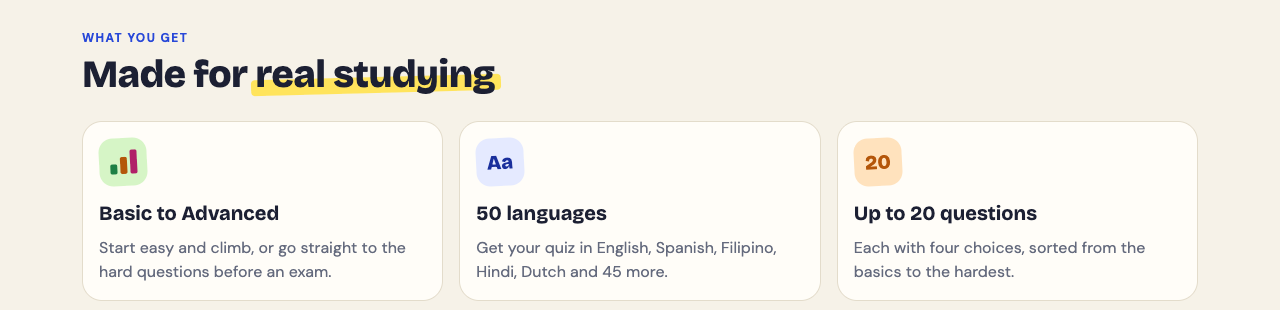
For a grammar page, a good setup is:
- Questions: choose 5, 10, 15 or 20. Ten is the default and fits one grammar point well.
- Level: Tiered is the default and climbs from Basic ("Key terms, facts and definitions") through Intermediate ("Explain, compare and connect ideas") to Advanced ("Apply and predict in new situations"). On a grammar page, Advanced questions are the ones that ask you to use the rule in a new sentence.
- Language: pick the language for the questions, answers and explanations from 50 options. The app's own buttons and screens stay in English.
Then press Create questions. It can take up to a minute. You answer one question at a time, press Check answer, and see the right answer plus a short explanation. At the end, the results screen shows your score for each level and a Look at these again list of the questions you missed, with your answer next to the right one. That list slots straight into your exceptions and mistakes quiz.
The quiz is saved in your library with the page photo and your best score, so you can retake it on day 2, day 4 and a week later. Keep in mind it is multiple choice only. It does not replace filling in a blank table yourself, because choosing a form is easier than producing one. Use both.
Questions written by an AI model can contain mistakes. Read the explanation for each answer and compare it with your textbook. If a question is wrong, use Report a problem with this question under it.
Frequently asked questions
How many questions should I make from one grammar page?
Ten to fifteen is a good range for one grammar point: enough to cover the forms, the examples and the exceptions without turning into a chore. If the page has a long list of exceptions, add a separate short quiz just for those.
Should I quiz myself in my native language or the target language?
Do both. Instructions and explanations in your native language help you understand the rule, while questions in the target language get you used to reading it. In Study Shot, you can set the quiz language to either one, so you can make one version of each from the same photo.
How do I check my answers without a teacher?
Check every answer against the textbook's table and examples, and circle anything that does not match. If you use Study Shot, each answer comes with an explanation, which helps you see why a form is right, but still compare it with your book.
Get started: snap your grammar page with Study Shot and get a quiz
Pick the grammar page you are working on this week. Sort it into rule, forms, examples and exceptions. Fill in a blank table from memory. Then hold the page flat, fill the frame, and take a photo for Study Shot. It runs in the browser on your phone or computer, and you need an account to use it.
Try Study Shot: it is free to start. Photograph the page you are studying tonight and get 10 practice questions on it, from basic to advanced.
Comments
No comments yet.
Sign in or make an account to comment.