How to Quiz Yourself on a Novel for English Class
You read the assigned chapters, you followed the story, and then the test asks which character said a line in chapter 4, or how the narrator's view of the town changes. If you want to know how to quiz yourself on a novel for English class, the answer is to test yourself as you go: on what happened, on who changed, and on the lines that matter. This guide shows a simple routine for each chapter, the research behind it, and a plan for the week before the test.
Why rereading a novel does not prepare you for the test
A novel is long, and by the time you reach the end, the early chapters are a blur. Rereading feels like the safe fix, but it mostly makes the text feel familiar again. A test asks you to produce details and ideas without the book open.
With prose passages, Roediger and Karpicke (2006) found that students who tested themselves remembered far more two days and a week later than students who reread, even though rereading made them feel more confident. Rereading won only on a test five minutes later.
What a novel test usually asks
English tests on a novel tend to mix four kinds of question:
- Plot: what happened, in what order, and why.
- Character: who someone is, what they want, and how they change.
- Theme: the big ideas the book keeps returning to.
- Language: who said a line, what an image means, and how the author's choices shape the reader's view.
Your self-quizzing should cover all four, not just plot.
Quote questions deserve their own practice, because they usually have three parts. Cover the speaker's name and say who said the line. Then say when in the story it happens. Then say why it matters: what it shows about the character or a theme. If you can answer all three for a quote, you can use it in an essay.
How to quiz yourself on a novel for English class, chapter by chapter
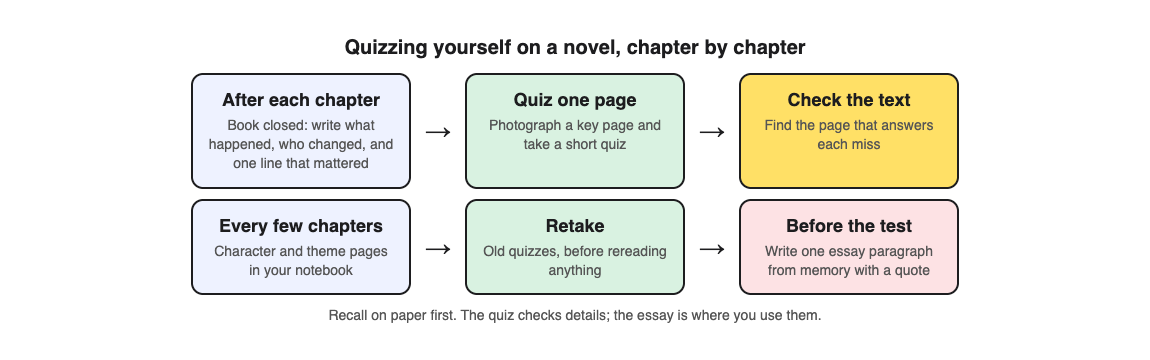
Step 1: close the book and write three lines
When you finish a chapter, close the book and write, from memory: what happened, which character changed or revealed something, and one line or image that seemed to matter. Keep it to three lines. This is the recall that does the work.
Step 2: check your three lines against the text
Open the book and check each line. This step matters more for stories than you might think. In one study, people who practised recalling a folktale remembered it better in some conditions, but also added story-related details that were never in it. Recall can blend what the book said with what you expected it to say. Checking against the page catches that before it becomes "fact" in an essay.
Step 3: quiz yourself on one key page
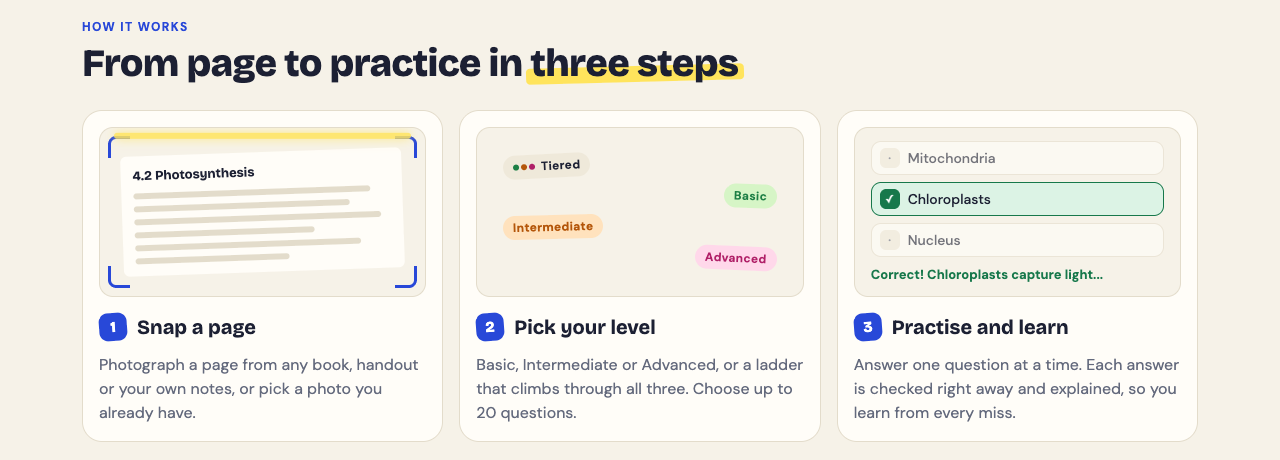
Pick the page in the chapter where the most happens, often a turning point or a long conversation. Open Study Shot in your phone's browser, tap Make a new quiz, then Take photo. Hold the page flat and fill the frame.
Choose 10 questions. Basic covers key facts from the page; Intermediate asks you to explain, compare and connect ideas, which suits character and theme; Advanced asks you to apply and predict in new situations. Press Create questions, answer one at a time, and press Check answer to see the right answer and a short explanation.
The questions are written by an AI model and can contain mistakes, and a novel is easy to misread from one page. If a question gets the book wrong, trust the text, and use Report a problem with this question.
Step 4: keep character and theme pages
Every few chapters, add to two pages in your notebook: one per main character (what they want, how they change, one quote), and one per theme (where it shows up, by chapter). Write these from memory first, then check. These pages are also good to photograph for an Intermediate quiz later.
A worked example: one week before the test
Say your class finished a 20-chapter novel and the test is on Friday.
- Monday: without opening the book, write the plot in ten lines, one per two chapters. Then check and mark every gap.
- Tuesday: open your library, where each quiz is saved with its page photo and best score, and retake the quizzes from the chapters with the most gaps. Use the Look at these again list to find each miss in the text.
- Wednesday: rewrite your character pages from memory, check them, then photograph them and take an Intermediate quiz on each.
- Thursday: pick one likely essay question, such as how a character changes, and write one paragraph from memory with one quote. Then check the quote in the book.
- Friday morning: a short retake of your weakest quiz, and nothing new.
If your class reads together, use Share this quiz to send a link. Each person needs a Study Shot account and gets their own copy of the questions, without your photo.
What a quiz can and cannot do for an essay
A multiple-choice quiz is good at checking details: who said what, what happened when, what a passage is about. It cannot write your argument for you, and picking from four choices is easier than producing an answer. That is why the routine starts with writing from memory and ends with a paragraph. The quiz sits in the middle, as a check.
For non-fiction readings in other classes, see how to quiz yourself on a reading assignment, and for the science behind self-testing, why testing yourself beats rereading your notes.
Frequently asked questions
How do I remember quotes from a novel?
Pick a few short quotes per main character or theme, write them from memory every few days, and check them against the book. Fewer quotes you know well beat a long list you half remember.
Should I read a summary instead of the novel?
A summary can help you check your own recall, but it cannot give you the language, quotes and details a test or essay asks about. Use it after reading, not instead.
Can I quiz myself on a novel in another language?
Yes. Study Shot can write quizzes in 50 languages, though its own screens stay in English.
How often should I quiz myself while reading?
After every chapter for the three-line recall, and a page quiz every chapter or two. Retake older quizzes before you reread anything.
Get started
Tonight, after your next chapter, close the book and write three lines. Then check them, and quiz yourself on the page where the most happened.
Try Study Shot: it is free to start. Photograph the page you are studying tonight and get 10 practice questions on it, from basic to advanced.
Comments
No comments yet.
Sign in or make an account to comment.