How to Quiz Yourself on a Periodic Table Page: 7 Active Recall Drills
If you want to know how to quiz yourself on a periodic table page, start here: reading the page again will not do it. You need to pull the information out of your head, check it, and fix what you got wrong. Below are seven active recall drills you can run with nothing more than a pencil, a blank sheet and the page in your textbook. The last few also show how to turn a photo of that page into a practice quiz.
How to quiz yourself on a periodic table page, not just stare at it
A periodic table page is dense. It has more than a hundred boxes, each with a symbol, a name, a number and often a mass. When you look at it, everything feels familiar. That feeling is the trap. Recognizing "Na" when you see it is not the same as producing "sodium, 11, group 1" when the page is closed.
In a 2006 study by Roediger and Karpicke, students who took recall tests on a passage remembered more of it two days and one week later than students who reread it, even though rereading made them feel more confident. So your practice should make you produce, not only recognize. Every drill below follows one rule: close the page, answer, then open it and check.
It also helps to see the table for what it is: a grid where position tells you something. Once you know what the rows and columns mean, you do not need to memorize every box as a separate fact.
Decide what you actually need to memorize first
Before you drill anything, check your syllabus or ask your teacher. Most courses do not ask you to recite all 118 elements. A common set looks like this:
- The first 20 elements, by symbol, name and atomic number.
- The names of the main groups: alkali metals, alkaline earth metals, halogens, noble gases.
- Where the transition metals, metalloids and nonmetals sit.
- The trends: atomic radius, electronegativity and ionization energy.
- A handful of common elements outside the first 20, such as iron, copper, silver, gold, zinc and iodine.
Write your own list on a sticky note. That list is your target. Everything else is a bonus.
Drill 1: Fill in a blank periodic table grid from memory
Draw an empty grid: 18 columns and 7 rows, with the gaps at the top where the table steps down. You can trace the outline from your textbook once and photocopy it.
Now, with the book closed, fill in every symbol you can. Start with the first 20. Then add the groups you know.
When you run out, open the book and mark your grid in a second color. Every box in that color is a gap. Tomorrow, start with those boxes before you do anything else.
A worked example: you fill rows 1 and 2 fully, but in row 3 you write "Na, Mg, Al, Si" and then stall. Your red boxes are P, S, Cl and Ar. Those four are tomorrow's warmup.
Drill 2: Symbol, name and atomic number flashcards
Make one card per element on your target list. Write the symbol on the front. On the back, write the name and atomic number.
Then shuffle and run the deck three ways:
- Symbol to name: see "K", say "potassium".
- Name to symbol: see "lead", say "Pb".
- Number to element: see "26", say "iron, Fe".
Split the deck into two piles as you go: "knew it" and "missed it". Only rerun the missed pile. Keep going until it is empty.
Pay extra attention to symbols that do not match the English name. Most come from Latin: Na (natrium), K (kalium), Fe (ferrum), Cu (cuprum), Ag (argentum), Au (aurum), Pb (plumbum), Sn (stannum), Hg (hydrargyrum). Tungsten is W, from its German name, wolfram. They are easy to miss because the English name gives no clue.
Drill 3: Quiz yourself on groups, periods and families
This drill tests structure, not single boxes. Write questions like these on a sheet, cover the answers, and work down:
- Which group holds the noble gases? (Group 18.)
- Name three halogens. (Fluorine, chlorine, bromine, iodine.)
- Which period is calcium in? (Period 4.)
- Is silicon a metal, a nonmetal or a metalloid? (Metalloid.)
- What do lithium, sodium and potassium have in common? (Group 1, alkali metals, one outer electron.)
Then flip it. Point to a random box on your blank grid and say its group, period and family out loud. If you can place an element without its name, you understand the layout.
If your notes show the families as a branching diagram, the method in how to quiz yourself on a flowchart from your notes works well here too.
Drill 4: Turn periodic trends into why questions
Exams often ask you to explain trends, not only state them. A plain "radius decreases across a period" is not enough. You need the reason.
So rewrite each trend as a why question:
- Why does atomic radius get smaller from left to right across a period? (More protons pull the same shell of electrons in closer.)
- Why does atomic radius get larger down a group? (Each step down adds a new electron shell.)
- Why is fluorine more electronegative than iodine? (Its outer electrons are closer to the nucleus and less shielded.)
- Why do noble gases have such high first ionization energies? (Their outer shells are full and stable.)
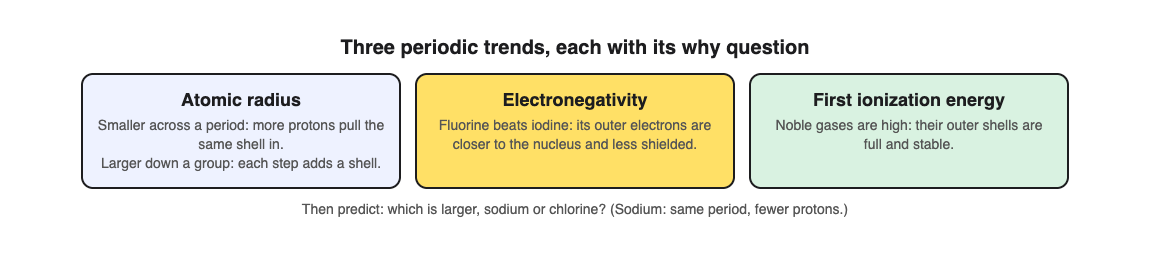
Answer each one in a full sentence, out loud or on paper. Then go one step further and predict: "Which has the larger radius, sodium or chlorine?" Prediction questions are the closest thing to what a hard exam question looks like.
Space your periodic table quizzes so you keep what you learn
Spread the drills out. A 2006 review of 317 experiments by Cepeda and colleagues found that spacing study sessions apart helps retention, and that the best gap grows the further away the test is. A simple plan:
- Day 1: Drills 1 and 2 on your full target list.
- Day 2: Rerun only what you missed on day 1, then Drill 3.
- Day 4: Drill 4, then a quick blank grid.
- Day 7: Everything once, fast. Note what still trips you up.
The next three drills fit into that schedule and use a photo of your page.
Drill 5: Turn a photo of the page into a tiered quiz
Study Shot makes a practice quiz from a photo of a page. You tap Take photo or Choose photo, pick how many questions you want (5, 10, 15 or 20), and choose a level. The default level, Tiered, works like a ladder. It splits the questions as evenly as it can across basic, intermediate and advanced, in that order.
For a periodic table page, that maps well to the drills above. Basic questions cover key terms and facts. Intermediate ones ask you to explain and compare. Advanced ones ask you to apply and predict. Hold the page flat and fill the frame. The app says diagrams, textbooks and notes all work. If it cannot write questions for a photo, it says so and asks you to try a different page.
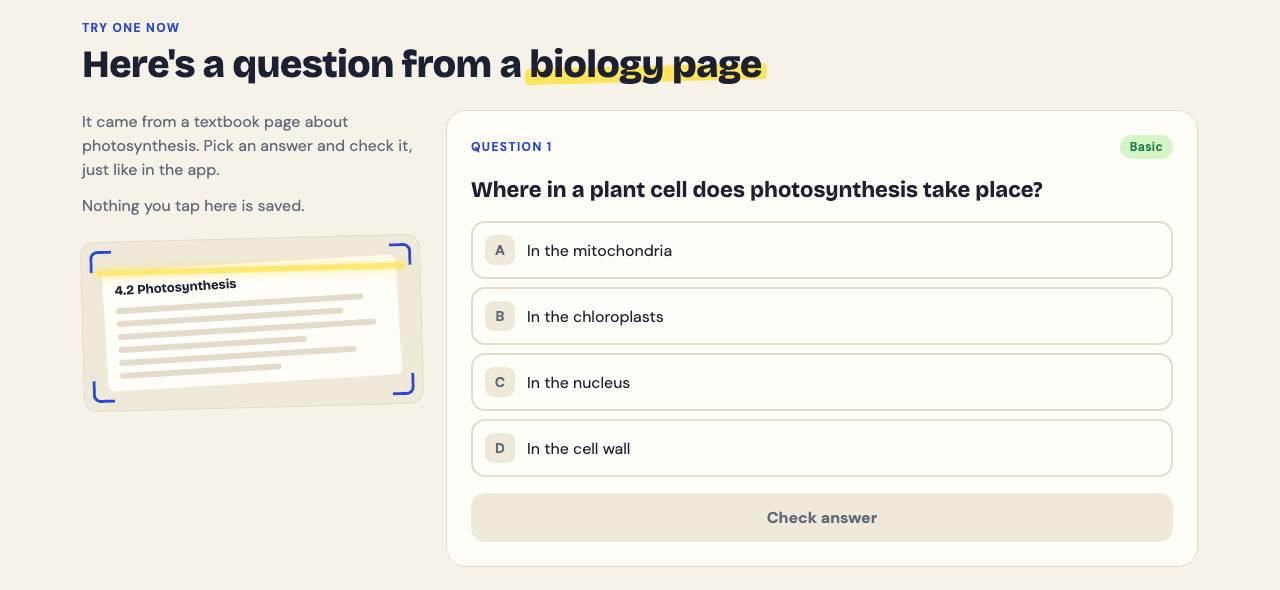
Every question has four choices. After you press Check answer, you see whether you were right, the correct answer, and a short explanation. Read the explanation even when you get it right. The questions are written by an AI model and can contain mistakes, so the explanation also lets you check the question against your textbook. If one looks wrong, use Report a problem with this question.
Drill 6: Retake only your misses
At the end of a quiz, the results screen shows your score for each level and a list called Look at these again. It shows each question you missed, your answer and the right answer.
Copy those misses onto flashcards from Drill 2. Then come back on day 4 and press Retake quiz from your library. Your quizzes are saved with the page photo and your best score, so you can see if you have moved up from Getting there to Good or Mastered.
Drill 7: Go straight to Advanced before the test
Two days before your exam, make a new quiz from the same page and set the level to Advanced. Skip the easy questions. This is your Drill 4 under pressure: apply the trends to situations you have not seen. If your class is taught in another language, you can set the quiz language to one of 50 options. The same idea works for other dense pages too, like a grammar page in a language textbook.
Frequently asked questions
How long does it take to memorize the periodic table?
It depends on how much of it your course needs. The first 20 elements can take a few short sessions spread over a week. Memorizing all 118 takes much longer and is rarely required.
Should I memorize all 118 elements for a chemistry exam?
Usually not. Most exams expect the first 20, the main group names and the trends, and they often give you a printed table. Check your syllabus before you spend time on the rest.
What is the fastest way to learn element symbols?
Use flashcards in both directions, symbol to name and name to symbol, and rerun only the cards you miss. Learn the Latin based symbols like Fe, Na, K and Pb as a separate small group.
Get started: turn your periodic table page into a quiz with Study Shot
Pick your target list, run Drills 1 to 4 on paper, and use a photo quiz to check yourself over the week. Study Shot runs in the browser on your phone or computer, and every screen needs an account. Your quizzes stay in your library so you can retake them.
Try Study Shot: it is free to start. Photograph the page you are studying tonight and get 10 practice questions on it, from basic to advanced.
Comments
No comments yet.
Sign in or make an account to comment.