How to Quiz Yourself on a Primary Source for History Class
If you want to learn how to quiz yourself on a primary source for history, start by accepting one thing: reading a document three times is not the same as knowing it. A primary source is a letter, a speech, a diary entry, a law, or a photograph made by someone who lived through the events. Your teacher will not ask you to recite it. They will ask who wrote it, why, what it shows, and how it fits with other evidence. This guide walks you through five rounds of self-quizzing that match those questions, using one example document the whole way.
Why quizzing yourself beats rereading a primary source
Rereading feels productive because the words look familiar. But familiar is not the same as remembered. When you close the page and try to answer a question, you find out right away what you actually know and what you only recognize.
Primary sources make this gap worse. The language is often old and the author assumes you know things you do not. A short quiz makes you slow down on the parts you skimmed.
The research backs this up. In a classic 2006 study, students who tested themselves on prose passages remembered much more a week later than students who reread them, even though rereading made them feel more confident. And in a sixth grade social studies class, short multiple-choice quizzes on course material raised scores on the real chapter and semester exams, including short-answer tests.
For the rest of this guide, imagine your teacher assigned Abigail Adams's 1776 letter to her husband John, the one where she asks Congress to "remember the ladies" when writing new laws. Swap in whatever document you are studying.
Step 1: Read the source once for the big picture
Read the whole document one time, start to finish, without stopping to look things up. Your only goal is to answer three questions in your own words:
- What is this document? (A letter, a speech, a law.)
- What is the author asking for, arguing, or describing?
- What is the tone? (Angry, hopeful, formal, joking.)
Write those three answers in one or two lines each. For the Adams letter, you might write: "A private letter from a wife to her husband in Congress. She asks that new laws limit husbands' power over wives. The tone is polite but has a warning in it."
That summary is your anchor for every question that follows.
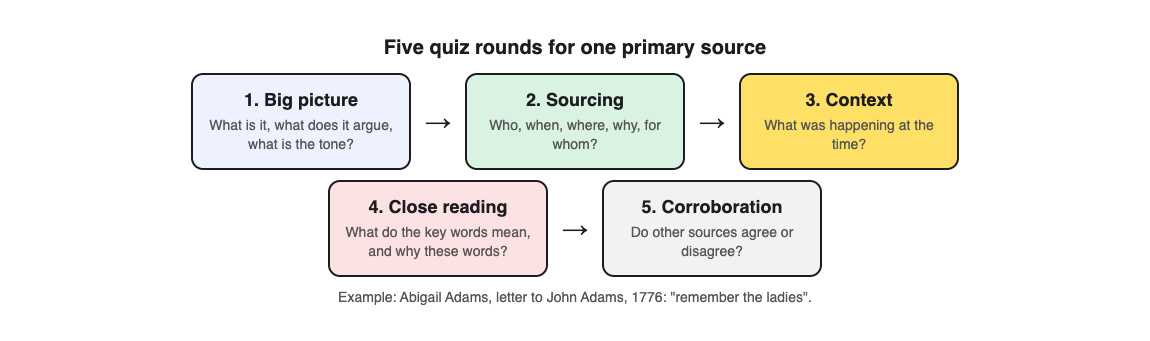
Step 2: Quiz yourself on sourcing (who, when, where, why)
Historians call this step sourcing. Before you trust what a document says, you ask who made it and under what conditions. Write one question for each of these:
- Who wrote it, and what was their position in society?
- When was it written, and what was happening that month or year?
- Where was the author, and where was the audience?
- Why did they write it? Who was the intended reader?
For the Adams letter, a good sourcing question is: "Why does it matter that this was a private letter and not a public speech?" The answer shapes how you read everything else. She could be more direct with her husband than she could be in public.
Cover the answers and test yourself. If you cannot answer a sourcing question without peeking, that is the first thing to review.
Step 3: Quiz yourself on context and what was happening at the time
A source makes sense only inside its moment. Context questions ask what the author knew, what the reader knew, and what events were pressing on both of them.
Try questions like these:
- What major decision was Congress facing in spring 1776?
- What legal rights did married women have at the time?
- What other ideas about liberty were people discussing that year?
You will need your textbook or class notes for this round. The point is to link the document to the bigger story.
Step 4: Ask close-reading questions about key words and claims
Now go back into the text itself. Pick three to five phrases that carry the most weight and ask what each one means and why the author chose it.
For the Adams letter, you might ask:
- What does she mean by "remember the ladies"?
- What does she threaten to do if the ladies are not remembered?
- Which word choice shows she is borrowing the language of the Revolution itself?
Close reading is where most students lose points: they describe the source in general terms and never quote it. Writing questions about specific words trains you to cite evidence. The approach in how to quiz yourself on a novel for English class uses the same idea of testing yourself on key passages.
Step 5: Test corroboration and connect the source to your timeline
Corroboration means checking one source against others. A single letter tells you what one person thought. It does not tell you what everyone thought.
Write questions that push you to compare:
- How did John Adams reply, and does his answer agree or disagree?
- Do any other sources from 1776 raise the same concern?
- What would a historian need to see before claiming this view was common?
Finally, place the source on your timeline. Which events came just before it, and which came after? A source pinned to a date is much easier to remember than one floating on its own.
Turn your questions into cards and space your reviews
By now you have roughly 15 to 20 questions across sourcing, context, close reading, and corroboration. Put each one on a card, question on the front and a short answer on the back. Keep answers to one or two sentences so you can check yourself fast.
Then space your reviews. A simple schedule works:
- Review all cards the same day you write them.
- Review again the next day. Set aside any you got right twice.
- Review the hard pile two or three days later.
- Do one full pass the night before the test.
Shuffle the order each time, so you learn the content and not the sequence. The same spacing works in other subjects too, as in how to study for a sociology exam.
How to quiz yourself on a primary source for history with Study Shot
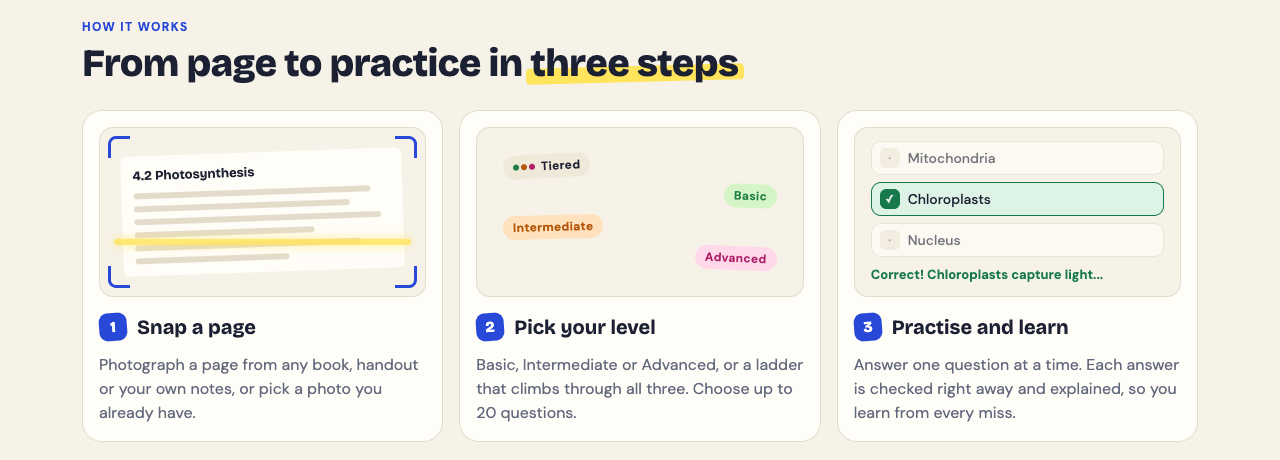
Writing 15 questions by hand takes time. Study Shot can draft multiple-choice questions from a photo of the document:
- Choose Make a new quiz, then Take photo or Choose photo. Hold the page flat and fill the frame. A printed document, a textbook page or your notes all work.
- Pick 15 or 20 questions, so there is room for sourcing, context and close reading.
- Leave the level on Tiered, which splits the questions as evenly as it can across Basic (key terms and facts), Intermediate (explain, compare and connect) and Advanced (apply and predict in new situations).
- Press Create questions. It can take up to a minute.
Each question has four choices. After Check answer, you see whether you were right, the correct answer and a short explanation. During the quiz, Show page brings your photo back so you can find the line a question is about, which is close-reading practice in itself.
The results screen shows your score for each level and a Look at these again list. The quiz is saved to your library, so you can retake it on the schedule above, and Share this quiz sends a study partner their own copy without your photo.
Two limits. The questions are written by an AI model and can contain mistakes, so check each explanation against the document and use Report a problem with this question if one is wrong. And a multiple-choice quiz cannot mark a written document answer, so practise those on paper.
Frequently asked questions
How many questions should I write for one primary source?
Aim for 15 to 20: about four on sourcing, four on context, five on close reading, and three or four on corroboration. Fewer than ten usually skips a whole category, and more than 25 gets repetitive for a single document.
What is the difference between quizzing on a primary source and a secondary source?
With a primary source, you quiz yourself on who made it, why, and how reliable it is as evidence. With a secondary source, like a textbook chapter, you quiz yourself on the historian's argument and the evidence they use to support it.
How do I quiz myself for a DBQ or document-based exam?
Practise with several short documents on one topic and, for each, ask one sourcing question and one "how does this support or challenge an argument" question. Then write a one-sentence thesis that uses at least three of the documents together.
Can I quiz myself on images, maps, or political cartoons?
Yes. Ask who made the image, who it was for, what each symbol or label means, and what message the creator wanted to send. Treat each detail in the picture the way you would treat a key word in a text.
Get started
Try Study Shot: it is free to start. Photograph the page you are studying tonight and get 10 practice questions on it, from basic to advanced.
Comments
No comments yet.
Sign in or make an account to comment.