How to Quiz Yourself on a Reading Assignment for Class
You finish the assigned article for tomorrow's class, close it, and feel ready. Then the teacher asks what the author's main argument was, and you can only remember the topic. If you want to know how to quiz yourself on a reading assignment, especially a short reading for a history, English, politics or social science class, the trick is to quiz yourself on the argument, not just the facts. This post shows you how, in six short steps you can use tonight.
Why rereading a reading assignment leaves you unsure in class
Rereading makes the words feel familiar. Familiar is not the same as remembered, and it is very different from being able to explain the reading out loud in a seminar.
There is research on exactly this. In two experiments, Roediger and Karpicke (2006) had students study prose passages and then either restudy them or take recall tests with no feedback. On a test five minutes later, the restudy group did better. Two days and one week later, the groups that had tested themselves remembered substantially more. Restudying also made students more confident, even though it did not help them remember longer.
That last point matters. Rereading the night before class can feel like the safer choice. The research says the feeling is a poor guide.
Reading assignments ask different questions than textbooks
A textbook chapter is built to teach facts and terms. A reading assignment for a humanities class is usually an argument: an essay, a journal article, a primary source or a chapter from a book that takes a position. If you are studying a textbook chapter for a test, our guide on how to read a textbook chapter for a test fits better.
For an argument, the questions you will be asked sound like this:
- What is the author's main claim?
- What evidence do they use, and how strong is it?
- Why does it matter, and who would disagree?
Those three questions are the backbone of the method below.
How to quiz yourself on a reading assignment in six steps
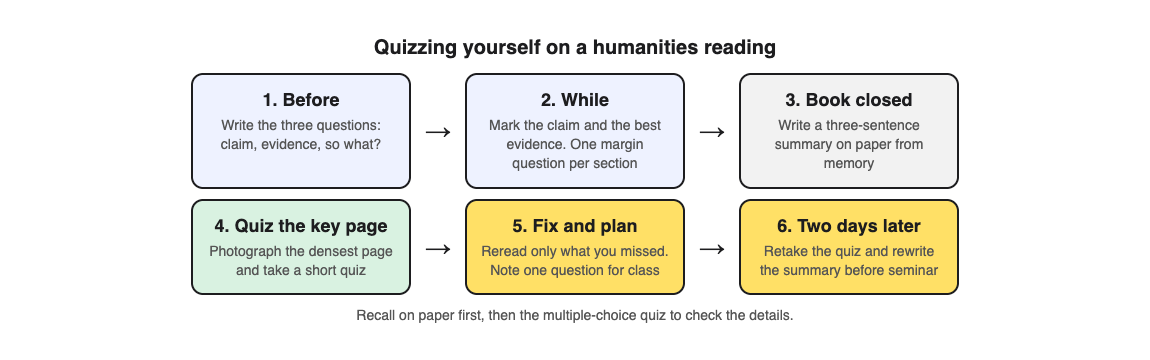
Step 1: Write three questions before you read
At the top of a page, write: What is the claim? What is the evidence? So what? Skim the title, the first paragraph and the last paragraph for two minutes. You are now reading to answer something, not just to finish.
Step 2: Mark the claim and one question per section
As you read, underline the one sentence that states the main claim, and mark the strongest piece of evidence. At the end of each section, write one question in the margin. Ask about the reasoning, not the wording. "Why does the author think the treaty failed?" is better than "What year was the treaty?"
Step 3: Close the reading and write a three-sentence summary
Put the reading out of reach. On paper, write three sentences from memory: the claim, the best evidence, and why it matters. Then answer your margin questions without looking.
This is the step that does the most work, and it is the one a multiple-choice quiz cannot do for you. Writing the argument in your own words is recall. Picking from four choices is closer to recognition. You want both.
Step 4: Quiz yourself on the densest page
Now check the details. Open Study Shot in your browser, tap Make a new quiz, and photograph the page that carried the most argument, often the introduction or the conclusion. You can also pick a photo you already have.
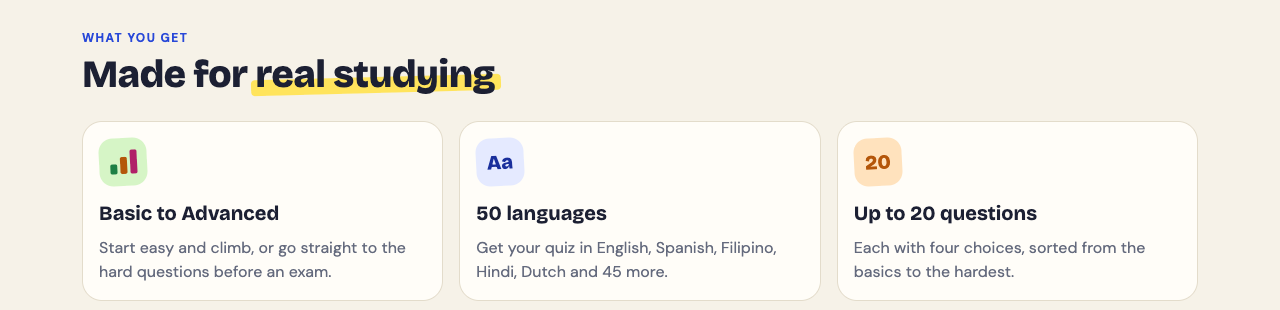
Choose 10 questions and the Intermediate level, which writes questions to explain, compare and connect ideas. That suits an argument better than Basic, which sticks to key terms and facts. Press Create questions, answer one question at a time, and press Check answer after each. You see the right answer and a short explanation either way.
The questions are written by an AI model and can contain mistakes, and an argument is easy to misread. Compare each explanation with the page. If a question puts words in the author's mouth, trust the reading and use Report a problem with this question.
Step 5: Fix what you missed, and bring one question to class
The results screen shows your score and a list called Look at these again, with your answer and the right answer for each miss. Reread only the paragraphs behind those misses, then fix your three-sentence summary. Finally, write one honest question you still have about the reading. That is your contribution to the discussion.
Step 6: Retake before class
Your quiz is saved in your library with its page photo and your best score. If the class is two days away, rewrite the summary from memory first, then tap Retake quiz. That gap is where Roediger and Karpicke's tested students pulled ahead.
A worked example: one article, two evenings
Say your politics class assigns a 12-page article on why voter turnout is lower among young people.
- Monday, 10 minutes: skim and write the three questions. Read with a pencil, one margin question per section.
- Monday, 10 minutes: close the article and write the claim, the evidence and the so what in three sentences.
- Monday, 10 minutes: photograph the conclusion page, take a 10-question Intermediate quiz, and fix your summary from the misses.
- Wednesday, 10 minutes before class: rewrite the summary from memory, retake the quiz, and reread your one question for discussion.
Forty minutes in total, and you walk in able to say what the author argued and why.
If your class reads together, use Share this quiz to send a link. Each person needs a Study Shot account and gets their own copy of the questions, without your photo. Comparing who missed what is a quick way to find the hard part before the seminar. Our post on checking your understanding after reading has more ways to spot gaps.
Frequently asked questions
How many questions should I write for a short reading?
One per section plus the three big questions is enough for most articles. For a short primary source, the three big questions alone may be all you need.
Should I quiz myself before or after the class discussion?
Before, so you arrive with the argument in your head and a question to ask. A quick retake after class checks whether the discussion changed your reading.
Can I use this for a reading in another language?
Yes. Study Shot can write quizzes in 50 languages, though its own screens stay in English. Keep your three-sentence summary in the language the class uses.
Why is it so hard to remember what I just read?
Reading once mostly builds familiarity. Recalling the argument without the text, and then checking it, is what the research above found lasts longer.
Get started
Pick tonight's reading. Write the three questions, read with a pencil, close it and write your summary. Then photograph the densest page and check yourself with a short quiz. More on why this works is in why testing yourself beats rereading your notes.
Try Study Shot: it is free to start. Photograph the page you are studying tonight and get 10 practice questions on it, from basic to advanced.
Comments
No comments yet.
Sign in or make an account to comment.