How to Quiz Yourself on a Worked Example From a Math Textbook
A worked example looks easy when you read it. Every line follows from the one before, and by the end you feel like you could do it yourself. Then you hit the homework problem and freeze. This guide shows you how to quiz yourself on a worked example from a math textbook, so you find out what you actually know before the exam does it for you.
How to quiz yourself on a worked example from a math textbook, not just read it
When you read a solution, the author makes every decision for you. They pick the method. They choose which side of the equation to simplify. They know when to substitute. You only have to agree with each step, and agreeing is much easier than deciding.
On a test, nobody makes those decisions for you. The skill you need is choosing the next move from a blank page. Reading trains recognition. In a 2006 study by Roediger and Karpicke, students who took recall tests on a passage remembered more of it two days and one week later than students who reread it, even though rereading made them feel more confident.
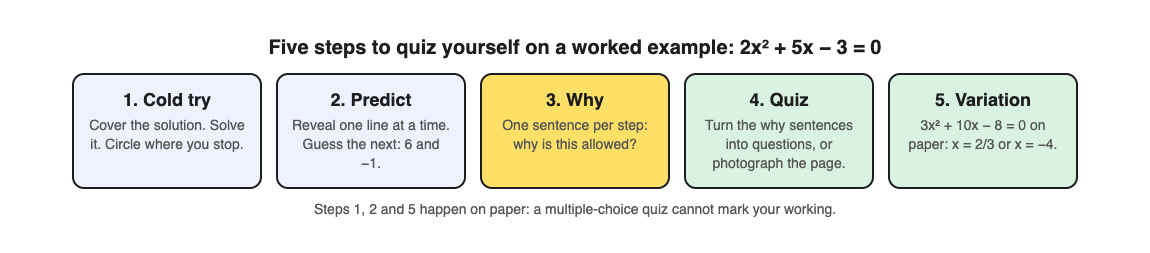
Take a typical example from an algebra chapter: Solve 2x² + 5x − 3 = 0. The textbook factors it into (2x − 1)(x + 3) = 0 and gives x = 1/2 or x = −3. Four lines. You nod along. We will use this example all the way through.
Step 1: Cover the solution and attempt the problem cold
Put a sheet of paper over everything below the problem statement. Then try to solve it with no hints.
Write down everything you try, including the wrong turns. If you start with the quadratic formula instead of factoring, that is fine. Write it out. The point is not to match the book. The point is to see where your own thinking stops.
When time is up, mark the exact spot you got stuck. Circle it. That circle is the most useful thing on the page, because it tells you which step to study.
Step 2: Reveal one line at a time and predict the next step
Now slide the paper down so only the first line of the solution shows. Before you move it again, say or write what you think the next line will be.
For our example, the first line might read: We look for two numbers that multiply to 2 × (−3) = −6 and add to 5. Stop. What comes next? You should predict 6 and −1. Then slide the paper down and check.
Keep a tally. Each correct prediction gets a tick. Each miss gets a short note on what you expected and what the book did instead. After two or three examples, your notes start showing a pattern. Maybe you always miss the step where terms get regrouped. That is a specific weakness you can now practise on purpose.
Step 3: Ask why each step works, not just what it does
Predicting the step is good. Explaining it is better. For each line, write one sentence that answers "why is this allowed?" or "why did the author choose this?"
- Why multiply 2 by −3? Because when the leading coefficient is not 1, you split the middle term using two numbers whose product is a × c.
- Why set each factor to zero? Because if a product equals zero, at least one factor must be zero.
- Why factor instead of using the formula? Because the numbers are small and the factors come out clean. The formula would also work.
If you cannot write the "why" sentence, you have found a step you are copying rather than understanding. Go back to the section of the chapter that introduced that idea and reread only that part.
The last question in that list matters more than it looks: knowing that another method would also work, and when you would pick it, is part of choosing a method on a test.
Step 4: Turn the example into question-and-answer flashcards
Your "why" sentences are already most of a quiz. Turn each one into a question with a clear answer. For our example you might write:
- When factoring ax² + bx + c with a ≠ 1, what two conditions must your split numbers meet?
- Why can you set each factor equal to zero separately?
- What are the roots of 2x² + 5x − 3 = 0?
- How could you check those roots without redoing the factoring?
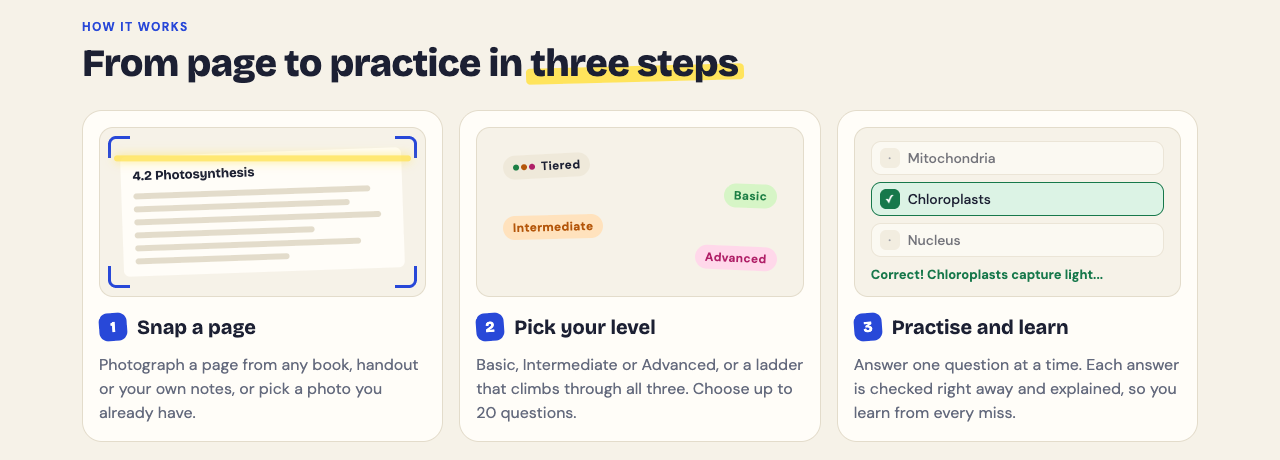
Writing cards by hand works, but it takes time, and you tend to write questions you already know the answers to. A faster option is to photograph the page and let Study Shot, a web app, write the questions. It reads the photo and writes multiple-choice questions, each with four choices and one right answer.
For a worked example, choose the Tiered level. It builds a ladder: basic questions first (key terms and facts), then intermediate (explain and connect ideas), then advanced (apply and predict in new situations). That maps closely onto Steps 1 to 3. You can pick 5, 10, 15 or 20 questions. Ten is the default, and it is plenty for one example.
Here is the workflow:
- Open Study Shot in your phone or computer browser and tap Make a new quiz.
- Choose Take photo. Hold the book flat and fill the frame with the example, including the problem statement.
- Pick 10 questions and the Tiered level, then press Create questions. It can take up to a minute.
- Answer one question at a time. After each one, press Check answer to see if you were right, the correct answer, and a short explanation.
If you forget a detail mid-quiz, Show page brings up your photo. Try not to use it until you have committed to an answer.
At the end you get a score for each level. If you scored well on Basic but poorly on Advanced, you can follow the steps but cannot yet apply them. That tells you to spend more time on Step 5. A multiple-choice quiz cannot mark your working, so it checks the ideas, not your algebra. The questions are written by an AI model and can contain mistakes. Read each explanation against your textbook, and if a question looks wrong, use Report a problem with this question under it.
The same approach works for other dense pages. See how to quiz yourself on a math formula sheet and how to quiz yourself on a flowchart from your notes.
Step 5: Change the numbers and solve a variation from scratch
This is the real test, and it has to happen on paper. A 2018 review of 122 experiments by Pan and Rickard found that practice tests help with new questions, but least of all for problems involving worked examples. Write a new problem with the same structure but different numbers, then solve it without looking at the book.
For our example, try 3x² + 10x − 8 = 0. Now you need two numbers that multiply to −24 and add to 10. That gives 12 and −2, so the roots are x = 2/3 and x = −4. Plug each root back into the original equation to check.
Some tips for writing good variations:
- Keep the method the same. If the original factors cleanly, make sure yours does too. Work backwards from two factors you choose, then expand them.
- Change one thing at a time. First change the numbers. Then change a sign. Then make the leading coefficient negative.
- Make one variation that breaks the method. Try 2x² + 5x + 4 = 0. No two numbers multiply to 8 and add to 5. The quadratic formula then shows why: 25 − 32 is negative, so there are no real roots. Spotting that is a skill worth practising.
If you can solve two variations cold, you own the method. If you cannot, go back to Step 2 on the original example and find the line where your prediction failed.
How to space your reviews so the method sticks before the exam
One session is not enough. A 2006 review of 317 experiments by Cepeda and colleagues found that spacing study sessions apart helps retention. A simple schedule:
- Day 1: All five steps on the example.
- Day 2: Step 1 only. Cover the solution and solve it cold. Then do one new variation.
- Day 4 or 5: Retake your quiz. Solve one more variation.
- The week before the exam: Retake the quiz again and solve a variation under timed conditions.
Study Shot saves each quiz to your library with its page photo and your best score, so you can retake it on any of those days. The results screen has a Look at these again list showing the questions you missed, your answer, and the right answer. Write those down and review them first next time.
Frequently asked questions
How many worked examples should I quiz myself on per chapter?
Pick one example for each distinct method in the chapter, which is usually two to four. Skip examples that repeat a method you have already quizzed on.
What if I get stuck on the first step?
Reveal only the first line, then cover the rest and try to continue from there. If you are still stuck, reread the part of the chapter that introduces that first move before you try again.
Should I quiz myself on worked examples or on end-of-chapter problems?
Do both, in that order. Worked examples teach you the method step by step, and end-of-chapter problems test whether you can choose and apply it without help.
Get started: turn your next worked example into a Study Shot quiz
Open your textbook to the worked example you understand least. Cover the solution and try it cold first. Then photograph the page and let Study Shot quiz you on it, from basic to advanced.
Try Study Shot: it is free to start. Photograph the page you are studying tonight and get 10 practice questions on it, from basic to advanced.
Comments
No comments yet.
Sign in or make an account to comment.