How to Quiz Yourself with a Past Exam Paper (Step by Step)
If you want to know how to quiz yourself with a past exam paper, the short answer is this: sit the paper like the real thing, mark it against the mark scheme, write down every mark you lost, and then retest yourself on those exact weak spots until they stop being weak. This guide walks you through each step, with a worked example you can copy tonight.
Why past exam papers beat rereading your notes
Rereading feels productive because everything looks familiar. But familiar is not the same as remembered. In a well-known 2006 study, students who tested themselves on a passage remembered much more two days and a week later than students who reread it, even though the rereaders felt more confident.
A past paper does test that. It also shows you three things your notes never will:
- How questions are worded. Examiners repeat command words like "explain", "compare" and "evaluate". You learn what each one asks for.
- Where the marks go. The mark scheme tells you which points earn credit and which get ignored.
- What you actually don't know. Every lost mark is a precise, honest list of gaps.
The paper itself is only half the value. The other half is what you do with your mistakes afterwards. That is where most students stop too early.
How to quiz yourself with a past exam paper: what you need
Set yourself up before you sit down. You need:
- Two or more past papers for your course or exam board. Save the most recent one for last.
- The matching mark schemes or examiner reports. A paper without answers is still useful, but marking is much harder.
- A timer set to the real exam length.
- A blank notebook page for your error log. This page matters more than you think, as you will see in Step 3.
- A quiet space with your phone out of reach, except as a timer.
Check which topics the paper covers. If your course changed recently, older papers may include topics you no longer study. Skip those questions rather than panicking about them.
Step 1: Take the paper under real exam conditions
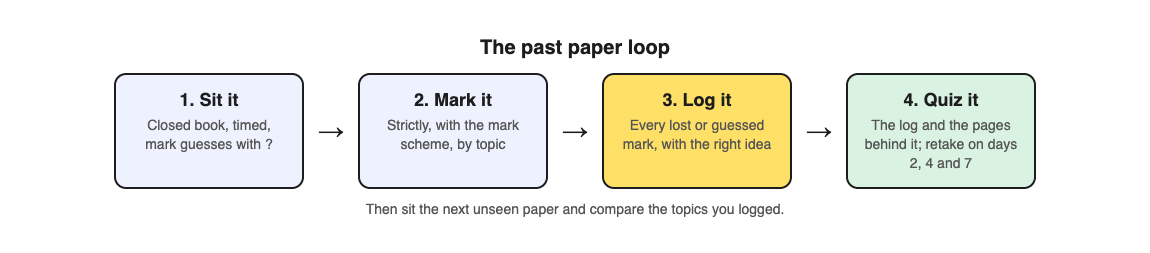
Closed book. Timed. No checking answers halfway through. If the real exam bans calculators or formula sheets, ban them here too.
When you hit a question you can't answer, don't leave it blank and move on silently. Write your best attempt, then put a small mark in the margin:
- ? means you guessed.
- ✗ means you had no idea.
These marks matter later. A guess that happened to be right is still a gap. If you only log the questions you got wrong, lucky guesses hide in your score and come back to hurt you on exam day.
Step 2: Mark it honestly with the mark scheme
Mark the paper as strictly as an examiner would. If the scheme wants a specific term and you wrote something close, decide honestly whether you would get the mark. When in doubt, don't give it to yourself.
Write your score at the top, then break it down by topic. A total of 58% tells you very little. "Strong on cell structure, weak on respiration, lost every mark on graph questions" tells you exactly what to do next.
Read the examiner report too, if one exists. It often explains the common errors that cost students marks, and you may spot your own mistake described there.
Step 3: Build an error log of every lost mark
Now open that blank notebook page. For every mark you lost, and every question you marked with ? or ✗, write one line with three parts:
- The topic. For example, "Photosynthesis: where it happens".
- What you wrote or thought. "Said mitochondria."
- The correct idea, in your own words. "Chloroplasts. Mitochondria do respiration, not photosynthesis."
Keep each entry short and specific. "Revise biology" is not an entry. "Mixed up which organelle does respiration and which does photosynthesis" is.
Also note the type of mistake. Most lost marks fall into a few buckets: you didn't know the fact, you knew it but misread the question, you ran out of time, or you knew the idea but didn't use the wording the scheme rewards. Each bucket needs a different fix. Only the first one is solved by more content review.
Step 4: Turn mistakes into quiz questions you can retest
An error log you never look at again is just a list of bad news. To make it useful, you need to be tested on it, again and again, without seeing the answers first.
You can write your own flashcards from the log. Or you can let Study Shot do the question writing. It turns a photo of a page into a multiple-choice practice quiz. Your error log is a page, and so is the relevant section of your textbook or notes.
Here is the workflow:
- Write your error log neatly on one page, with the correct ideas filled in. The quiz can only ask about what's on the page, so the right answers need to be there.
- Open Study Shot in your phone or computer browser, choose Make a new quiz, then Take photo or Choose photo. Hold the page flat and fill the frame.
- Pick how many questions. You can choose 5, 10, 15 or 20. The default is 10.
- Pick a level. Basic covers key terms, facts and definitions. Intermediate asks you to explain, compare and connect ideas. Advanced asks you to apply and predict in new situations. Tiered, the default, splits the questions across all three, basic first.
- Press Create questions. It can take up to a minute.
Each question has four choices. You pick one, press Check answer, and see right away whether you were correct, what the right answer is, and a short explanation. If you need context mid-quiz, Show page brings back your photo.
Which level should you pick? Match it to your mistake type. If you lost marks on definitions, start with Basic. If you lost marks on "explain" and "evaluate" questions, use Intermediate or Advanced. That second case is common in essay subjects. See our guides on studying for a sociology exam and studying for a political science exam for how to handle those.
A tip: photograph the textbook pages behind your weakest topics as well, not just the log. Your log tests the exact facts you missed. A 2018 review found that practice testing transfers least to material that was never itself tested, so quiz the ideas around each mistake too.
The quiz is multiple choice, and most exam papers ask for written answers. So after each quiz, cover your log and rewrite the answer to one lost-mark question in full, the way the mark scheme wants it.
One honest caution. The questions are written by an AI model and can contain mistakes. Read the explanation after each answer, and check it against your mark scheme. If a question looks wrong, use Report a problem with this question underneath it.
Step 5: Space your retakes and track your scores
One quiz session is not enough. You want to retest the same weak spots over several days, with gaps in between, so you are forced to recall rather than recognise.
A simple schedule that works for most people:
- Day 1: sit the paper, mark it, build the log, take the quiz.
- Day 2: retake the quiz.
- Day 4: retake again.
- Day 7: retake, then sit the next past paper.
Study Shot saves each quiz to your library with its page photo and your best score, so retaking is one tap. After each attempt, the results screen shows your percentage and a grade: Mastered at 90% and up, Good at 70% and up, Getting there at 50% and up, and Needs another try below that. On a Tiered quiz it also shows a separate score for Basic, Intermediate and Advanced. That tells you whether you've fixed the facts but still struggle to apply them.
The Look at these again list on the results screen shows each question you missed, your answer, and the right answer. Copy anything that keeps showing up back into your error log. Those are your true weak spots.
When a quiz reaches Mastered twice in a row, move on. When your next past paper score climbs on the topics you logged, you know the loop is working.
Frequently asked questions
How many past papers should I do before an exam?
There's no fixed number, but quality beats quantity. Two papers done fully, with marking, an error log and spaced retakes, will teach you more than five papers you only skim. Save the most recent paper for a final timed run a few days before the exam.
What if my course has no past papers with answers?
Use the questions anyway, then check your answers against your textbook and notes instead of a mark scheme. You can also photograph your notes or a textbook page and quiz yourself from it, which works for sources like a primary source for history or a lab manual.
Is it bad to repeat the same past paper twice?
Not bad, but your second score will be inflated because you remember the questions. Instead of repeating the whole paper, retest the mistakes from it in a fresh format, and keep unseen papers for measuring real progress. For essay subjects, practise new answers to old prompts, as covered in our guide on studying for a philosophy exam.
Get started
Try Study Shot: it is free to start. Photograph the page you are studying tonight and get 10 practice questions on it, from basic to advanced.
Comments
No comments yet.
Sign in or make an account to comment.