How to solve roommate problems with a shared list
If you want to know how to solve roommate problems with a shared list, start with one idea: the hardest house arguments are the repeat ones. The dishes for the fourth time, with no record of what anyone agreed last time. A shared list fixes that. You write each problem down once, attach what you tried, and record whether it worked. Then the next conversation starts from facts, not memory.
Why roommate problems keep coming back
Roommate problems repeat for three plain reasons.
- Nobody wrote down the fix. You agreed on a bin rota in March. By May, two people remember it differently.
- Nobody wrote down what failed. You tried a chore chart. It lasted a week. Someone suggests a chore chart again.
- Problems get raised in the moment. You bring up the noise at 11pm when you are tired and annoyed. That is the worst time to plan anything.
A list does not make anyone tidier. It makes the history visible, so you stop arguing about what happened and start deciding what to try next. Factories call this visual management: the Lean Enterprise Institute defines it as putting things in plain view so the status can be understood at a glance by everyone involved.
What a shared problem list is and why it works
A shared problem list is a short record that everyone in the house can read. Each entry has three parts: the problem in one line, the fixes you have tried, and the outcome of each fix.
The outcome is the part most people skip, and it matters most. "We tried a cleaning rota" tells you nothing. "We tried a cleaning rota, it partly worked, the bathroom still got skipped" tells you exactly where to push next.
This is the same approach that works for teams at work. If you have read our guide on tracking work problems without a ticket system, you will recognise the pattern: a light record beats a heavy process that nobody keeps up.
Set up a shared house list in 15 minutes
One person keeps the list: they write the problems and record outcomes, and everyone else reads it and tells them what to add. You can do this on paper, but here is how it looks in Problem Graph, a problem and solution journal that draws itself as a map. It is free and runs in your phone's web browser.
- Look around first (2 minutes). Open the app. If your graph is empty, press "Load example set" to see how problems and solutions connect. You do not need an account to browse.
- Create an account (2 minutes). To add problems, you need a username and a password. The app asks for an email for password resets.
- Write your first problem (3 minutes). Type one line, put it in the Personal lane, and press Enter. It lands on the graph straight away.
- Make it a main node (1 minute). Only a main node can be shared. When you share it, its solutions, their outcomes and the requirements they need go along with it.
- Create a private network (3 minutes). Call it something like "Flat 4B". You get an invite code. Send it to your roommates. Anyone with the code can join, so send it only to them.
- Share the main node into the network (1 minute). Your roommates can now see it, with its solutions and outcomes. Nobody outside the network can.
- Agree the first three problems (3 minutes). Do not try to log everything on day one. Pick three.
One detail to know: anything you only link to a main node stays private, like the rest of your graph. So you can keep a personal note such as "I am tired of being the one who notices" linked to the shared problem, and your roommates will not see it. Private is the default for everything.
Writing problems without blame: examples that work
The wording decides whether the list helps or starts a new fight. Describe the situation, not the person.
- Instead of "Sam never cleans the pans," write "Pans sit in the sink overnight."
- Instead of "Jo is too loud," write "Music after 11pm on weeknights wakes people up."
- Instead of "People steal my food," write "Food on the shared shelf gets eaten by mistake."
- Instead of "Nobody pays on time," write "Utility money comes in at different times each month."
A good test: could the person most likely to cause the problem read the line and nod? If yes, the wording is right. If they would feel accused, rewrite it.
Keep it to one line. If you need a paragraph, you are describing a grievance, not a problem.
Turning problems into agreed fixes and owners
Each problem gets one or more solutions. In Problem Graph you add solutions as ideas, mark the ones you are trying, and record the outcome as worked, partly, or failed.
Here is a worked example for "Pans sit in the sink overnight":
- Idea: Whoever cooks washes up the same night.
- Trying: Soak and wash by 10am next day. Owner: Alex.
Put the owner's name right in the solution line. That way the name travels with the fix and nobody has to guess who agreed to what.
Some fixes need something first. A dish rota might need a second sponge or a drying rack. Problem Graph's map key names this a requirement. Add "Buy second drying rack" as a requirement of the solution. When it is shared, the requirement goes along too.
After two weeks, mark the outcome. If it failed, leave it. Do not delete it. As the Problem Graph home page puts it: "A solution that failed three times stays on the map as a failed solution, and that is exactly what the next person needs to know." In a shared house, the next person is often a new roommate in September.
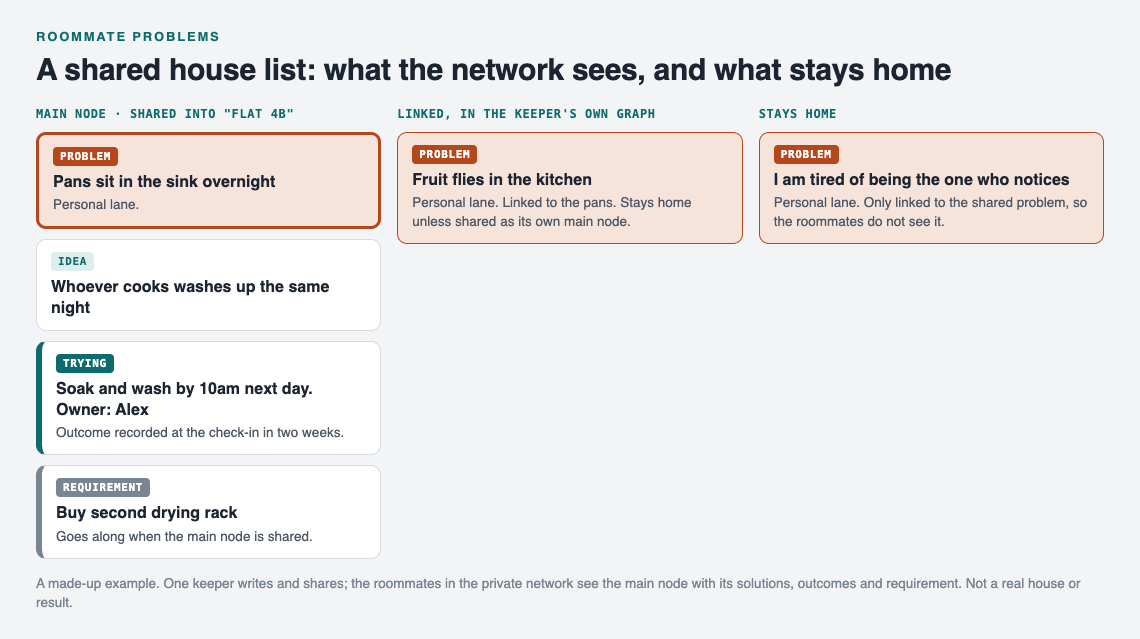
A made-up house list: what the roommates see, and the note that stays private.
When a few problems turn out to be related, link them. "Pans in the sink" and "Fruit flies in the kitchen" belong together. Seen on a map, you may notice that one fix solves both.
Running a short weekly house check-in
The list only works if you look at it. Set ten minutes a week, same day, same time. Sunday evening is one option.
Use this order:
- Outcomes first (3 minutes). For each fix being tried, ask: worked, partly, or failed? The keeper records it.
- New problems (3 minutes). Anyone can raise one, as a one-line problem. No discussion yet; the keeper writes it down.
- Pick one to work on (4 minutes). Choose the problem that bothers the most people. Agree one fix and one owner.
Only one new fix a week. Changing five things at once means you cannot tell what worked. If you need help choosing, a simple order helps: health and money first, then shared spaces, then preferences.
Use the app's Network filter to see only what you shared with the house, and the List view if a map feels like too much during the meeting.
Common roommate problems and fixes to start your list
These are starting points, not answers. Try one, record the outcome, adjust.
- Bins overflow before anyone takes them out. Try: a fixed weekly owner who rotates on the first of the month.
- Shared supplies run out (toilet roll, soap). Try: a small house fund everyone pays into on the same date.
- Guests stay without warning. Try: a one-day heads up rule for overnight guests.
- Bathroom queue in the morning. Try: agreed slots on weekdays only.
- Thermostat disagreements. Try: a set range everyone accepts, written down.
- Bills split unfairly. Try: split by usage for one month, compare to equal split, then decide.
Problem Graph can also help here. It shows similar problems other people have shared publicly, in any lane, along with which of their solutions worked. You can borrow one into your own graph with one tap, and it keeps a link back to where it came from. You can also ask for suggestions: the AI proposes new solutions based on what worked for others on similar problems. Treat these as ideas to test, not answers.
If your house list grows into a record that new roommates read, you are close to building a small team knowledge base for problems and fixes. A house is a small team.
Frequently asked questions
What if my roommate won't use the shared list?
Keep it yourself and bring it to the weekly check-in. They can read it and tell you what to add when they are ready.
Should we use an app or a whiteboard?
A whiteboard is visible but gets wiped, so you lose the record of what failed. An app keeps the history and lets you link related problems, though someone has to open it. Pick whichever your house will actually look at.
How do we handle problems nobody wants to own?
Rotate ownership on a fixed date, such as the first of each month. Write the owner's name into the solution line so the rotation is on record.
What should go on the list versus a direct conversation?
Put shared, recurring issues on the list: chores, bills, noise, guests. Anything personal, urgent, or about one person's behaviour toward another should be a private, direct conversation first.
Get started
Start small. Write one problem your house actually argues about. Add the fix you plan to try first and the name of whoever owns it. Make it a main node, create a private network, and send the invite code to your roommates. At your first check-in, record the outcome.
Try Problem Graph: it is free, and you can look around the public network without an account. Write one problem down in a line and attach the first thing you will try.
Comments
No comments yet.
Sign in or make an account to comment.