How to stop forgetting what you studied: a review loop
You studied a chapter on Sunday and by Thursday it feels like you never read it. That is not a sign that something is wrong with your memory. Forgetting is normal, and it follows a pattern. This post explains how to stop forgetting what you studied: why memories fade, what research says actually makes them last, and a simple review loop you can start today.
Why you forget what you studied
Most of us expect memory to work like a notebook: once something is written down, it stays. Real memory works more like a path through grass. Walk it once and it is visible for a while. Leave it alone and it grows over.
Two ideas from research help explain this.
- Forgetting follows a curve. Over a century ago, Hermann Ebbinghaus learned lists and measured how much he had kept at different times later, by how much quicker he could learn them again. The pattern he found is called the forgetting curve.
- New memories are fragile at first. A memory you formed today has not yet settled. Until it does, other mental activity can disturb it.
What the research says about forgetting
In 2015, Murre and Dros repeated Ebbinghaus's experiment. One person spent 70 hours learning lists and relearning them after 20 minutes, 1 hour, 9 hours, 1 day, 2 days or 31 days. The results were similar to Ebbinghaus's original curve. One detail stood out: the curve was not perfectly smooth, and most probably showed a small jump upwards at the one-day point. The study had a single participant, as Ebbinghaus's did, so it shows the shape of forgetting rather than how fast it will be for you.
Why do new memories fade? A review by Wixted (2004) argues that much everyday forgetting comes from new memories being disturbed before they settle. The disturbance does not have to be similar material; ordinary mental activity and forming other new memories can do it. This idea also helps explain why sleep after learning tends to protect a recently learned list: while you sleep, you are not forming many new memories to get in the way.
So forgetting is expected. The useful question is what slows it down.
How to stop forgetting what you studied
The answer from research is to practise pulling the answer back up from memory, again, after you already know it, instead of reading it again.
In Karpicke and Roediger (2008), students learned foreign language words. Once they could recall a word correctly, some kept studying it and some kept being tested on it. Extra studying after they knew it made no difference to how much they remembered on a later test. Extra testing made a large difference. And the students' own guesses about how much they would remember had no link to how much they actually did. You cannot judge this one by feel.
It also holds outside the lab. In a randomised trial by Larsen, Butler and Roediger (2009), doctors in training learned two medical topics. For one topic they took short-answer tests with feedback; for the other they studied a review sheet with the same information. Both happened three times, about two weeks apart. About six months later, the tested topic scored 39% on average and the studied topic 26%. The group was small, but six months is a long time.
The gaps matter too. Our post on spaced repetition for exams sets out a review schedule in detail. This post keeps it simple: come back after a day or so, then after a few days, then after a week or more.
A simple review loop
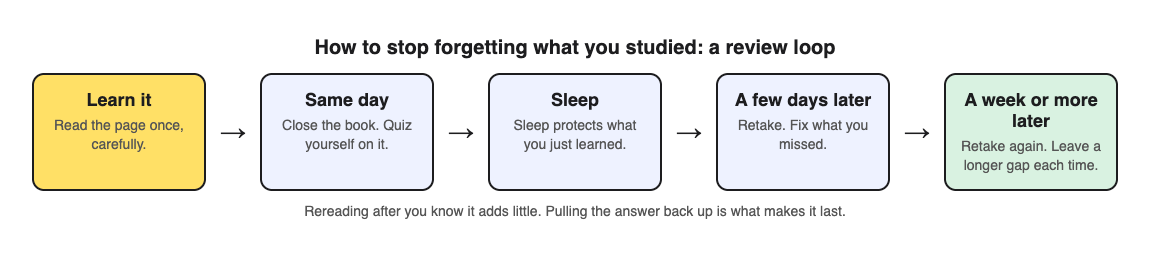
- Learn it once, carefully. Read the page with full attention. Rereading it three times in a row adds little.
- Test yourself the same day. Close the book and answer questions on it. Mistakes now are useful, because you fix them while the page is fresh.
- Sleep. Do not trade sleep for one more chapter.
- Test again a few days later. Fix what you miss, from the page, not from memory.
- Test again a week or more later. Each time you get it right, leave a longer gap before the next time.
Worked example: keeping a history chapter for the final
Say you studied a chapter on the causes of the First World War for a unit test, and the same chapter will be on the final in two months. Here is the loop with Study Shot, which turns a photo of a page into a multiple-choice practice quiz, checks each answer and explains it.
- Monday. After reading, photograph the chapter's summary page and make a quiz of 10 questions. Answer every one before you look back at the page. After each answer, Check answer shows Correct! or Not quite., the correct answer and a short explanation.
- Fix the misses. The results screen shows a percentage, a score for each level, and Look at these again, listing each miss with your answer and the right answer. During the quiz, Show page brings up your photo so you can see where the answer was.
- Thursday. The quiz is saved in your library. Press Retake quiz. If you score 90% or more, which the app calls Mastered, leave it for a week.
- The following weeks. Retake it once a week, then every two weeks. When a score drops, that is the chapter to reread, and only that one.
- Add recall on paper. Multiple choice lets you recognise an answer. Before each retake, write down the main causes from memory on a scrap of paper, then check them against the quiz.
The questions are written by an AI model and can contain mistakes. If a question does not match your notes, trust the notes and your teacher, and use Report a problem under the question. For more on reading your scores, see how to use your quiz results.
Habits that make forgetting worse
- Rereading until it feels familiar. Familiar pages feel learned. The students above could not tell how much they would remember, so do not trust the feeling; test it.
- Studying a topic once and moving on. Without a second look, the curve does its work. Put the next review in your calendar before you close the book.
- Checking the answer too soon. If you look at the answer before you try, you are reading, not recalling. Give your answer first, then check.
- Cutting sleep after a big study day. New memories are fragile until they settle, and sleep after learning helps protect them.
Frequently asked questions
Why do I forget things so quickly after studying?
New memories are fragile until they settle, and forgetting follows a predictable curve. Testing yourself after you have learned something slows it down more than rereading does.
Is rereading my notes enough to remember them?
Usually not. Once students could recall a word, more studying made no difference on a later test, while more testing made a large one.
How often should I review to stop forgetting?
Review after a day, then a few days, then a week or more. Make each gap longer when you get the answers right.
Does sleep help me remember what I studied?
A review of forgetting research says sleep after learning helps memory for what you just learned, and explains it by fewer new memories forming to disturb it.
Get started
Try Study Shot: it is free to start and works on your phone and computer. Photograph the page you studied today, take 10 questions on it tonight, and retake the same quiz in three days to see what stayed.
Comments
No comments yet.
Sign in or make an account to comment.