How to Study for a Biochemistry Exam: Pathways, Structures, Problems
If you are searching for how to study for a biochemistry exam, you have probably noticed that reading the textbook twice does not work. Biochemistry asks you to hold pathways, molecular structures, enzyme math and clinical reasoning in your head at once. This guide gives you a plan for each of those pieces, with specific exercises you can start tonight.
How to study for a biochemistry exam: why it feels harder than it should
Biochemistry feels hard because it mixes three kinds of thinking. You memorize names and structures. You follow cause and effect through pathways. You solve numeric problems. It is tempting to study all three the same way, by rereading and highlighting. That feels productive, but it mostly trains recognition. On the exam you have to produce answers, not recognize them.
The fix is to match your method to the material. Pathways need logic. Structures need drawing. Kinetics needs worked problems. Every part of it needs retrieval practice, where you pull the answer out of memory before you look.
Map the big picture before memorizing pathways
Before you learn a single enzyme, draw one page that shows how metabolism fits together. Put glucose in the middle. Draw arrows to glycolysis, then to pyruvate, then to acetyl CoA, the citric acid cycle and oxidative phosphorylation. Add branches for glycogen, the pentose phosphate pathway, fatty acid synthesis and breakdown, and amino acid entry points.
Keep this map rough. Its job is to answer one question for every pathway you study later: where does this sit, and what feeds into it? When you know that a pathway starts from a molecule you already placed on the map, the details have somewhere to attach.
Add two labels to every branch: the cell compartment (cytosol or mitochondria) and the state when it runs (fed or fasting). Many questions turn on exactly those two labels.
Learn metabolic pathways by logic, not by rote: inputs, regulation, outputs
For each pathway, fill in the same five headings before you memorize any intermediates:
- Purpose: what problem does the cell solve with this pathway?
- Inputs: what goes in, including cofactors like NAD+ or ATP.
- Outputs: what comes out, and the net yield of ATP, NADH or FADH2.
- Committed step: the irreversible step that locks the cell in.
- Regulation: what turns that step on or off, and why that makes sense.
Take glycolysis. The committed step is phosphofructokinase 1. High ATP inhibits it. AMP activates it. That is not a random fact. When the cell has plenty of energy, it slows down the pathway that makes energy. Once you see the logic, you can predict regulation you have not memorized yet, which is exactly what advanced exam questions test.
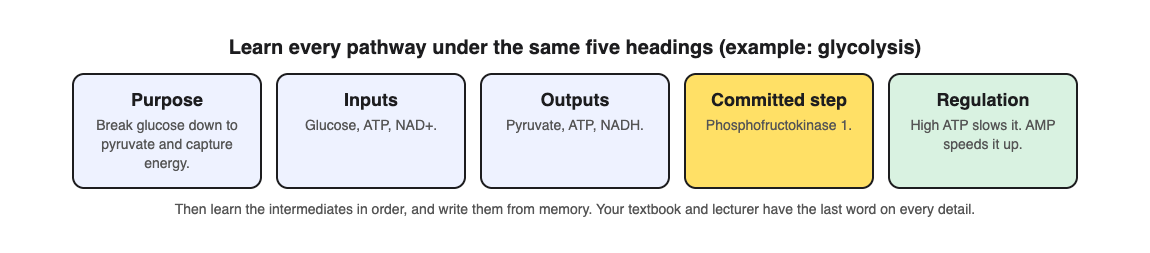
Only after you have the five headings should you learn the intermediates in order. Say them out loud while tracing your map. Then cover the page and write them from memory.
Draw structures and mechanisms until you can do it from memory
You cannot learn a structure by looking at it. You learn it by drawing it with the book closed, checking, and drawing it again. Start with the structures your course stresses most. These are usually the 20 amino acids, the common sugars in ring form, nucleotide bases, and key cofactors.
Group amino acids by side chain: nonpolar, polar uncharged, acidic and basic. Draw one group a day. For each one, note the property that shows up on exams, such as which side chains can be phosphorylated or which form disulfide bonds.
For mechanisms, draw the arrows yourself. Write what each arrow means in a few words next to it. If you can explain why a catalytic residue is protonated at one step and not the next, you understand the mechanism. If you can only copy the picture, you do not yet.
Master enzyme kinetics and calculations with practice problems
The ideas in kinetics are not complicated. The trap is reading worked examples instead of solving fresh ones.
Learn the Michaelis-Menten equation, then learn what each term means physically. Km is the substrate concentration at half of Vmax. A low Km means the enzyme reaches half speed at low substrate. Then learn the Lineweaver-Burk plot and what each inhibitor type does to it:
- Competitive: Km goes up, Vmax stays the same. Lines cross on the y axis.
- Noncompetitive: Vmax goes down, Km stays the same. Lines cross on the x axis.
- Uncompetitive: both Km and Vmax go down. Lines run parallel.
Then do problems. Set a timer, solve without notes, and check your units at every step. Keep a short error log: the problem, what you did wrong, and the rule you missed. Our guide to studying for an engineering exam covers this problem-first habit and unit checking in more detail. It transfers directly to pH, free energy and kinetics calculations.
Keep these calculations on paper. A 2018 review of 122 experiments by Pan and Rickard found that practice tests help with new questions, but least of all for problems with worked solutions, and a multiple-choice quiz cannot mark your working anyway.
Use active recall and spaced repetition for enzymes, cofactors, and regulators
A lot of biochemistry is plain recall: which enzyme needs biotin, which vitamin becomes FAD, what activates acetyl CoA carboxylase. For this material, testing yourself beats rereading: in a 2006 study by Roediger and Karpicke, students who took recall tests on a passage remembered more of it two days and one week later than students who reread it. Answer first, then check. Come back to it after a day, then a few days, then a week.
Writing hundreds of practice questions by hand takes time you may not have. One shortcut is Study Shot, a web app that turns a photo of a page into a multiple-choice quiz. It runs in the browser on your phone or computer. Here is a workflow for a pathway page:
- Open your notes on the citric acid cycle and tap Take photo. Hold the page flat and fill the frame. Textbook pages, handwritten notes, diagrams and whiteboards all work.
- Choose 15 questions and leave the level on Tiered. Tiered splits the questions as evenly as possible across Basic (key terms and definitions), Intermediate (explain, compare and connect) and Advanced (apply and predict in new situations), in that order.
- Press Create questions. It can take up to a minute.
- Answer one question at a time. After Check answer, you see whether you were right, the correct answer, and a short explanation.
The results screen gives you a score for each level. That tells you something useful. If you scored well on Basic and poorly on Advanced, you know the names but cannot yet reason with them, so go back to the regulation logic above. The Look at these again list shows each missed question with your answer and the right one. Quizzes are saved in your library with the page photo and your best score, so you can press Retake quiz on day 3 and day 7 for spaced review.
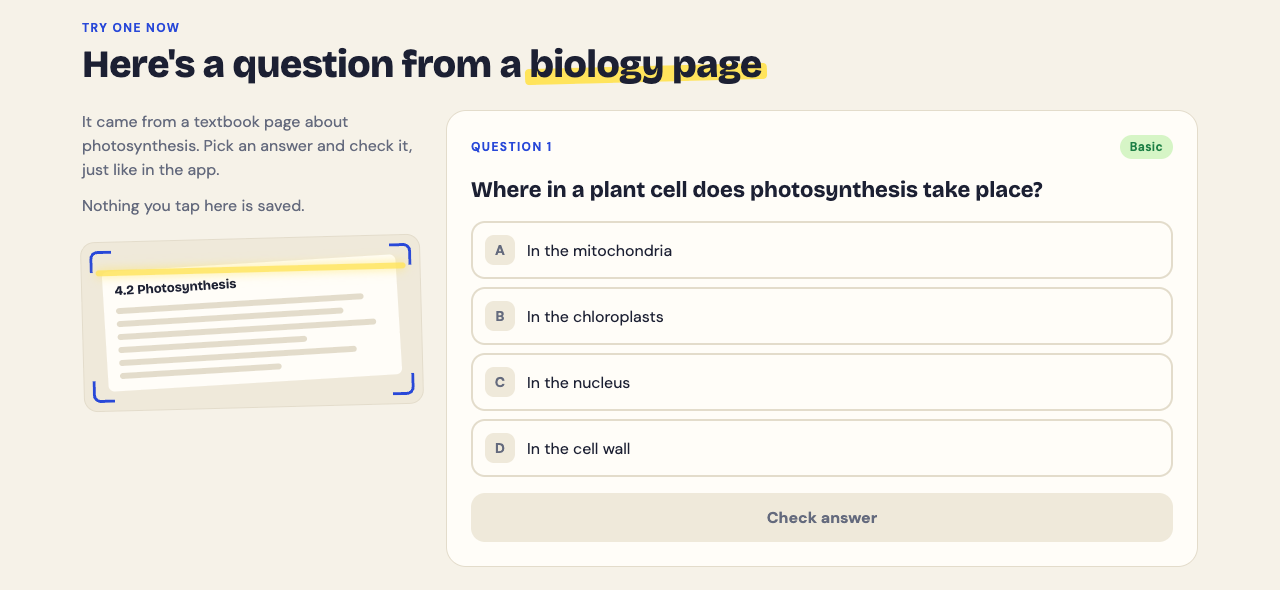
The questions are written by an AI model, so they can contain mistakes, and your textbook and lecturer have the last word on any enzyme, pathway or disease. Read the explanation against your notes. If a question is wrong, use Report a problem with this question under it.
Connect pathways to clinical and experimental scenarios
Many biochemistry exams wrap facts inside a scenario. A patient cannot break down glycogen in muscle. An experiment adds an inhibitor to isolated mitochondria. You have to work backward from the symptom or result to the enzyme.
Practice this with a simple template. For each key enzyme, write: what builds up before the block, what runs short after it, and what the body or cell does to compensate. A deficiency in an urea cycle enzyme, for example, leads to ammonia buildup. If you have mapped the pathway, you can predict that without memorizing every disease.
Scenario thinking is also the core of other life science exams. Our immunology exam guide applies the same case-based approach to signaling pathways. And if your course leans toward energy systems in exercise, the sports science exam guide links metabolism to performance in a way that reinforces fed and fasting states.
Before the exam, write five scenarios of your own. Swap them with a classmate. Writing a good question forces you to understand the answer.
Frequently asked questions
How long should I study for a biochemistry exam?
Start two to three weeks ahead for a major exam, with short daily sessions instead of a few long ones. Spaced sessions give you time to retest pathways several times before the exam.
What is the best way to memorize metabolic pathways?
Learn the purpose, inputs, outputs, committed step and regulation first, then the intermediates. Trace the pathway from memory on a blank page and check it against your notes.
Do I need to memorize every structure in biochemistry?
No. Focus on the structures your course emphasizes, usually amino acids, common sugars, nucleotides and key cofactors. Check past papers or your syllabus to see which ones appear.
How do I get better at enzyme kinetics problems?
Solve fresh problems without notes and keep a log of every mistake. Learn what each inhibitor type does to Km, Vmax and the Lineweaver-Burk plot until you can sketch it from memory.
Get started: turn your biochemistry notes into recall questions with Study Shot
Pick the pathway you feel least sure about. Photograph your notes on it, choose Tiered, and see where your score drops between levels. That gap is your study plan for the next session. Study Shot is free to start, works in your browser, and saves every quiz so you can retake it later.
Try Study Shot: it is free to start. Photograph the page you are studying tonight and get 10 practice questions on it, from basic to advanced.
Comments
No comments yet.
Sign in or make an account to comment.