How to Study for a Business Management Exam: Models, Cases, Essays
If you are wondering how to study for a business management exam, start with this: reciting a model is only the first step. Most papers also ask you to apply a model to a company you have never seen before, and to judge what that company should do. This guide walks you through a method that builds those three skills in order: know the models, apply them to cases, then evaluate in timed essays.
How to study for a business management exam: what it actually tests
Most business management papers mix three kinds of questions.
- Knowledge questions. Define a term, name the stages of a model, list the factors in a framework. These are short and quick to mark.
- Application questions. Use a model on the case in front of you. "Analyse the competitive pressures facing Company X" wants Five Forces, filled in with details from the case.
- Evaluation questions. "To what extent should Company X expand overseas?" These need a judgement, not just analysis.
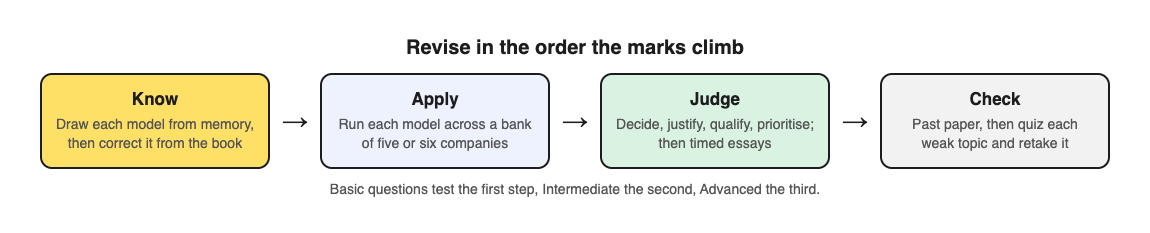
Read the mark scheme for your course if you can get it, and see how marks are split between describing, applying and judging. Your revision should climb in the same order.
Map the syllabus into models, theories, and definitions
Before you revise anything, sort your syllabus into three piles on one sheet of paper.
- Models you can draw or list: SWOT, PESTLE, Porter's Five Forces, the Ansoff Matrix, the Boston Matrix, the product life cycle, stakeholder mapping.
- Theories with a named thinker: Maslow, Herzberg, Taylor, Mayo, Lewin's change model, Mintzberg's roles, leadership styles.
- Definitions and calculations: break even, gross and net profit margin, labour turnover, capacity utilisation, market share.
Tick each item in one of three colours: green if you could explain it to a friend now, amber if you half know it, red if it is new. That shows you where your time should go.
If your course overlaps with finance or marketing, the calculation and framework piles will look familiar. The guides on studying for an accounting exam and studying for a marketing exam cover those parts in more depth.
Learn the core models by drawing them from memory
Reading a model ten times feels productive, but it mostly builds confidence. In a classic study, restudying raised students' confidence while testing themselves gave far better recall two days and a week later. You know a model when you can produce it from a blank page.
Try this for each model:
- Look at it once in your textbook. Say each part out loud.
- Close the book. Draw it on scrap paper with every label.
- Open the book and correct your drawing in a different colour pen.
- Repeat tomorrow, then in three days, then in a week.
For the Ansoff Matrix, you should be able to draw the two by two grid, label the axes (products and markets, existing and new), name all four boxes, and write one risk for each. For Herzberg's two-factor theory, list three hygiene factors and three motivators without looking.
This is also where a quick self quiz helps. With Study Shot, you photograph the textbook page on, say, Porter's Five Forces. Then choose Basic, which the app describes as "Key terms, facts and definitions." You get multiple-choice questions with four options each, checked one at a time, with a short explanation after every answer. It is a fast way to find the gap between "I recognise this" and "I know this."
Apply every model to a real company case
Application means showing the model working on the business in the question, not on any firm. Practice tests carry over best to this kind of question: a review of 122 experiments found transfer was greatest to application and inference questions.
Build a small bank of five or six companies you know well. Mix sizes and sectors: a supermarket, a tech firm, a fast fashion brand, a local family business, an airline, a charity. For each one, write a single page with:
- What it sells and to whom
- One recent change it made (a new product, a new market, a restructure)
- One problem it faces
- Two or three specific facts you can quote
Now run each model across your bank. Do a SWOT for the supermarket. Place the tech firm's products on the Boston Matrix. Use Lewin's model on the restructure. You will notice that some models fit some companies far better than others. Noticing that is the start of evaluation.
Here is where the Intermediate level is useful. Study Shot describes it as "Explain, compare and connect ideas." Photograph your one page case summary and ask for Intermediate questions. You get questions that push you to link the facts on your page to the reasoning behind them, rather than just recalling them.
Practise evaluation: weigh up, then decide
Evaluation means weighing up and reaching a justified decision. Describing two sides and stopping at "it depends" leaves the decision out.
Use this four part pattern for every judgement:
- Decide. State a clear answer. "Company X should enter the Indian market."
- Justify. Give the strongest reason from the case.
- Qualify. Say what it depends on. "This depends on whether it can find a local partner, because..."
- Prioritise. Say which factor matters most and why.
Practise this out loud with your case bank. Ask yourself: "Should the airline cut prices?" Answer in four sentences using the pattern above. Then switch sides and argue the opposite. If you can argue both and still pick one, you are ready.
The Advanced level in Study Shot is described as "Apply and predict in new situations." That matches what evaluation questions ask of you. Questions at this level are a good warm up before you write a full essay, because they make you predict outcomes rather than repeat facts.
Write timed essay answers with a simple structure
Long answers fall apart under time pressure unless you have a structure you can use without thinking. Keep it simple:
- Opening (two or three sentences): define the key term and state your line of argument.
- Two or three analysis paragraphs: each one makes a point, applies a model, uses a case fact, and explains the consequence for the business.
- A counter paragraph: the strongest argument against your line.
- Conclusion: your decision, what it depends on, and the single most important factor.
Write at least one timed answer per week from the halfway point of your revision. Use the real time allowance for the question. Then mark it against the mark scheme and underline every sentence that applies a model to the case. If you cannot underline at least one per paragraph, your answer is too generic.
Quiz yourself with past papers in the final two weeks
Past papers show you the wording, mark weights and kinds of cases your exam uses. In the last two weeks, make them the centre of your revision.
Here is a worked workflow:
- Sit one past paper under timed conditions.
- Mark it. Write down every model or term you got wrong or left out.
- Photograph the textbook page for each weak topic. In Study Shot, tap Make a new quiz, then Take photo.
- Choose 15 questions and leave the level on Tiered. Tiered is a ladder from basic to advanced, and it splits questions as evenly as it can, so you get 5 basic, 5 intermediate and 5 advanced, in that order.
- Press Create questions. Work through them one at a time.
- On the results screen, read your score for each level. If you scored well on Basic but poorly on Advanced, you know the model but cannot apply it yet. Go back to your case bank.
- Read the Look at these again list, which shows each missed question with your answer and the right answer.
Your quiz is saved to your library with its page photo and your best score, so you can tap Retake quiz a few days later and see if the grade moves from "Getting there" to "Good" or "Mastered."
For a step by step guide to using a whole past paper this way, read how to quiz yourself with a past exam paper.
One honest note: the questions are written by an AI model and can contain mistakes. The explanation after each answer helps you check the reasoning against your textbook. If a question looks wrong, use Report a problem with this question under it.
If you revise with a study group, use Share this quiz to send a link. Each person who opens it needs a Study Shot account and gets their own copy of the questions, without your photo.
Frequently asked questions
How long should I study for a business management exam?
It depends on your course and how much is new to you. Spread short sessions over several weeks rather than cramming, with models and your case bank first and timed essays and past papers second.
Which business management models come up most often?
SWOT, PESTLE, Porter's Five Forces, the Ansoff Matrix, the Boston Matrix and the main motivation theories appear on most syllabuses. Check your own specification and past papers, because exam boards differ.
How do I remember case study examples?
Keep a bank of five or six companies, each on one page with a few specific facts, and reuse them across every model. Testing yourself on those pages every few days works better than rereading them.
Get started
Try Study Shot: it is free to start. Photograph the page you are studying tonight and get 10 practice questions on it, from basic to advanced.
Comments
No comments yet.
Sign in or make an account to comment.