How to Study for a Cell Biology Exam: A Practical Plan
If you want to know how to study for a cell biology exam, start by accepting that the course is a lot of vocabulary, a lot of diagrams and a lot of processes that depend on each other. You cannot cram it the night before. You can, though, break it into a plan that fits the weeks you have left. This post gives you one: map first, then organelles, then pathways, then practice.
Why cell biology exams feel overwhelming
Three things pile up at once. First, the terms: endoplasmic reticulum, Golgi apparatus, cyclin-dependent kinase, G protein. Second, the scale: you jump between molecules, organelles and whole cells in a single lecture. Third, the question style. Exams rarely ask "what does the Golgi do?" They ask what happens to a protein if a signal sequence is missing.
That last point shapes everything below. Memorizing a definition is the first step, not the goal. You need to explain, compare and predict. If you feel the dread building, it is worth knowing that stress can get in the way of recall, and this post on stress and exam memory covers what research says about it.
Start with the big picture: map the cell before the details
Before you learn any single organelle, draw one cell from memory on a blank page. Put in the nucleus, the rough and smooth ER, the Golgi, mitochondria, lysosomes, the plasma membrane and the cytoskeleton. Add arrows for how things move: DNA to RNA to protein, protein from ER to Golgi to membrane.
Your first attempt will be messy. That is the point. The gaps show you what you do not know yet. Then look at your lecture slides and fix the map in a different color. Repeat this a few times across the first week.
Sort your course into a short list of big themes so each new topic has a place to land:
- Structure: what the parts look like and where they sit.
- Transport: how molecules and vesicles move.
- Energy: how the cell makes and uses ATP.
- Information: how genes become proteins and how that is controlled.
- Communication: how cells send and receive signals.
- Division: how cells copy themselves and what regulates it.
How to learn organelles and their functions
Do not learn organelles as a list of names with one-line jobs. Learn each as an answer to a question the cell has to solve. The mitochondrion answers "where do we make most of our ATP?" The lysosome answers "where do we break things down safely?" The rough ER answers "where do proteins for secretion or the membrane get made and folded?"
For each organelle, write four short lines:
- What it does.
- What it is made of or how it is built (membranes, folds, enzymes inside).
- What it connects to (which organelle sends it material, which one receives).
- What goes wrong if it fails.
The fourth line is where exam questions live. If lysosomal enzymes are missing, what builds up? If the nuclear pore is blocked, what stops?
Then compare similar pairs side by side: rough ER and smooth ER, mitochondria and chloroplasts, endocytosis and exocytosis. Exam writers love pairs.
How to master signaling pathways and cell processes
Pathways are where many students lose marks, because they memorize the steps without the logic. Treat every pathway as a story with a trigger, a relay and an outcome.
Use the same template for every pathway
Take a G protein-coupled receptor pathway as an example. Write it like this:
- Trigger: a ligand binds the receptor.
- Relay: the receptor activates a G protein, which activates an enzyme, which makes a second messenger such as cAMP.
- Outcome: a kinase is activated and changes what the cell does.
- Off switch: how the signal stops.
- Break it: what changes if one step is blocked or stuck on.
Use the same five lines for the cell cycle checkpoints, apoptosis and protein trafficking. When every process has the same shape, you spend less effort remembering the format and more on the content. The same approach works in other pathway-heavy courses, as you can see in these guides for biochemistry and neuroscience.
Use diagrams and active recall instead of rereading
Rereading feels productive because the page looks familiar. Familiar is not the same as recalled. Close the book and test yourself instead. In a 2006 study by Roediger and Karpicke, students who took recall tests remembered substantially more after 2 days and after 1 week than students who restudied the same passage, even though restudying made them feel more confident about remembering it. Restudying did better only when the final test came 5 minutes later.
Here are three active methods that work well for cell biology:
- Blank-page redraw. Pick a diagram from your notes, such as the secretory pathway. Redraw it from memory, then check it.
- Explain it out loud. Describe a process as if teaching a friend. Where you stall is where you need more work.
- Cover and predict. Cover the second half of a pathway and say what must come next.
A quick way to get questions on your own material is to photograph a page and let Study Shot write them. Take a photo of a diagram page or your own notes, choose how many questions you want (5, 10, 15 or 20), and press Create questions. It writes multiple-choice questions with four options each, checks your answer right away and gives a short explanation. Treat those explanations as a way to check your thinking, since the questions are written by an AI model and can contain mistakes. If one looks wrong, use Report a problem with this question.
How to study for a cell biology exam: a four-week schedule
Short sessions spread over several weeks beat one long session. Here is a simple schedule for a four-week run-up. Adjust it to your own exam date.
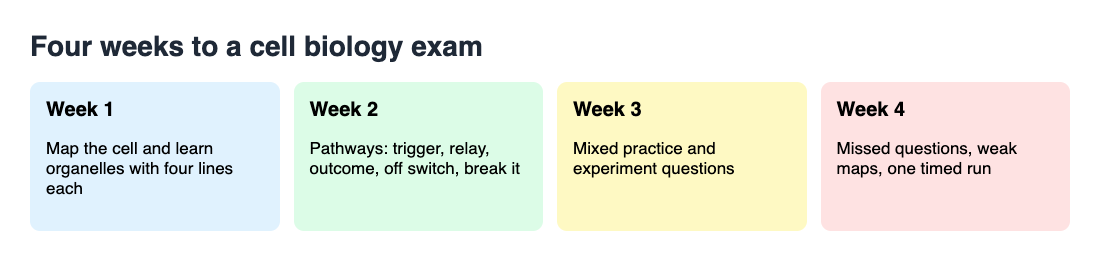
Week 1: map and organelles
Redraw the cell map every other day. Work through the four-line organelle notes. Do a short quiz at the end of the week.
Week 2: pathways and processes
Use the trigger, relay, outcome template on one pathway per session. At the start of each session, spend five minutes recalling last week's organelles.
Week 3: mixed practice
Stop studying by topic. Mix organelles, pathways and experiments in one session so you practice choosing the right idea, not just recalling it. Retake the quizzes you scored worst on.
Week 4: gaps and rehearsal
Review only the missed questions and weak maps. Do one timed, full-length practice session. Sleep properly the night before.
If your course includes a lot of mechanisms too, the pacing in this organic chemistry study plan is a useful model, and this pathophysiology plan shows how to connect cell-level failures to disease.
Practice with exam-style questions and experiments
Cell biology exams often show you an experiment and ask what the result means. Practice reading them. For each experiment in your notes, write down the question being asked, what was changed, what was measured and what the result says about the process.
Here is a worked example. Suppose your notes describe a cell where a drug blocks vesicles leaving the ER. Ask yourself:
- Which organelle is starved of incoming protein?
- What builds up in the ER?
- What happens to proteins meant for the plasma membrane?
Now do this with Study Shot. Photograph the notes page on the secretory pathway, then pick a level. Tiered is the default and splits the questions across basic, intermediate and advanced, in that order. Basic covers key terms, facts and definitions. Intermediate asks you to explain, compare and connect ideas. Advanced asks you to apply and predict in new situations, which is the kind of question your exam is likely to ask. In the last week, go straight to Advanced.
At the end you get a percentage and grade, a score for each level, and a list called Look at these again that shows each missed question with your answer and the right answer. Use that list as your next study session. Your quizzes are saved in your library with your best score, so you can retake them as the exam gets closer. If you study in a group, Share this quiz makes a link, and the other person needs a Study Shot account to open it.
Frequently asked questions
How long does it take to study for a cell biology exam?
Plan on about four weeks of short, regular sessions if you can. If you have less time, keep the same order: map, organelles, pathways, practice questions.
What is the best way to memorize signaling pathways?
Do not memorize them as lists. Use one template for every pathway: trigger, relay, outcome, off switch and what happens if a step breaks. Then redraw each one from memory.
Can I make practice questions from my own notes?
Yes. In Study Shot you can photograph a page of your notes, a textbook or a whiteboard and get multiple-choice questions on it. Use the explanations to check your understanding, and remember that an AI model can make mistakes.
Does Study Shot work on my phone?
Yes. It runs in the web browser on a phone or a computer. The quiz questions can be written in 50 languages, though the app's own screens stay in English.
Get started
Pick the one topic you understand least, photograph that page and quiz yourself on it tonight. Then repeat on a schedule.
Try Study Shot: it is free to start. Photograph the page you are studying tonight and get 10 practice questions on it, from basic to advanced.
Comments
No comments yet.
Sign in or make an account to comment.