How to Study for a Criminology Exam: Theories, Cases, Essays
If you are wondering how to study for a criminology exam, start with this: the exam rarely rewards memorizing a list of theorists. It rewards knowing what each theory claims, using it to explain a case, and judging where it falls short. This guide shows you how to build that skill in stages. You will map the theories, apply them to scenarios, cover the justice system and research methods, drill with active recall, and practise timed essays. A two-week plan at the end puts it all on a calendar.
What a criminology exam actually tests
Most criminology exams mix three kinds of tasks:
- Recall. Who proposed differential association? What are Hirschi's four elements of the social bond? What is the "dark figure" of crime?
- Application. A scenario describes a teenager in a neighbourhood with high turnover and few local ties. Which theory explains the pattern best, and why?
- Evaluation. "Labelling theory explains the continuation of offending better than its start. Discuss." You need a claim, evidence, and a critique.
Recall is the foundation, but it is not enough on its own. If you can name Merton's five adaptations and cannot say which one fits a white-collar fraudster, you lose the application marks. Study for all three levels from the start.
Build a theory map: schools, thinkers, and core claims
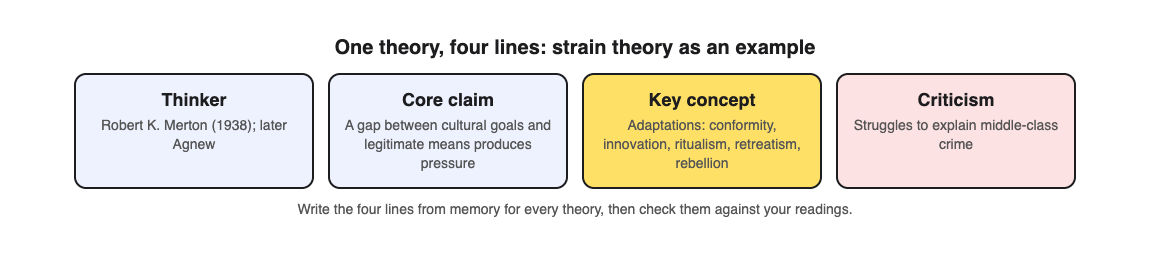
Put every theory on one or two pages, grouped by school. For each one, write four short lines: the thinker, the core claim, the key concept, and one main criticism. Here is a compressed example:
- Classical school (Beccaria, Bentham). People choose crime by weighing pleasure against pain. Punishment should be swift, certain, and proportionate. Criticism: it assumes everyone reasons the same way.
- Biological positivism (Lombroso). Offenders are born different. Criticism: weak methods and no proper control group.
- Social disorganization (Shaw and McKay, Chicago school). Crime clusters in areas with poverty, high residential turnover, and weak community ties. Criticism: it can blame places and miss individual differences.
- Strain (Merton; later Agnew's general strain theory). A gap between cultural goals and legitimate means produces pressure. Merton's adaptations: conformity, innovation, ritualism, retreatism, rebellion. Criticism: it struggles to explain middle-class crime.
- Differential association (Sutherland). Crime is learned in close groups, including techniques and attitudes. Criticism: hard to test directly.
- Social control (Hirschi). The question is why people do not offend. Bonds: attachment, commitment, involvement, belief. Later, Gottfredson and Hirschi stressed low self-control.
- Labelling (Lemert, Becker). Primary deviance versus secondary deviance. Being labelled can push someone into a deviant identity. Criticism: it says little about why the first act happens.
- Routine activity (Cohen and Felson). Crime needs a motivated offender, a suitable target, and no capable guardian, meeting in time and space.
- Critical, conflict, and feminist approaches. Who makes the law, whose harms count, and how gender shapes offending and victimization.
Use your own course readings to fill in the exact thinkers your lecturer stresses. The format matters more than the length. Four lines per theory is enough to recall, apply, and critique.
Apply theories to real cases and scenarios
Once the map exists, test it against cases. Take a scenario from your textbook, a lecture example, or a news story, and run it through three or four theories. Ask the same questions each time:
- What does this theory say caused the behaviour?
- Which detail in the case supports that reading?
- Which detail does the theory fail to explain?
Example: a group of young people shoplift together after school. Differential association points to learned techniques and shared attitudes. Routine activity points to busy shops, small items, and few staff watching. Social control asks what bonds were weak. Writing three short paragraphs like this trains exactly the move an application question wants. The approach is close to how you would handle cases in politics; see how to study for a political science exam for a similar concepts-to-cases method.
Learn the criminal justice system, research methods, and key statistics
Many courses include a unit on the justice system and on how crime is measured. Do not skip it.
For the system, draw the path a case takes: report, investigation, arrest, charge, court, sentence, and corrections. Note where discretion happens at each step, because exams like to ask about it.
For methods, know the three main sources of crime data and the weakness of each:
- Official statistics. Recorded by police and courts. They miss crime that is never reported or recorded, the "dark figure."
- Victimization surveys. Ask people what happened to them. They capture unreported crime but miss crimes without a direct victim.
- Self-report studies. Ask people what they did. They depend on honest answers and good memory.
For statistics, learn only the figures your lecturer gave you, and learn them with their source and year. A number without its source is weak evidence in an essay.
Turn readings and lectures into active recall flashcards
Rereading your theory map feels productive. In a well-known 2006 study, students who tested themselves on a passage remembered much more two days and a week later than students who reread it. Start on paper: cover the map and write the four lines for each theory from memory. Then get questions on it.
Study Shot turns a photo of a page into a multiple-choice quiz. You snap a page from a textbook, your notes, or a whiteboard, and an AI model writes questions about it, checks your answers, and explains each one. Here is a workflow for criminology:
- Photograph your theory map page. Hold it flat and fill the frame. Photos can be JPEG, PNG, WebP or GIF up to 5 MB.
- Choose 15 questions and leave the level on Tiered. That gives you a ladder: basic questions first (key terms and definitions), then intermediate (explain, compare, connect), then advanced (apply and predict in new situations).
- Press Create questions. It can take up to a minute.
- Answer one question at a time. After each Check answer, you see whether you were right, the correct answer, and a short explanation.
The results screen shows your score for each level. If you get every Basic question right but miss half the Advanced ones, you know your problem is application, not recall. Go back to case practice. The Look at these again list shows each missed question with your answer and the right one.
Each quiz is saved to your library with its page photo and your best score, so you can retake it two days later. When you are ready, make a new quiz from the same page set to Advanced only.

Questions are written by an AI model and can contain mistakes. Read each explanation against your notes. If a question is wrong or unclear, use Report a problem with this question underneath it.
Practice timed essays with a theory, evidence, critique structure
Essay questions need practice under time. Use a simple structure for each main paragraph:
- Theory. State the claim in one or two sentences, with the thinker.
- Evidence. A study, a case, or a statistic from your course that supports it.
- Critique. A limitation, a counter-example, or a rival theory that explains the same thing better.
Take the prompt "Labelling theory explains the continuation of offending better than its start." One paragraph sets out Lemert's primary and secondary deviance. The next brings evidence from your course readings on what happens after someone is labelled. The next critiques it: labelling says little about primary deviance, so you bring in strain or control theory to explain the first act. Your conclusion answers the question directly.
Set a timer for the length your exam allows. Plan for five minutes, write, then check your work against the structure. The argue-and-object habit is the same one philosophy students drill; this guide to philosophy exams has more on building objections.
How to study for a criminology exam in two weeks
Days 1 to 3. Build the theory map. Four lines per theory. Make a Tiered quiz from each page and note your weakest level.
Days 4 to 5. Justice system flow chart and research methods page. Quiz yourself on both.
Days 6 to 8. Case practice. Run one scenario a day through three theories. Retake your earlier quizzes from the library.
Days 9 to 11. One timed essay a day, using theory, evidence, critique. Mark it yourself against past questions or the marking guide.
Days 12 to 13. Advanced-only quizzes on your theory map. Work through every item in your "look at these again" lists.
Day 14. Light review of the map, one short essay plan, and sleep.
Frequently asked questions
How long should I study for a criminology exam?
The plan above uses two weeks for a final, which leaves room to build the map, practise cases and write several timed essays. For a unit test, shrink each stage to a day.
How do I remember all the criminology theories?
Group them by school and write four lines for each: thinker, core claim, key concept, criticism. Then test yourself on those pages instead of rereading them.
How do I write a strong criminology essay answer?
Build each paragraph around a theory, evidence for it, and a critique. End by answering the question directly, not just summarizing.
Are criminology exams mostly multiple choice or essays?
It depends on your course and level. Many mix short recall questions with application scenarios and at least one essay, so check past papers and prepare for each format.
Get started
Try Study Shot: it is free to start. Photograph the page you are studying tonight and get 10 practice questions on it, from basic to advanced.
Comments
No comments yet.
Sign in or make an account to comment.