How to Study for a Dental Hygiene Exam: A Practical Plan
If you are working out how to study for a dental hygiene exam, start with one idea: many exams ask you to use what you know on a case, so practise producing answers rather than rereading pages. You need tooth anatomy, gum disease, drugs, radiographs and procedures well enough to apply them. This plan shows you how to build that, step by step.
How to study for a dental hygiene exam: start with the outline
Before you plan anything, find out which exam you are preparing for. A course exam covers what your instructors taught. A board or licensure exam is set by an outside body. Ask your program or that body for the official content outline, then treat it as your checklist.
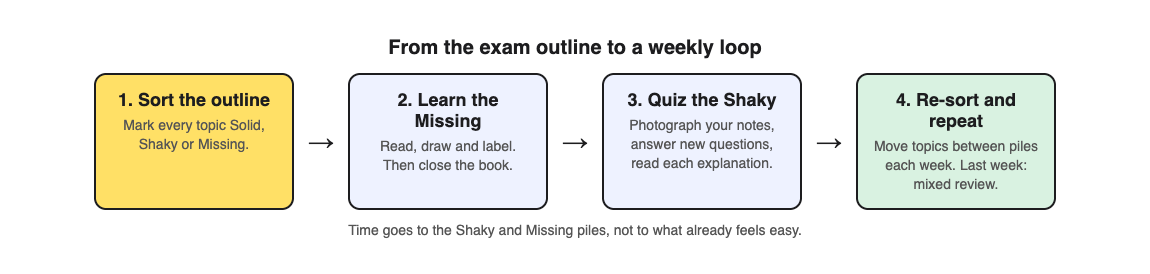
Sort every topic on that outline into three piles:
- Solid: you can explain it without notes.
- Shaky: you recognize it but cannot produce it.
- Missing: you have never really learned it.
Be honest. Most of your time should go to the shaky and missing piles. Rereading what you already know feels productive, but in one study repeated studying raised students' confidence while repeated testing gave them more recall on tests two days and a week later (Roediger and Karpicke 2006, PubMed 16507066). Feeling sure is not the same as being able to recall.
Build a study schedule that works backward from exam day
Count the weeks to your exam and work backward. Give each major subject a block, and leave the last stretch for mixed review. A simple split looks like this:
- First third: learn or relearn the missing topics.
- Middle third: fix the shaky topics with questions and recall.
- Final stretch: mixed practice, weak spots, and rest.
How long each third lasts depends on your course and how much is missing. Short, regular sessions with one clear goal, such as "list the stages of gum disease from memory," work better than a vague "study perio" block. Put review sessions on your calendar too, because old topics fade. Our post on a simple review schedule shows one way to space them.
Master the core subjects: anatomy, periodontology and pharmacology
These three areas carry a lot of the memorization, so give each a different approach.
Anatomy and tooth morphology
Learn teeth by comparing them. For each tooth, note its features, then ask how it differs from the tooth next to it or the one across the arch. Draw the shapes from memory, label them, and check against your textbook. Drawing forces you to recall rather than recognize. Our anatomy test plan goes deeper on labeling.
Periodontology
Focus on process and classification. Know how healthy tissue becomes diseased, what you would see, and what you would do next. Explain each stage out loud as if you were teaching a patient. If you stumble, that is the gap to fix.
Pharmacology
Group drugs by class and learn what each class does and why a patient takes it. Then look up where your textbook says it matters for dental care. Build short tables on paper: drug class on one side, what it means for treatment on the other. Our pharmacology exam plan covers drug classes in more detail. For any dose or procedure, your textbook and your instructor have the last word.
The same method works in other science-heavy courses. Our plans for a pathophysiology exam and a cell biology exam use the same idea: understand the process before memorizing the details.
Use active recall and spaced repetition for heavy memorization
Active recall means pulling an answer out of your head before you look at it. Spaced repetition means revisiting that answer after a growing gap: a day, then a few days, then a week. A 2013 review of ten learning techniques, which included rereading, practice testing and distributed practice, is a good place to see how they compare (Dunlosky et al. 2013, PubMed 26173288). Our post on retrieval practice explains the testing side.
Here is a simple routine:
- Close the book and write down everything you remember about a topic.
- Open the book and mark what you missed.
- Turn the missed items into questions.
- Test yourself on those questions again in a day or two, then again a few days later.
Write your own questions where you can. Deciding what is worth asking is itself studying.
What the research says about testing in dental hygiene students
One study taught 112 dental and dental hygiene students the radiographic features and the disease mechanisms behind four bone abnormalities. One group then took a test on the mechanisms. The other group got extra study passages instead. On a diagnostic test, given right away and again a week later, the tested group did better. On a plain memory test there was no difference (Baghdady et al. 2014, PubMed 24528400).
Two lessons follow. Testing on why things happen may help you apply them to a case, which is what many clinical questions ask. And it is one study, on four conditions, so treat it as a good reason to try questions, not a promise.
There is a second caution. Testing tends to help most at long delays, or when the final test asks for recall rather than recognition (Halamish and Bjork 2011, PubMed 21480751). A multiple-choice quiz is mostly recognition. If your exam asks you to write or explain, add the close-the-book step above after every quiz.
Practise with case-based questions made from your own notes
Knowing a fact is not the same as using it. Practise questions that give you a situation and ask for a decision, and start early, not only in the last week.
You can make practice questions from your own materials with Study Shot. Photograph a page from your textbook, your notes or a whiteboard, and the app writes multiple-choice questions about it. Each question has four options. The app checks your answer and explains it.
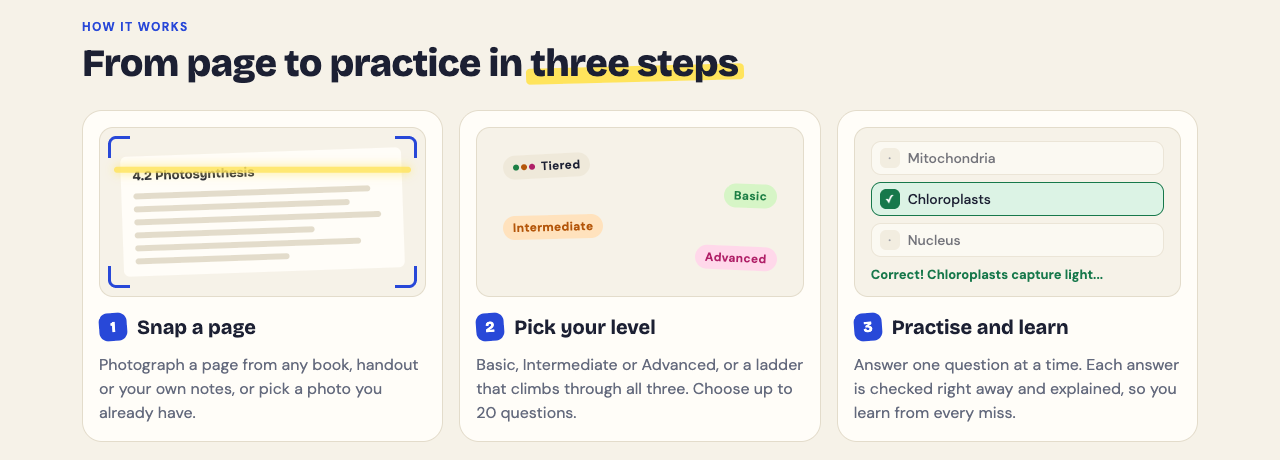
A worked example: you photograph your notes on periodontal disease. You pick the Tiered level, which climbs from basic to advanced, and choose 15 questions. Tiered splits the questions as evenly as possible across the three levels, so you get five of each. The basic questions cover key terms and definitions. The intermediate ones ask you to explain, compare and connect ideas. The advanced ones ask you to apply and predict in new situations, which is the closest the quiz gets to a case question.
When you finish, the results screen shows your score for each level and lists the questions you missed under Look at these again, with your answer and the right answer. If you score well on basic and poorly on advanced, you know the facts but not yet their use. That tells you what to study next. Then close the book and write out the missed topics from memory.
One caution: the questions are written by an AI model and can contain mistakes. Use the explanation to help you check the answer against your textbook. If a question looks wrong, use Report a problem with this question. A quiz also cannot teach you hands-on skills, so keep those for your lab and clinic time.
Learn instruments, radiography and clinical procedures
Hands-on skills need a different kind of practice. Reading about an instrument is a start, but you also need to name it, know its use and picture the motion.
- Instruments: sort them by purpose. For each one, say what it does, where you use it and why its shape suits that job.
- Radiography: learn the sequence of steps, then the common errors and what each one looks like on an image. Ask yourself what you would change to fix it.
- Procedures: write the steps in order from memory, then compare with your source. Walk through them with a classmate.
Diagrams matter here. Photograph a labeled figure from your book and quiz yourself on it, as in our post on turning a figure into quiz questions.
Protect your sleep and your nerves before test day
Stress and sleep both touch memory, and the research on each has limits. Our posts on stress before an exam, sleeping after studying and cramming set out what is known. For the last few days, a calm routine is simple:
- Review your weak-spot list rather than starting new material the night before.
- Prepare what you need for exam day, such as ID and directions, in advance.
- Go to bed at a normal hour.
- Eat and drink normally on the morning of the exam.
If your program includes public health content, see how to study for a public health exam.
Frequently asked questions
How long should I study for the dental hygiene board exam?
It depends on how much of the material you already know, so start with the content outline and sort topics into solid, shaky and missing. Then work backward from your exam date and set regular sessions.
What is the best way to memorize tooth anatomy and morphology?
Draw each tooth from memory, label it, then check against your book. Compare neighboring teeth and teeth across the arch so you learn the differences, not just the shapes.
Are practice questions enough to pass a dental hygiene exam?
No. Practice questions show you what you do not know, but you still need to go back and learn it. Use them to find gaps, then fix those gaps with recall and review.
How many hours a day should I study for dental hygiene school exams?
There is no single right number. Focused sessions with a clear goal, spread across the week, are easier to keep up than long unfocused ones. Pick an amount you can repeat every day.
Get started
Try Study Shot: it is free to start. Photograph the page you are studying tonight and get 10 practice questions on it, from basic to advanced.
Comments
No comments yet.
Sign in or make an account to comment.