How to Study for a Genetics Exam: Work Problems, Not Notes
If you are wondering how to study for a genetics exam, the short answer is this: stop rereading your notes and start working problems. Genetics tests rarely ask you to recite a definition. They hand you a cross, a pedigree, or a probability question you have never seen and ask you to reason through it. This guide shows you how to build that skill in a week, and how to turn your textbook pages and your own mistakes into practice you can repeat.
Why genetics exams feel different from other biology tests
Most biology units reward recall. You learn the parts of a cell, the steps of a pathway, the names of structures. Genetics flips that. The facts are few, but each one has to be applied in a new setting under time pressure.
A typical genetics question gives you a phenotype ratio and asks for the parents' genotypes. Or it shows a family tree and asks you to name the mode of inheritance. You cannot look these up in your memory. You have to work them out.
That is why students who "know the material" still lose points. Reading a solved Punnett square feels like understanding; solving one cold is a different skill. The fix is the same one that works for statistics: practice problems first, review second.
Master the vocabulary first: alleles, genotypes, phenotypes, and linkage
Problems go wrong fast when the words are fuzzy. Before you touch a cross, make sure you can say each of these in one sentence without notes:
- Allele: one version of a gene.
- Genotype: the alleles an organism carries, like
Aa. - Phenotype: the trait you can observe.
- Homozygous and heterozygous: two same alleles versus two different ones.
- Dominant, recessive, codominant, incomplete dominance: how alleles show up together.
- Linkage: genes close together on a chromosome that tend to be inherited together, unless crossing over separates them.
- Recombination frequency: the share of offspring with new allele combinations, used to estimate distance between genes.
Test yourself on these for ten minutes a day, so that when a problem says "a heterozygous tall plant," your hand writes Tt without a pause.
Work Punnett squares and probability problems until they are automatic
This is the core of how to study for a genetics exam. Set a goal of doing crosses by hand until the setup takes seconds.
Start with monohybrid crosses. Then move to dihybrid crosses, where you should know the 9:3:3:1 ratio by heart and know where it comes from. Then add sex linkage, where you track the X chromosome separately.
Once squares feel easy, learn to skip them. For larger crosses, use the product rule. For example, in a cross of AaBbCc × AaBbCc, the chance of an aabbcc offspring is 1/4 × 1/4 × 1/4 = 1/64. Drawing a 64 box square for that wastes your exam time. Multiply instead.
Use the sum rule when an outcome can happen in more than one way. The chance of a heterozygote from Aa × Aa is 1/4 (A from mom, a from dad) plus 1/4 (a from mom, A from dad), which is 1/2.
Work five to ten of these a day. Before you look at any worked answer, write your own prediction first. In a large genetics course, students felt that worked examples helped them most, but they gained more on the course test from activities where they predicted before being told. Struggling first feels worse and works better.
Plan before you calculate and check after. In a study of more than 1,800 student answers to genetics problems, experts planned and checked their work more often than students did, and reasoning through each step predicted success. When you get one wrong, write down which step broke.
How to read and solve pedigree problems step by step
Pedigrees look busy, but a checklist helps. The key habit is to rule modes out, not to argue for the one you suspect. In a study of 89 secondary students, beginners argued for the mode they already believed, while more advanced students tested each option against specific families in the tree. Run the checks in this order:
- Look for two unaffected parents with an affected child. If you find one, the trait is recessive.
- Look for two affected parents with an unaffected child. If you find one, the trait is dominant.
- Check the sexes. If mostly males are affected and the trait passes from carrier mothers to sons, suspect X-linked recessive.
- Test X-linked dominant. An affected father passes it to every daughter and no sons.
- Assign genotypes to every person you can, starting with the affected individuals for recessive traits.
- Answer the probability question with the product rule, remembering that an unaffected child of two carriers has a 2/3 chance of being a carrier, not 1/2.
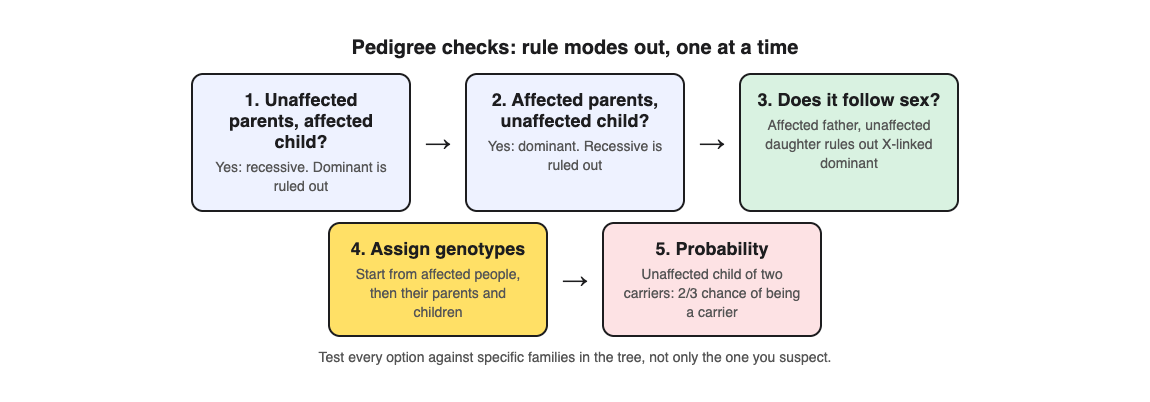
That last point catches many students. Once you know a person is unaffected, the aa option is gone, so only three of the four outcomes remain.
Connect molecular genetics to inheritance patterns with one-page concept maps
Exams often mix the molecular unit (DNA replication, transcription, translation, mutation) with the inheritance unit. Students tend to study them as separate chapters. The questions do not.
Make one page per big idea. For example, put "loss of function mutation" in the middle. Draw arrows to "less working protein," then to "why this is often recessive," then to "why a carrier has a normal phenotype." Now a molecular fact explains an inheritance pattern.
Keep it to one page. The same idea works for other dense courses; see how to organize a microbiology exam by organism.
Keep a mistake log and turn every wrong answer into a practice card
Your mistakes are the most useful study material you have. Keep one page, or a few, where every wrong problem goes. For each entry, write:
- The question, in short.
- What you answered.
- The right answer.
- The step that broke, in one line. For example: "forgot the 2/3 rule for unaffected siblings."
Then quiz yourself on that page with Study Shot, which turns a photo of a page into a multiple-choice practice quiz. Photograph your mistake log or a textbook page on pedigrees, and an AI model writes questions about it, checks your answers and explains each one.
Here is a worked example. Open Study Shot, choose Make a new quiz, then Take photo. Hold your mistake log flat and fill the frame. Pick 10 questions and the Advanced level, described as "Apply and predict in new situations." That pushes the questions toward new scenarios instead of definitions. Press Create questions. It can take up to a minute.
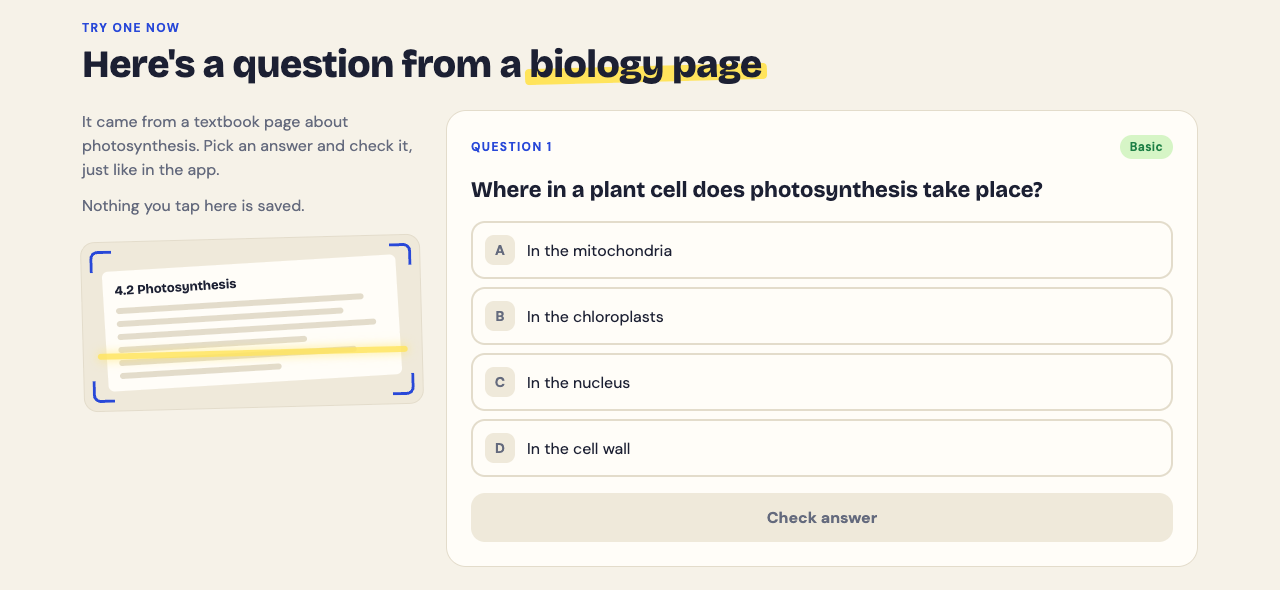
Answer one question at a time. After each one, you see Correct! or Not quite., the right answer, and a short explanation. At the end, the results screen lists missed questions under Look at these again, with your answer next to the right one. Those go straight back into your mistake log.
Two things to keep in mind. First, the questions are multiple choice only, so keep doing your Punnett squares and pedigrees on paper. Use the quiz to check your reasoning and your vocabulary. Second, the questions are written by an AI model and can contain mistakes. Read the explanation to check the logic, and if a question looks wrong, use Report a problem with this question under it.
How to study for a genetics exam in 7 days
- Day 1: Vocabulary and Mendel. Define every key term from memory. Work 10 monohybrid crosses. Photograph your main textbook page and take a Basic quiz to check terms.
- Day 2: Dihybrid crosses and probability. Work 10 problems with the product and sum rules. Start your mistake log.
- Day 3: Sex linkage. Work 8 X-linked problems. Add every miss to the log.
- Day 4: Pedigrees. Run the checklist on 8 to 10 pedigrees. Photograph the pedigree chapter and take a Tiered quiz, which climbs from basic to advanced.
- Day 5: Linkage and molecular links. Work 5 recombination problems. Draw two concept maps.
- Day 6: Mixed practice. Do a timed set of 20 problems from all topics. Then quiz yourself on your mistake log at Advanced.
- Day 7: Review. Retake your saved quizzes from your library. Redo only the problems in your mistake log. Sleep.
Your quizzes stay in your library with the page photo and your best score, so on day 7 you can tap Retake quiz instead of starting over. Aim to move each one toward the Mastered grade, which means 90% or higher.
Frequently asked questions
How many practice problems should I do before a genetics exam?
Aim for 50 to 80 problems across the week, spread over every topic on the syllabus. The number matters less than redoing the ones you got wrong until you can solve them cold.
What is the fastest way to solve pedigree questions?
Look first for two unaffected parents with an affected child (recessive) or two affected parents with an unaffected child (dominant). Then check whether the pattern follows sex, which points to X linkage.
Should I study worked examples or try problems first?
Try first. In one large genetics course, students learned more from predicting before being told than from worked examples, even though worked examples felt more helpful.
How do I study for genetics if I am bad at math and probability?
Most genetics math is just fractions and two rules: multiply for "and," add for "or." Practice those two rules on simple crosses daily until they feel routine, and the harder problems become a series of small steps.
Get started
Try Study Shot: it is free to start. Photograph the page you are studying tonight and get 10 practice questions on it, from basic to advanced.
Comments
No comments yet.
Sign in or make an account to comment.