How to Study for a Geography Test From Your Notes
If you want to know how to study for a geography test from your notes, start with one idea: your notes are raw material, not the study session itself. Reading them over feels like work, but it rarely shows you what you can actually recall when the paper is in front of you. This guide shows you how to sort your notes, turn them into map drills and quick questions, practise case studies, and spread your review over the days before the test.
Why rereading your geography notes is not enough
Rereading builds familiarity. You see "Lagos" and think, yes, I know that. But a test asks you to name it, place it, explain it, or use it.
Geography makes this gap worse because it mixes several kinds of knowledge:
- Where things are (countries, rivers, plate boundaries, cities).
- What words mean (erosion, urbanisation, migration push factors).
- How things happen (the water cycle, how a meander forms).
- Real examples with facts and figures (a named earthquake, a named city).
Each one needs a different kind of practice. Rereading treats them all the same. The fix is to make yourself answer questions, then check what you got wrong. That is called retrieval practice, and it is the core of everything below.
Sort your notes into places, terms, processes, and case studies
Before you test yourself, take 15 minutes to sort. Go through your notes with four colours of highlighter, or four columns on a sheet of paper:
- Places: anything you need to locate on a map.
- Terms: words with a definition you need to know.
- Processes: anything with steps, causes, or a sequence.
- Case studies: named examples with specific facts.
Here is a worked example. Say your notes on a volcanoes unit include this line: "Mount Etna, Sicily, sits near the boundary where the African plate moves toward the Eurasian plate. Lava flows, ash, tourism and fertile soil."
Split it like this:
- Places: Sicily, Mount Etna.
- Terms: plate boundary, lava flow.
- Processes: how plates moving toward each other create volcanic activity.
- Case study: Etna, with its effects and why people live near it.
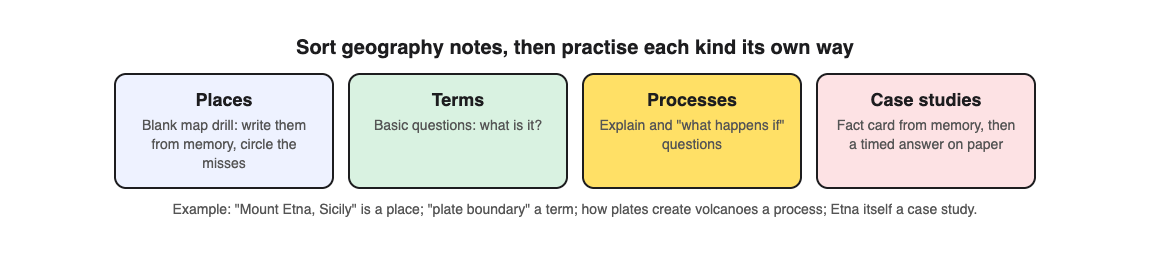
Now you know what kind of practice each piece needs. You also spot gaps. If your notes say "fertile soil" but not why the soil is fertile, you have found something to look up before test day.
Turn your notes into map drills you can test yourself on
Map questions are pure recall: either you can point to it or you cannot. Testing works for maps, not just words. In a 2007 study, people learned one map by studying it and another by seeing it with one feature missing, such as a road or a river, and trying to recall it. Their drawings half an hour later were better for the map they had been tested on.
- Blank map drill: print or trace a blank outline map. Write every place from your "places" list from memory. Then check against your notes and circle the misses.
- Reverse drill: put dots on the blank map and label them from memory. This is closer to how many tests ask the question.
- Cluster by region: do not drill 40 places at once. Drill eight to ten from one region, then move on.
Keep your missed places on a separate list; that list is your next session.
Say the place and one fact out loud as you write it: "Nile, flows north into the Mediterranean."
Make quick questions from key terms and processes
For terms and processes, turn each note into a question. A note that says "Infiltration: water soaking into the ground" becomes "What is the name for water soaking into the ground?" A note on meanders becomes "Why does a river erode faster on the outside of a bend?"
Write questions at different depths:
- Basic: what is it? (Define infiltration.)
- Middle: how does it connect? (How does infiltration affect flood risk?)
- Harder: what would happen if? (A town paves over a field. What happens to infiltration and to the river nearby?)
That last type is where many students lose marks: they can define the term but cannot apply it. Quizzing helps here too. In a study in a sixth grade social studies class, short multiple-choice quizzes on course material raised scores on the real chapter and semester exams, including short-answer tests.
Let your notes write the questions for you
Writing good questions by hand takes time. Study Shot does this step from a photo. You take a photo of a page of your notes, a textbook page, or a whiteboard, and an AI model writes multiple-choice questions about it. Each question has four choices and one right answer. It checks your answer straight away and explains it.
Here is how that looks with the volcano page from above:
- Open Study Shot in your phone or computer browser and choose Make a new quiz, then Take photo or Choose photo. Hold the page flat and fill the frame.
- Choose how many questions: 5, 10, 15 or 20. Ten is the default.
- Choose a level. Basic covers key terms, facts and definitions. Intermediate asks you to explain, compare and connect ideas. Advanced asks you to apply and predict in new situations. Tiered, the default, is a ladder that starts basic and climbs to advanced.
- Press Create questions. It can take up to a minute.
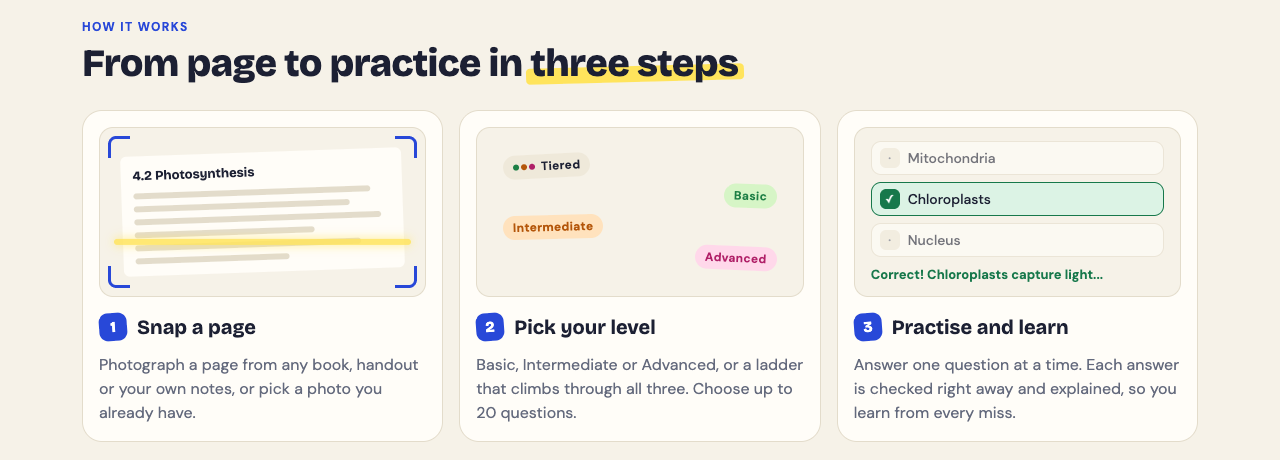
Notice how the levels line up with the three depths above. A Tiered quiz on your rivers notes gives you definitions first, then connections, then "what happens if" questions. When you finish, the results screen shows your score for each level. If you got every Basic question right but missed most Advanced ones, you know your problem is applying ideas, not remembering words.
The quiz also lists missed questions under Look at these again, with your answer next to the right one. That list does the same job as your circled misses on the blank map.
One honest caution: the questions are written by an AI model and can contain mistakes. Read each explanation and compare it with your notes. If a question looks wrong, use Report a problem with this question under it.
Practice case studies and data questions out loud or on paper
Case studies are where long answers come from, and multiple choice alone will not prepare you for those. Use quizzes to lock in the facts, then practise the writing.
For each case study, build a short fact card from memory:
- Where and when.
- Causes.
- Effects on people, the economy, and the environment.
- Responses, short term and long term.
- Two or three specific numbers or names.
Then cover the card and answer a past exam style question out loud, as if you were explaining it to a friend. Set a timer for three minutes. If you stall, that is the bit to review.
For data questions (climate graphs, population pyramids, choropleth maps), practise the routine, not just the answer. Read the title and axes. State the overall trend. Quote one or two figures. Name an anomaly. Doing this out loud on two or three graphs from your notes makes it automatic.
How to study for a geography test from your notes in 5 days
Short sessions spread over several days work better than one long session the night before; see spaced repetition for exams. Here is a plan for a test five days away:
- Day 1: sort your notes. Photograph each page of notes and make a Tiered quiz for each topic.
- Day 2: blank map drill. Take each quiz once. Write down every missed question.
- Day 3: case study fact cards from memory. Retake only the quizzes where you scored lowest.
- Day 4: timed case study answers out loud. Map drill on your missed places only.
- Day 5: one short retake of each quiz. Look at your "missed" lists. Stop early and sleep.
Study Shot saves every quiz in your library with its page photo and your best score, so the quizzes you made on Day 1 are still there to retake on Day 3 and Day 5. A topic at Mastered (90% and up) can wait; a topic at Getting there (50% and up) gets your next session.
If you study with classmates, you can use Share this quiz to send a link. They need a Study Shot account, and they get their own copy of the questions without your photo. You can stop sharing at any time.
Frequently asked questions
How long before a geography test should I start studying?
Start about five days before if you can. That gives you room for short, spaced sessions, which help you remember more than one long session the night before.
What is the fastest way to memorize countries and capitals?
Drill one region at a time on a blank map, eight to ten places per round, and say one fact out loud for each. Keep a list of the ones you miss and drill only those next time.
How do I study geography case studies from my notes?
Make a fact card from memory covering where, causes, effects, responses and a few specific figures. Then answer an exam style question out loud on a timer and review whatever made you stall.
Can I make practice questions from my class notes automatically?
Yes. Study Shot writes multiple-choice questions from a photo of your notes, up to 20 per quiz, from basic to advanced, and explains each answer. The questions come from an AI model, so check the explanations against your notes and report any question that looks wrong.
Get started
Try Study Shot: it is free to start. Photograph the page you are studying tonight and get 10 practice questions on it, from basic to advanced.
Comments
No comments yet.
Sign in or make an account to comment.