How to Study for a Law Exam: Rules, Cases, IRAC Answers
If you are searching for how to study for a law exam, start with this: most law exams do not ask you to recite your notes. A typical question gives you a long, messy fact pattern and limited time to find the legal problems in it, state the rules, and apply them. This guide shows you how to build an outline, drill rules until you can recall them cold, learn cases for what they decide, and practise writing IRAC answers against the clock.
Why law exams test application, not memorized notes
Many law school exams are issue-spotting essays. The fact pattern hides several legal questions, and you need to find them, state the correct rule, and walk through how the facts satisfy or fail each element.
Knowing the rules still matters. You cannot apply a rule you half remember. But memory is only the entry ticket. You score points by spotting issues and analysing them, which is why you need two kinds of practice:
- Recall practice so the rules and elements come to mind without effort.
- Application practice so you can use those rules on facts you have never seen.
Rereading notes makes the material look familiar, and that feels like being ready. In a classic study, rereading raised students' confidence, but students who tested themselves remembered far more two days and a week later.
Build a working outline from your course materials
An outline is a condensed map of the course, organised the way you will use it on the exam. Build it from your class notes, the syllabus, and your case briefs.
- Follow the syllabus structure. Your professor's topic order usually reflects how they think about the subject.
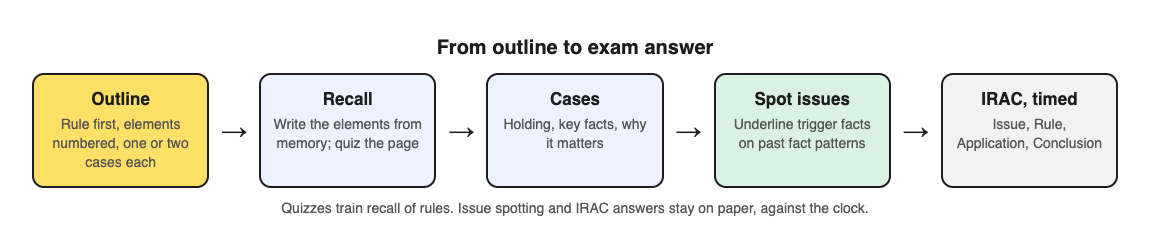
- Lead with the rule. Under each topic, write the rule first, then its elements as a numbered list.
- Add one or two cases per rule. Note the holding and the facts that drove it. Skip the procedural history.
- Note exceptions and defences. They are easy to forget under time pressure.
- Mark your professor's emphasis. If they spent a full class on a doctrine, flag it.
Keep each topic short enough to fit on one page. A 120-page outline is a textbook, not a tool. Many students write a short "attack outline" on top of the full one: a checklist of issues in the order you would look for them on an exam.
Turn rules and elements into quiz questions you can recall cold
Once a topic is outlined, test yourself on it. Cover the page and try to write the elements from memory. If you miss one, that is the one to drill.
A faster way to get quiz questions is to photograph an outline page and let Study Shot write them. It turns a photo of a page into multiple-choice questions, checks each answer, and explains it. Here is a worked example with a page on the elements of negligence (in most jurisdictions: duty, breach, causation and damages):
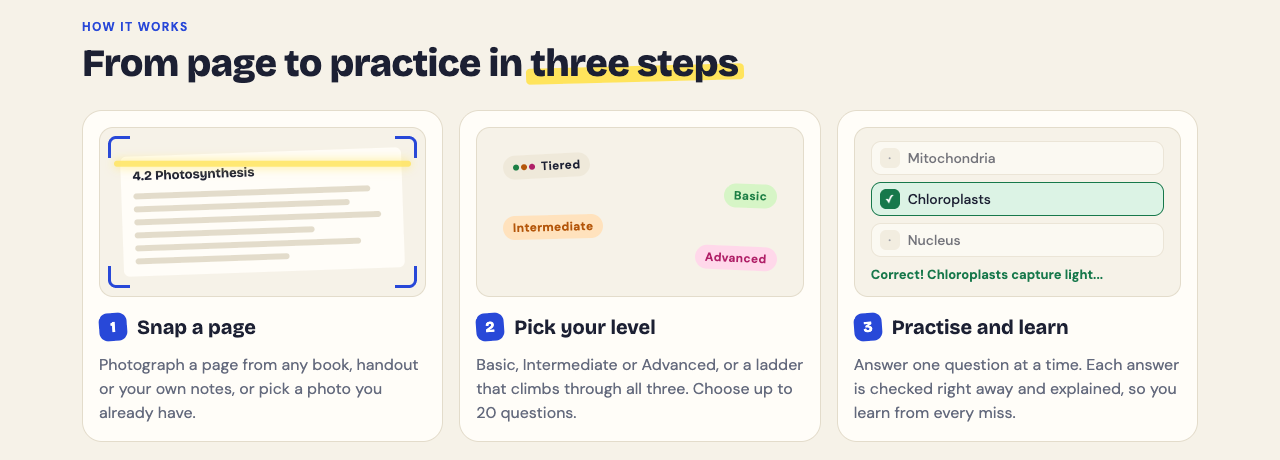
- Open Study Shot in your phone or computer browser and tap Make a new quiz, then Take photo. Hold the page flat and fill the frame.
- Pick 10 questions (you can choose 5, 10, 15 or 20).
- Pick a level. Basic targets key terms, facts and definitions, which is right for "What are the four elements of negligence?" Intermediate asks you to explain, compare and connect ideas, such as how actual cause differs from proximate cause. Advanced asks you to apply and predict in new situations, which is closest to exam thinking.
- Tap Create questions. It can take up to a minute.
The default level, Tiered, is a ladder. It splits your questions as evenly as possible across basic, intermediate and advanced, in that order. That mirrors how you want to learn a doctrine: definitions first, then distinctions, then application.
After each answer you see whether you were right, the correct answer, and a short explanation. At the end, the results screen shows your score for each level and a Look at these again list of the questions you missed. If your basic score is high but your advanced score is low, you know the rule but cannot yet use it. Spend your next session on hypotheticals.
Two honest caveats. First, the questions are multiple choice, so they train recall and recognition, not essay writing. Second, an AI model writes them, and it can make mistakes. Rules also vary by course and jurisdiction, so your casebook and professor have the last word. If a question is wrong, use Report a problem with this question under it.
Learn cases for their holdings and key facts, not their stories
In most courses you do not need to cite case names on the exam. You need what the case stands for. For each case, keep three things:
- The holding: the rule the court applied or created.
- The key facts: the two or three facts that made the outcome go one way.
- Why it matters: what it adds to the rule, such as a limit, an exception, or a test.
Write those three lines for every case. If you can explain why changing one fact would change the result, you understand the case well enough to use it. Photograph a page of these three-line summaries and run an Intermediate quiz. That level focuses on comparing and connecting ideas, which is how cases relate to each other.
Practice issue spotting on hypotheticals and past exams
Practise issue spotting on real fact patterns, ideally your professor's past exams. Practice carries over best to application questions like these, according to a review of 122 experiments.
- Read the fact pattern once without writing.
- Read it again and underline every fact that could trigger a rule. Dates, ages, money amounts, relationships, and statements of intent are common triggers.
- In the margin, label each underlined fact with the issue it raises.
- Compare your list with a model answer or your attack outline. Note every issue you missed.
Our guide on how to quiz yourself with a past exam paper covers marking and logging in more detail. Keep a running list of missed issues. After a few practice exams, patterns appear. Maybe you always miss defences, or you forget to discuss damages. Add those to your attack outline as reminders.
Write IRAC answers under timed conditions
IRAC stands for Issue, Rule, Application, Conclusion. It is a common structure for legal analysis on hypothetical questions.
- Issue: one sentence naming the legal question. "The issue is whether Dana owed Sam a duty of care."
- Rule: state the rule and list its elements.
- Application: take each element in turn and tie it to specific facts. Argue both sides where the facts are close.
- Conclusion: say which way it likely comes out. A brief conclusion is fine.
Watch for a long rule section and a thin application. Use the word "because" often. "Dana breached her duty because she ran a red light" is application. "Breach occurs when a person fails to act reasonably" is only a rule.
Practise under the real time limit. If your exam gives you three hours for three questions, give yourself one hour per question and stop when the timer ends. Then grade your answer against a model answer and count how many issues you reached. Speed comes from repetition.
How to study for a law exam: a two-week plan
Here is a plan for the final two weeks. Adjust it if you have several exams close together.
Days 1 to 4: finish and condense
- Finish your full outline for every topic.
- Write your attack outline.
- Run one Basic quiz per outline section to find the rules you cannot yet recall.
Days 5 to 9: recall plus application
- Each morning, retake a saved quiz from your library on a weak topic. Your library keeps each quiz with its page photo and your best score.
- Each afternoon, do one timed practice question and grade it.
- Switch topic quizzes to Advanced once your Basic scores are at Mastered (90% and up).
Days 10 to 13: full practice exams
- Sit at least two full past exams under real timing.
- After each, update your missed-issues list and add reminders to your attack outline.
- If you study with a group, use Share this quiz to send a link. Each person needs a Study Shot account and gets their own copy of the questions, without your photo.
Day 14: light review
- Read your attack outline twice.
- Retake the quiz with your lowest best score, then stop and get some sleep.
Frequently asked questions
How many hours should I study for a law exam?
There is no fixed number. Measure readiness instead: can you recall every rule's elements without notes, and can you finish a past exam in the time allowed with most issues spotted?
Should I make my own outline or use a commercial one?
Your own outline follows your professor's emphasis, and building it makes you work through the material. A commercial outline can help you check a rule you find unclear.
How do I study for an open-book law exam?
Prepare as if it were closed book. You will not have time to look up rules for every issue, so use your notes only to confirm details. A tabbed attack outline is the most useful thing to bring.
How do I memorize the elements of every rule?
Practise retrieving them rather than rereading. Cover your outline and write the elements from memory, or photograph the page and take a short Basic quiz on it, then retake it a few days later until you score Mastered.
Pick the outline section you feel least sure about. Photograph it, choose Tiered, and see where your score drops between basic and advanced. That tells you whether you need to learn the rule or practise using it.
Get started
Try Study Shot: it is free to start. Photograph the page you are studying tonight and get 10 practice questions on it, from basic to advanced.
Comments
No comments yet.
Sign in or make an account to comment.