How to Study for a Linguistics Exam: Trees, Transcription, Data
If you are wondering how to study for a linguistics exam, start with this: recall is only part of it. You may be handed words from a language you have never seen and asked to find the rule, asked to draw a tree for a new sentence, or asked to transcribe a word you have only ever spelled. This guide breaks the work into the parts of a typical intro or intermediate course and shows you how to drill each one, plus a 7-day plan you can follow this week.
How to study for a linguistics exam: what it tests
Most linguistics exams mix three kinds of question:
- Recall. What is a minimal pair? What does "bound morpheme" mean? Name the place of articulation for [k].
- Application. Transcribe these words. Gloss this word. Draw a tree for this sentence.
- Analysis. Here is a data set. Are [s] and [ʃ] separate phonemes or allophones? State the rule.
Definitions feel safe to study because you can read them and nod. But knowing what complementary distribution means is not the same as spotting it in twelve lines of data under time pressure. So make sure the terms are solid, then spend most of your time doing problems. Practice tests carry over best to exactly this kind of question: a review of 122 experiments found transfer was greatest to application and inference questions.
The terms still matter, because every analysis question uses them. If you hesitate over "allophone" versus "allomorph," you waste minutes. Get the vocabulary automatic first, so your head is free for the puzzle.
Phonetics and phonology: drill IPA transcription and rule-writing until it's automatic
Phonetics is a skill, like reading music, and our music theory exam guide uses the same approach: short daily practice rather than one long session.
Learn the chart by its logic, not as a grid of symbols
Consonants are sorted by three features: voicing, place and manner. Say [p] and [b] with your hand on your throat. Same place, same manner, one buzzes. Once you see the chart as a system, you can rebuild most of it from those three questions instead of memorising every cell.
Transcribe every day
- Pick ten words a day from whatever you are reading.
- Transcribe them broadly first, then narrowly if your course expects it.
- Check against your course's conventions. Dictionaries and lecturers do not always agree, and your lecturer marks the exam.
Write rules in the format your course uses
Phonology questions often end with "state the rule." Practise writing it in full, for example: in English, a voiceless stop is aspirated at the start of a word or a stressed syllable. Then write it in the notation your course uses. Do both every time: the plain version shows you understand it, and the formal version is what your course asks for.
Morphology: work through data sets and gloss real words
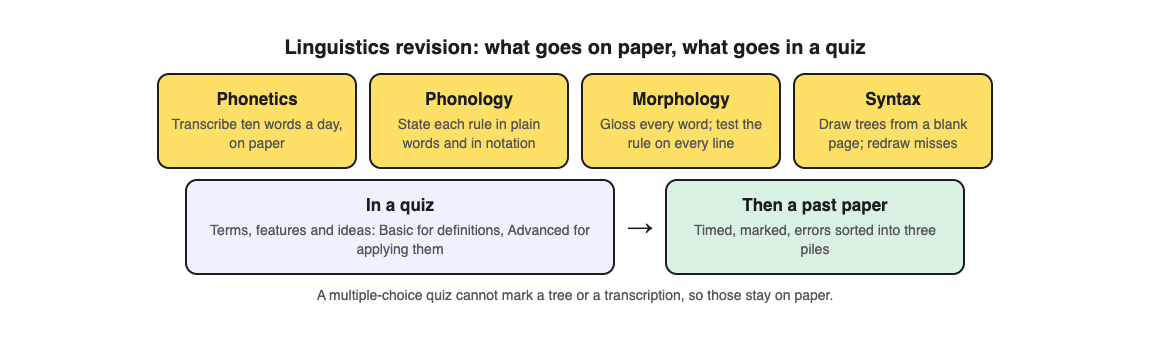
Morphology problems give you a list of words and translations and ask you to find the pieces. The method is the same every time:
- Find two words whose meanings differ by one thing (singular and plural, say).
- Line them up and find the part of the form that changes.
- Test your guess on every other line of data.
- Write a gloss for each word, morpheme by morpheme.
Glossing is where small errors pile up. Practise the line format: the word split by hyphens, the morpheme labels underneath, a free translation in quotes. Do it on English first. Gloss "unhappiness," "rewritten," "children." Then move to the data sets in your problem sheets.
The habit to build is step 3. It is easy to find a pattern in three lines and never check the other nine.
Syntax: draw trees from memory, then check them against your notes
Reading finished trees in your notes feels like study, but drawing them is the skill the exam tests. In a classic study, rereading raised students' confidence, while testing themselves gave far better recall two days and a week later.
- Start from a blank page. Write the sentence, then draw the tree without looking at your notes.
- Run constituency tests out loud. Can you replace the phrase with a pronoun? Move it to the front? Answer a question with it? Each test you pass tells you where a node goes.
- Check, then redraw. Compare with the model answer. If you were wrong, cover it and draw the whole tree again. Do not just fix the one branch.
- Collect hard sentences. Practise ambiguous ones like "I saw the man with the telescope" and draw both readings.
Use the same framework your lecturer uses. Trees look different from one theory to another, and the exam will mark you on the one taught in class.
Semantics and pragmatics: turn definitions into examples you can explain
This part of the course is full of terms that sound alike: entailment, presupposition, implicature. The test of whether you know one is simple. Can you make up your own example and say why it fits?
Try this for each term:
- Write the definition in one sentence.
- Write one example that fits.
- Write one near miss that does not fit, and say why.
For instance, "Some of the students passed" suggests that not all of them did. That is an implicature, because you can cancel it: "Some passed. In fact, all of them did." An entailment cannot be cancelled that way. The near miss shows you where the line between two ideas falls.
Practice with past papers and data problems under timed conditions
Once each topic feels steady, switch to full papers. Set a timer for the real exam length and do the paper without notes. Mark it honestly. Then sort every lost mark into one of three piles: did not know the term, knew it but misapplied it, or ran out of time. Each pile needs a different fix. Our step-by-step guide to quizzing yourself with a past exam paper walks through the whole routine.
Where a photo quiz fits
You can use Study Shot for the recall layer and part of the application layer. Here is how it works. You take a photo of a page of your notes, a textbook page or a whiteboard, and an AI model writes multiple-choice questions about it. Each question has four options and one right answer. After you press Check answer, you see whether you were right, the correct answer, and a short explanation.
A worked example. Say you have a page of notes on English plural endings, covering [s], [z] and [ɪz] and when each appears.
- Tap Make a new quiz, then Take photo. Hold the page flat and fill the frame.
- Choose 15 questions.
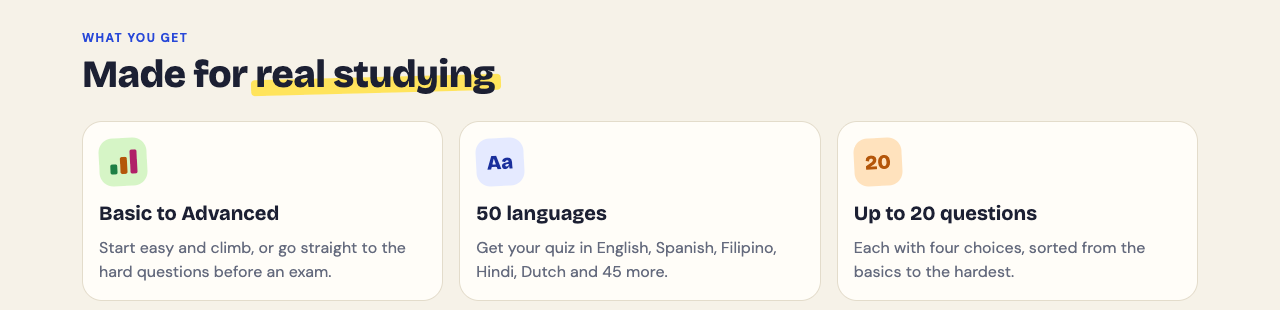
- Choose the level. Tiered is the default: it starts with basic questions, then intermediate, then advanced, split as evenly as it can. Basic covers key terms and definitions. Intermediate asks you to explain, compare and connect ideas. Advanced asks you to apply and predict in new situations, which is close to what a data problem asks you to do.
- Tap Create questions. It can take up to a minute.
When you finish, the results screen shows your score for each level. If you got every basic question right but half the advanced ones wrong, you know the terms and need more practice applying them. The Look at these again list shows each missed question with your answer and the right one. The quiz is saved to your library with your best score, so you can retake it on day 6 of the plan below.
Be clear about the limits. Multiple choice cannot ask you to draw a tree or write out a full transcription, so keep doing those by hand. And the questions are written by an AI model, so they can contain mistakes. Read the explanation for each one. If one looks wrong, check it against your notes and use Report a problem with this question.
A 7-day linguistics exam study plan
- Day 1: Terms. List every key term from the course. Make a quiz from your glossary pages on the Basic level. Note the ones you miss.
- Day 2: Phonetics. Rebuild the consonant chart from voicing, place and manner. Transcribe 20 words. Check them against your course's conventions.
- Day 3: Phonology. Do three data problems. State each rule in plain words and in formal notation.
- Day 4: Morphology. Do three data sets. Gloss every word. Test each rule against every line.
- Day 5: Syntax. Draw ten trees from a blank page, including two ambiguous sentences. Redraw any you got wrong.
- Day 6: Semantics, pragmatics and review. Write a definition, an example and a near miss for each term. Retake your earlier quizzes and focus on the missed questions.
- Day 7: Full paper. One timed past paper. Mark it, sort your errors into the three piles, and spend the evening on the biggest pile.
Frequently asked questions
How long should I study for a linguistics exam?
It depends on your course and how much is new to you. Daily sessions suit transcription and tree drawing, and the plan above ends with a timed past paper.
How do I memorize the IPA chart quickly?
Learn it as a system of voicing, place and manner, and say each sound aloud while you feel where it is made. Then transcribe ten real words a day so the symbols stick through use, not rereading.
What's the best way to practice syntax trees?
Draw them from a blank page without notes, use constituency tests to decide each node, then check the model answer. If you got it wrong, cover the answer and redraw the whole tree.
Pick the page of notes you trust least, photograph it, and see which level trips you up.
Get started
Try Study Shot: it is free to start. Photograph the page you are studying tonight and get 10 practice questions on it, from basic to advanced.
Comments
No comments yet.
Sign in or make an account to comment.