How to Study for a Marketing Exam: Frameworks, Cases, Calcs
If you are working out how to study for a marketing exam, start with this: most marketing questions ask you to pick a framework, apply it to a business, and back your answer with a number or a clear recommendation. A memorized list is only the first step. This guide shows you how to build the rest in a week, with recall drills, one worked example per framework, case practice and the core marketing math.
How to study for a marketing exam: know what it will ask
Marketing exams usually mix four types of question. Find out the balance before you plan anything.
- Definitions. Short questions like "Define market segmentation."
- Frameworks. "Explain the 4Ps" or "Outline Porter's Five Forces." You need the parts, in order, and what each one means.
- Cases. A scenario about a business, followed by "Recommend a strategy" or "Analyse the situation."
- Calculations. Break-even, contribution margin, market share, customer lifetime value and ROI.
Check the course outline and at least one past paper. If cases are worth half the paper, spend half your time on cases.
Turn core frameworks (4Ps, STP, SWOT, PESTLE, Porter's Five Forces) into recall cards
You cannot apply a framework you cannot remember under pressure. So the first job is fast, reliable recall. Make one card per framework with three things on it:
- The name and every part, in order. For example, PESTLE: Political, Economic, Social, Technological, Legal, Environmental.
- A one-line meaning for each part, in your own words.
- When you would use it. SWOT for a company's position. PESTLE for the outside environment. Five Forces for how attractive an industry is. STP (segmentation, targeting, positioning) for choosing who to sell to. The 4Ps (product, price, place, promotion) for the plan itself.
That third line matters most. A case question often describes a problem and leaves the choice of tool to you.
Test yourself by covering the card and writing it out from memory. Anything you miss goes in a pile you review again the next day. Writing from memory does more than reading the card again: in a classic study, students who took recall tests remembered more after two days and after a week than students who restudied.
Learn each framework with one worked example you can reuse
Application is where the marks are, so have one example ready for each framework before the exam. Here is the marketing mix applied to a made-up campus coffee shop:
- Product: coffee and quick breakfasts for students between classes.
- Price: below the chain café across the road, with a loyalty card.
- Place: a kiosk by the library, plus ordering ahead from a phone.
- Promotion: flyers at freshers' week and a discount during exam season.
Now do the same for SWOT, STP and Five Forces, with this shop or a brand your course uses. If you use a real company, keep to facts from your course materials. A wrong fact costs you more than a missing one.
Practice case study questions: read the scenario, pick the framework, recommend a plan
Case questions follow a pattern. Train the pattern, not the specific case.
- Read the question first, then the scenario. You need to know what you are looking for before you read.
- Underline the problem. Falling sales? A new market? A new competitor? Rising costs?
- Pick one or two frameworks that match the problem. A new competitor points to Five Forces. Entering a new country points to PESTLE.
- Apply them using facts from the case, not general theory. Quote numbers from the scenario where you can.
- Recommend. End with a clear action, a reason, and a risk. "Launch a lower-priced range for students because the case shows price is the main barrier. The risk is diluting the premium brand."
The same method works in other essay-heavy subjects; how to study for a criminology exam uses theory, applied to a case, ending in a judgement.
Drill the marketing math: break-even, contribution margin, market share, CLV, and ROI
Calculation questions follow set formulas, so they reward practice. Learn each one and work an example on paper until you can do it without notes.
Contribution margin and break-even
A product sells for 25 per unit. Variable cost is 15 per unit. Fixed costs are 50,000.
- Contribution margin per unit = price minus variable cost = 25 minus 15 = 10.
- Contribution margin ratio = 10 divided by 25 = 40%.
- Break-even units = fixed costs divided by contribution per unit = 50,000 divided by 10 = 5,000 units.
Market share
Your company sells 3 million in a market worth 20 million. Market share = 3 divided by 20 = 15%.
Customer lifetime value
A simple version: average order value times orders per year times years as a customer. A customer spends 40 per order, orders 6 times a year, and stays 3 years: 40 times 6 times 3 = 720 in revenue. If your course uses margin, multiply by it. At a 30% margin, CLV is 216. Check which version your course teaches.
Marketing ROI
A campaign costs 8,000 and brings in 12,000 of gross profit. ROI = (12,000 minus 8,000) divided by 8,000 = 50%.
Always write the formula, then the numbers, then the answer with units. If your course gives method marks, this is how you earn them.
Write short and long answers that apply the theory instead of just listing it
Listing is not applying. "SWOT stands for strengths, weaknesses, opportunities and threats" shows you know the name; using it on the case shows you can apply it.
Use a simple rule for every point: state, apply, explain.
- State: "A threat is a new low-cost competitor."
- Apply: "In the case, a discount chain opened two stores nearby."
- Explain: "This matters because the case says 60% of customers are price-sensitive, so sales could fall."
For short answers, one or two of those blocks is enough. For long answers, use three or four, then finish with a recommendation. Read your answer back and ask: could this paragraph be about any company? If yes, add a detail from the case.
Build a 7-day study plan and test yourself with past papers
Here is a plan you can follow if your exam is a week away.
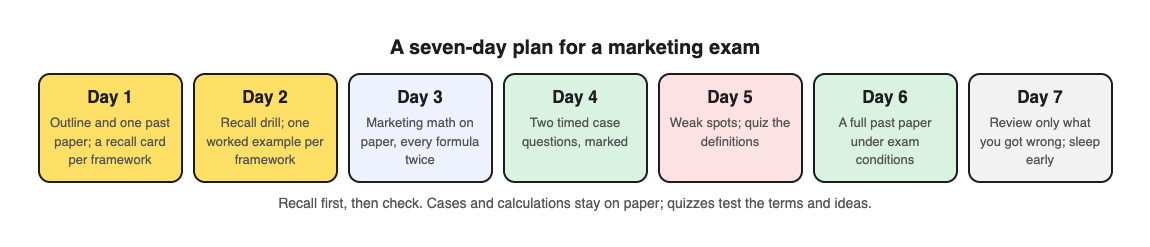
- Day 1: Read the course outline and one past paper. Make recall cards for every framework.
- Day 2: Recall drill on all frameworks. Write one brand example for each.
- Day 3: Marketing math. Do every formula from scratch, twice.
- Day 4: Two case questions, timed. Mark them against the scheme.
- Day 5: Weak spots from Days 2 to 4. Quiz yourself on definitions.
- Day 6: A full past paper under exam conditions.
- Day 7: Review only what you got wrong. Light recall drill. Sleep early.
For Day 6, follow the steps in how to quiz yourself with a past exam paper. The key is to mark honestly and keep a list of what cost you marks.
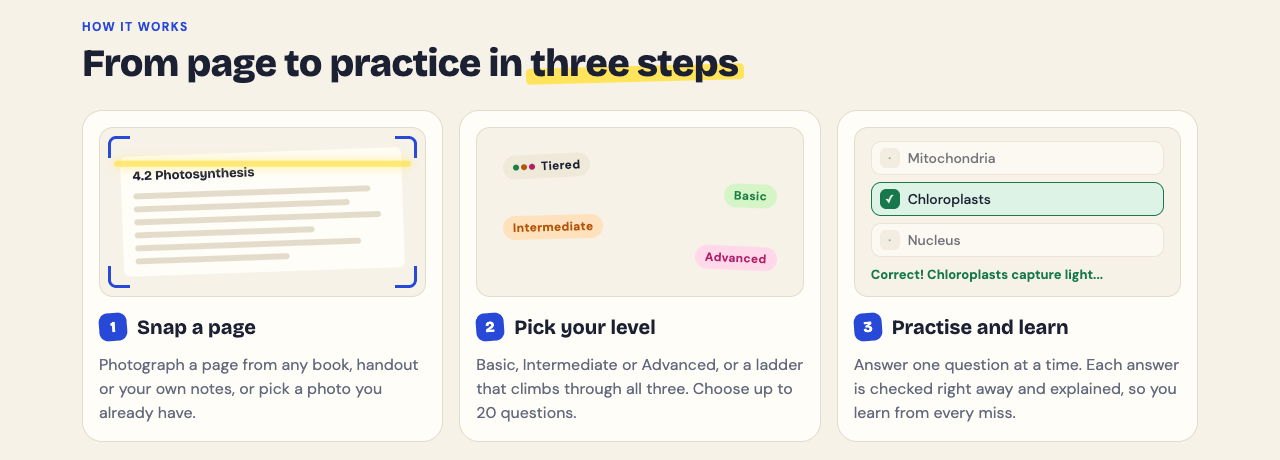
You can also turn your own notes into practice questions. With Study Shot, you photograph a page and it writes multiple-choice questions about it. Practice tests carry over best to application questions, according to a review of 122 experiments, which suits a subject built on applying frameworks. A useful workflow:
- Photograph your notes page on Porter's Five Forces. Hold the page flat and fill the frame.
- Choose 15 questions and the Tiered level. Tiered splits the questions as evenly as possible across basic, intermediate and advanced, in that order.
- Press Create questions, then answer one question at a time. Each answer is checked right away with a short explanation.
- On the results screen, look at the score for each level. If you did well on Basic but poorly on Advanced, you know the names but not how to apply them. That is your Day 5 focus.
- Read the Look at these again list of missed questions, then retake the quiz from your library the next day.
The Advanced level is described as "Apply and predict in new situations," which suits case-style thinking; Basic covers key terms and definitions. A quiz cannot mark a written case answer or your working on a calculation, so those stay on paper. Questions are written by an AI model and can contain mistakes, so use the explanation to check your reasoning against your notes, and use Report a problem with this question if one looks wrong. You can share a quiz by link with your study group, and each person gets their own copy.
Frequently asked questions
How long should I study for a marketing exam?
If you have kept up with classes, a focused week like the plan above is a reasonable start. Split each day between framework recall, calculations and timed case practice.
What are the most important topics on a marketing exam?
The 4Ps, STP, SWOT, PESTLE and Porter's Five Forces are common in introductory courses, along with break-even and other marketing calculations. Your course outline and past papers show what your exam weights most.
How do I memorize marketing frameworks without just cramming lists?
Learn each framework with when to use it and one brand example you know well. Then test yourself by writing it from memory, and review only the parts you missed.
How do I answer a marketing case study question under time pressure?
Read the question first, underline the problem in the scenario, and pick one or two frameworks that fit. Apply them with facts from the case and finish with a clear recommendation and one risk.
Get started
Try Study Shot: it is free to start. Photograph the page you are studying tonight and get 10 practice questions on it, from basic to advanced.
Comments
No comments yet.
Sign in or make an account to comment.