How to study for a math test with practice problems
A math test marks what you can do with a pencil: set up the problem, pick the right method, and carry it through to an answer. That is why reading your notes, or watching someone else solve examples, rarely prepares you well. If you are wondering how to study for a math test, the short answer is practice problems, mixed and spread out over several days. This guide explains why that works, why it feels worse than it is, and where a quick quiz on the ideas behind the problems fits in.
Why rereading worked examples is not enough
A worked example in your textbook looks easy when you read it, because every step is already there. On the test, nothing is there. You have to decide which method to use, and that decision is often the hard part.
A large review by Dunlosky and colleagues (2013) looked at ten study techniques across many kinds of material, from simple concepts to mathematical problems. Practice testing and spreading practice over several days were rated highly useful. Rereading was rated low. For math, practice testing mostly means solving problems without looking at the solution.
Mix and spread your practice problems
Most homework gives you one kind of problem at a time: twenty area problems, then twenty volume problems. That is called blocked practice. The alternative is to mix kinds in one session (interleaving) and come back to each kind on several days (spacing).
Hartwig, Rohrer and Dedrick (2022) point out that many randomized experiments in real classrooms found math learning improved a lot when problems of one kind were spread across assignments and mixed with other kinds. Yet in their two studies, most of the 193 and 175 university students they asked picked schedules with little spacing or mixing as the most effective. They also rated mixed and spaced schedules as harder and less enjoyable.
So expect mixed practice to feel worse while it works better. It is harder because each problem makes you work out which method applies, which is exactly what the test will ask.
How big is the gain? A meta-analysis of 59 studies by Brunmair and Richter (2019) found a small benefit of mixing for math tasks, and unclear results for reading texts. Mixing is worth doing for problem sets, not as a rule for everything. The interleaving practice guide covers the evidence in more detail.
What a multiple-choice quiz can and cannot do for math
Be clear about the limits first. A multiple-choice quiz cannot check your working. It will not tell you that you dropped a minus sign on line three. For that you need full problems on paper, checked against the answer key.
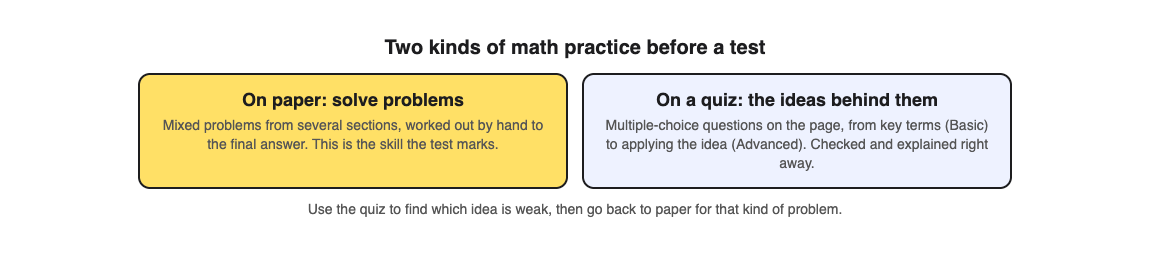
What a quiz can do is test the ideas behind the problems, quickly:
- Terms and definitions. What is a prime factor? What does the gradient of a line measure?
- Connections. How is the area of a triangle related to the area of a rectangle?
- Applying the idea. Given a new situation, which rule or formula applies?
Ten of these take a few minutes and tell you which idea is weak. Then you go back to paper for that kind of problem. The quiz points you at the gap, and the paper practice closes it.
How to study for a math test in four sessions
Say you have a test in a week covering three sections: fractions, percentages and ratio.
- Session 1: find the weak spots. Do a short quiz on each section's ideas. Then solve six problems by hand, two from each section, in mixed order. Mark them against the answer key.
- Session 2, two days later: mixed problems. Solve nine new problems, three per section, shuffled so no two in a row come from the same section. Before each one, write which method you will use.
- Session 3, two days later: the weak kind. Retake the quiz for the section you scored lowest on. Then do extra problems of that kind, still mixed with one or two from the other sections.
- Session 4, the day before: a mini test. A timed, mixed set of problems from all three sections, on paper, with no notes. Check, then fix each mistake by redoing the problem.
How often should you quiz yourself? One study by Sun and colleagues (2026) gave 100 high school students quizzes at three different frequencies for 12 weeks, in math, science and history. The middle schedule did best, and the most frequent quizzing did not add a matching gain. It is one study in one school, but it fits the plan above: regular practice with gaps, not every hour.
Worked example: a quiz on the ratio page
Here is session 1 for the ratio section, using Study Shot, which writes multiple-choice questions from a photo of a page.
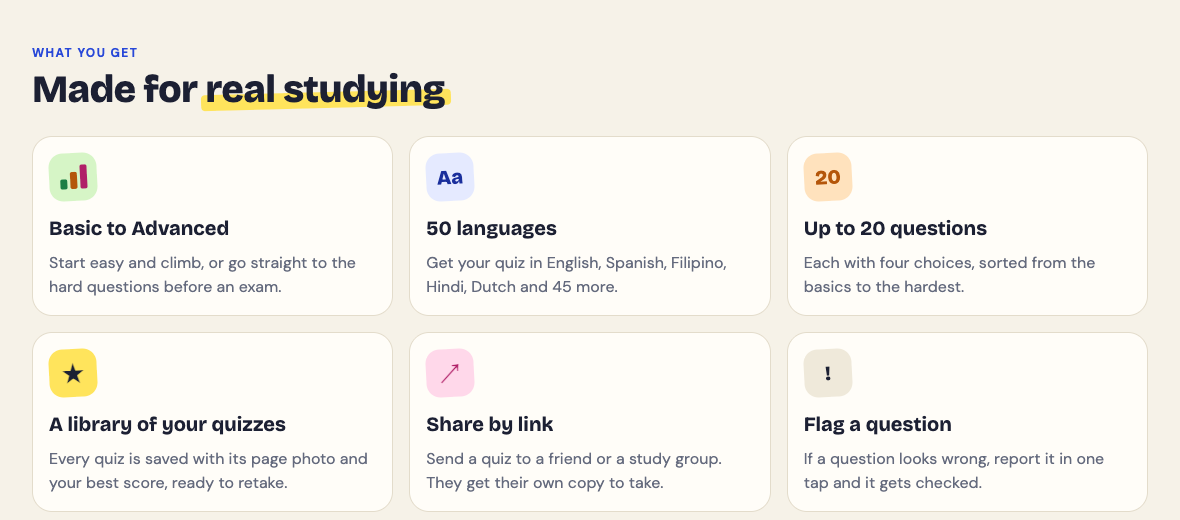
- Photograph the page. Pick the textbook page that introduces ratio, with its definitions and a worked example. Choose 10 questions at the Tiered level, which climbs from Basic (key terms and definitions) through Intermediate (explain and connect ideas) to Advanced (apply the idea in new situations).
- Answer and read every explanation. Each answer is checked right away and explained. Read the explanation even when you were right, to make sure you were right for the right reason.
- Read your level scores. The results give a score for each level. Full marks on Basic but a weak Advanced score means you know what a ratio is but struggle to use one in a new problem. That tells you what kind of paper problems to do next: word problems, not definitions. For more on reading results, see what to study next.
- Retake in session 3. The quiz is saved with the page photo and your best score, so you can retake it later without photographing the page again.
Questions are written by an AI model and can contain mistakes, and in math a single wrong number matters. If a question or its answer looks off, work it out yourself and check it against the worked example in your textbook. If it is wrong, use Report a problem under the question.
Frequently asked questions
What is the best way to study for a math test?
Solve practice problems without looking at the solutions, mix problem types in each session, and spread sessions over several days. Check each problem against the answer key and redo the ones you got wrong.
Why does mixed practice feel harder?
Each problem makes you decide which method to use, instead of repeating the one you just used. Students tend to rate it as harder and less effective, even though classroom experiments found it improves math learning.
Can a multiple-choice quiz replace practice problems?
No. A quiz can check that you understand the terms and which idea applies, but only full problems on paper practise the working a math test marks.
How many days before a math test should I start?
About a week gives you room for three or four sessions with gaps between them. If the test is tomorrow, do one mixed set of problems tonight and fix every mistake.
Get started
Try Study Shot: it is free to start. Photograph the first page your math test covers, take 10 Tiered questions to find the weak idea, then do your paper problems on that idea first.
Comments
No comments yet.
Sign in or make an account to comment.