How to Study for a Microbiology Exam: Organize by Organism
If you are wondering how to study for a microbiology exam, the short answer is this: stop studying by chapter and start studying by organism. Microbiology hands you hundreds of names, stains, toxins, diseases and drugs. They stick far better when each fact has a fixed place to live. This guide shows you how to build that place, fill it, and test yourself on it until recall is fast.
Why microbiology exams feel overwhelming
Many courses teach microbiology in layers. One week covers cell structure, another toxins, another antibiotics, another lab tests. The exam then asks one question that cuts across all four: "A catalase positive, coagulase positive Gram positive coccus causes a rash and low blood pressure. Which toxin?" You learned every piece, but in four different weeks.
The fix is to flip the structure. Make the organism the unit of study. Every fact gets filed under a bug, so a mixed question means pulling one file instead of searching four chapters.
Build one organism chart and fill it as you go
Make one page per organism, with the same headings every time so you always know where to look:
- Classification: Gram stain, shape, oxygen needs.
- Key lab tests: catalase, coagulase, hemolysis, lactose fermentation, special stains.
- Virulence factors: capsule, toxins, enzymes, surface proteins.
- Diseases: what it causes and how it spreads.
- Treatment: the first-line drug and resistance your course teaches.
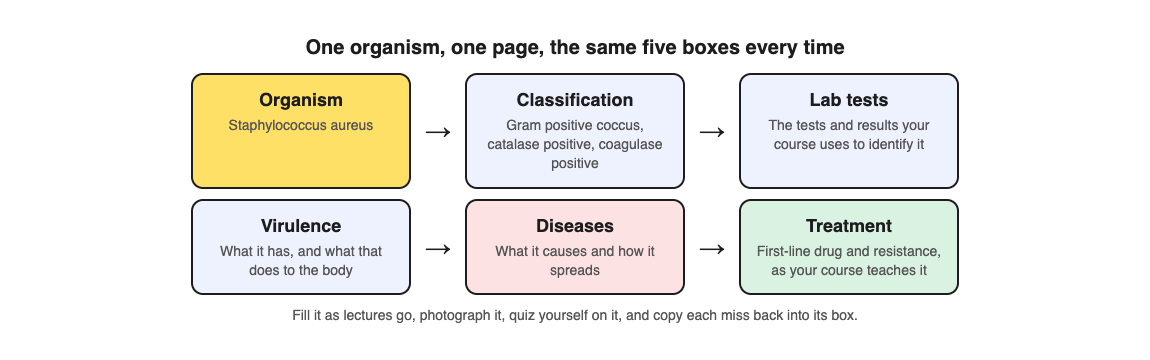
Fill the chart as lectures go, not the night before. Blank boxes in week three are fine. They show you exactly what you have not learned yet.
Learn the classification tree before the details
Before you memorize a single toxin, learn the branches. For bacteria, a simple tree looks like this:
- Gram positive or Gram negative?
- Cocci or rods?
- For Gram positive cocci: catalase positive (Staphylococcus) or catalase negative (Streptococcus and Enterococcus)?
- For staphylococci: coagulase positive (S. aureus) or coagulase negative?
- For streptococci: alpha, beta or gamma hemolysis?
Do the same for viruses (DNA or RNA, enveloped or naked), and keep fungi and parasites as their own branches. Exam questions often give two or three clues and expect you to walk down the tree, so an unfamiliar question becomes a sorting exercise. For reading the dense chapters that build the tree, see how to read a textbook chapter for a test.
Tie each pathogen to its mechanism and disease
A list of diseases is easy to forget. A reason is not. For every organism, ask: what does it have, and what does that do to the body?
- Streptococcus pneumoniae has a polysaccharide capsule that resists phagocytosis, which is why people without a working spleen are at higher risk.
- Clostridioides difficile makes toxins A and B, which damage the colon lining, often after antibiotics have disturbed the normal gut flora.
- Staphylococcus aureus can make toxic shock syndrome toxin, a superantigen that switches on huge numbers of T cells at once, which explains the fever, rash and low blood pressure.
Physiology works the same way: learn the cause and the effect follows. See how to study for a physiology exam.
Connect bugs to drugs and lab tests
Two columns of your chart do much of the work on exams: treatment and lab tests. Link them to the organism, not to separate lists.
For drugs, write the first-line choice your course teaches and the classic resistance, such as MRSA being resistant to methicillin. Treatment guidance changes, so your textbook and instructor have the last word on any drug. Learning antibiotics by class lets one fact cover many drugs; our guide on studying for a pharmacology exam by drug class pairs well with the chart.
For lab identification, write the test and the result side by side. On MacConkey agar, E. coli ferments lactose and gives pink colonies, while non-fermenters such as Pseudomonas do not. A beta hemolytic strep that is bacitracin sensitive points toward group A.
What research from microbiology courses shows
Microbiology fades fast without review. In one medical school, students who retook their microbiology exam after 16 weeks dropped from about 72% to 57%. Content from the first semester, which had been tested again later, held up better on some measures, and the authors suggest spaced repetition may explain it.
Spacing itself looks useful, with limits. In a study in two courses including general microbiology, a coaching tool got students to space and mix their quizzes much more. The two groups' exam scores did not differ, partly because only about half used the tool fully, but students who spaced more scored better. In a microbiology practical with daily quizzes, scores were a little higher and fewer students failed, though the differences were not statistically significant.
So: test yourself, and spread the tests out. Just do not expect any one method to carry the exam.
Test yourself on each page, then space the retakes
Rereading your chart is mostly recognition. On the exam you need recall. Once a page is filled, cover the organism name and say it from the clues, on paper first. Then check the details with a quiz.
Open Study Shot in your phone or computer browser, choose Make a new quiz, then Take photo. Photograph your Gram positive cocci page, held flat to fill the frame. Pick 15 questions and leave the level on Tiered, which splits them evenly: 5 Basic, 5 Intermediate, 5 Advanced. Press Create questions.
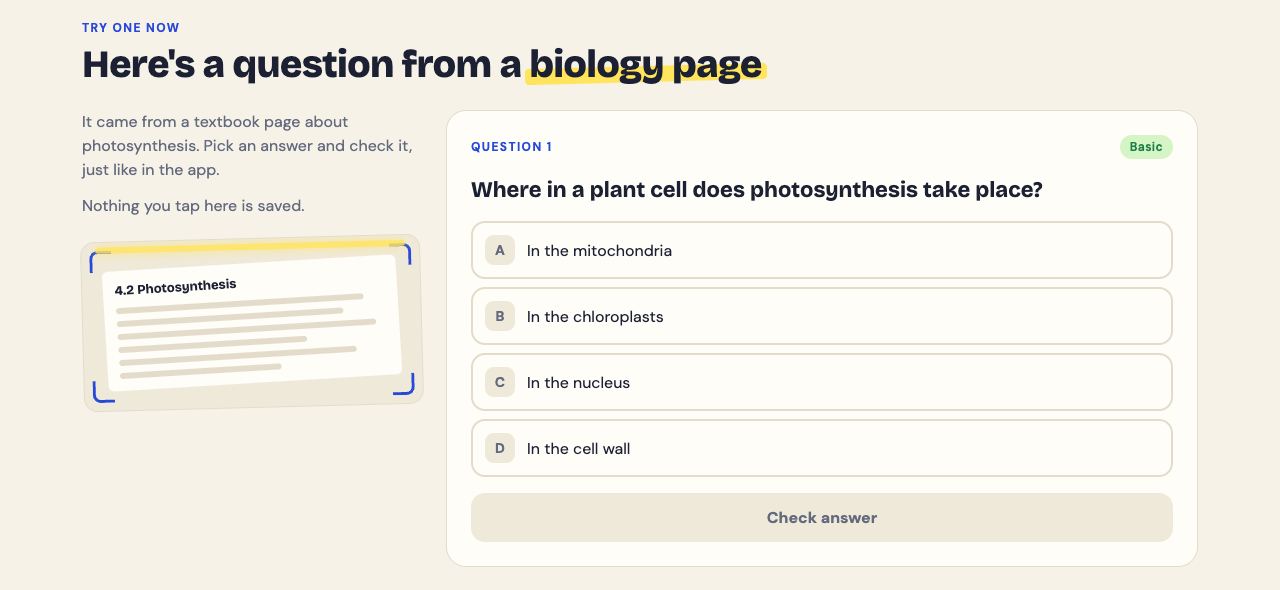
Basic checks key terms and facts. Intermediate asks you to explain and compare. Advanced asks you to apply ideas to new situations, the closest match to a clinical vignette. After each Check answer you see the right answer and a short explanation. The results show a score for each level: strong on Basic but weak on Advanced means you know the facts but cannot use them yet. Copy each miss from Look at these again into its box on the chart.
The quiz is saved in your library with its photo and your best score, so you can retake it two days later. The questions are written by an AI model and can contain mistakes, so check each explanation against your notes and use Report a problem with this question if one looks wrong.
How to study for a microbiology exam in 7 days
- Day 1: Draw the classification tree from memory and check it. Fill your Gram positive pages and quiz one at Basic.
- Day 2: Gram negative organisms. Fill the chart, then a Tiered quiz.
- Day 3: Viruses. Retake the Day 1 quiz.
- Day 4: Fungi and parasites. Retake the Day 2 quiz.
- Day 5: Drugs and resistance across all groups, with Advanced quizzes on the treatment pages.
- Day 6: Lab tests only. Cover the names and identify each bug from its results on paper. Retake any quiz below Good (70%).
- Day 7: Light review. Retake only quizzes below Mastered (90%), then sleep early.
Frequently asked questions
How long should I study for a microbiology exam?
About a week of daily sessions suits a unit exam if the chart is built during the course. For a cumulative final, start two to three weeks out and cycle through each organism group more than once.
What is the fastest way to memorize bacteria?
Learn the classification tree first, then attach every fact to an organism in a chart with fixed headings. Test yourself instead of rereading, and retake what you missed after a day or two.
How do I study for a microbiology lab practical?
Focus on test and result pairs: stains, catalase, coagulase, hemolysis and growth on selective media. Practise naming an organism from its results without looking, and photograph your lab notebook pages to quiz yourself on them.
Is microbiology harder than physiology?
It is less about hard ideas and more about volume. Physiology leans on mechanisms, and microbiology uses mechanisms plus a lot of names, so the same habits carry over.
Get started
Photograph one organism page tonight, take a Tiered quiz, and copy your misses back into the chart.
Try Study Shot: it is free to start. Photograph the page you are studying tonight and get 10 practice questions on it, from basic to advanced.
Comments
No comments yet.
Sign in or make an account to comment.