How to Study for a Music Theory Exam: Scales, Chords, Ear Training
If you are figuring out how to study for a music theory exam, start by splitting it into two skills. One is written: key signatures, scales, intervals, chords, Roman numerals and part writing. The other is aural: hearing intervals and chords and singing melodies at sight. You study the two differently. The written side rewards fast, accurate recall. The aural side only improves with short daily practice. This guide covers both, then gives you a 7-day plan.
How to study for a music theory exam: what it actually tests
Most music theory exams ask you to do five things:
- Identify keys, scales, intervals and chord qualities on the staff.
- Spell chords and scales from a given root or key.
- Analyze a short passage with Roman numerals and inversion symbols.
- Write four-part harmony that follows voice-leading rules.
- Hear intervals, chord qualities and cadences, and sometimes sing or take dictation.
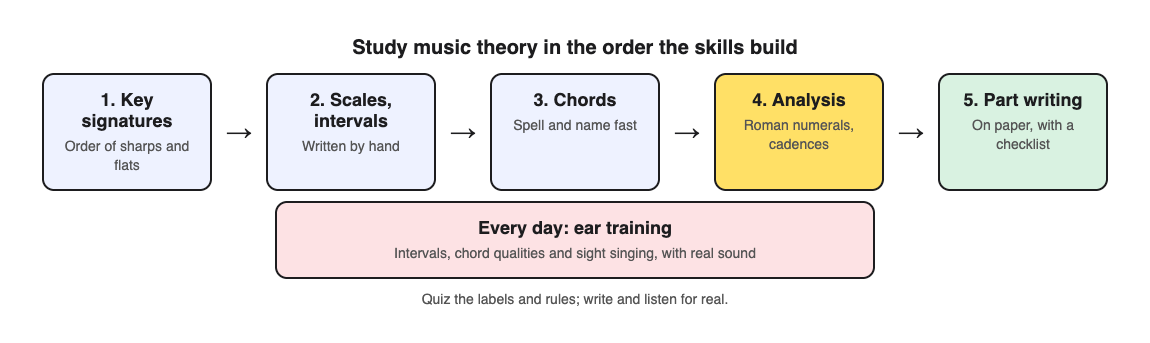
Each skill depends on the one before it. You cannot analyze a chord you cannot spell, and you cannot spell a chord if you hesitate over the key signature. So study in that order. If you only have a few days, spend most of them on the fundamentals, because every later question leans on them.
Lock in the fundamentals: key signatures, scales, and intervals
Key signatures come first. Learn the order of sharps (F C G D A E B) and the order of flats, which is the same list backwards (B E A D G C F). Then use two shortcuts:
- For sharp keys, the last sharp is the leading tone. Go up a half step to get the major key. Four sharps ends on D sharp, so the key is E major.
- For flat keys, the second to last flat is the key. Four flats is B, E, A, D, so the key is A flat major. Memorize F major (one flat) on its own.
Every major key shares its signature with a relative minor a minor third below. E major and C sharp minor share four sharps.
For scales, write them out by hand. Major is whole, whole, half, whole, whole, whole, half. For minor, know natural, harmonic (raised 7th) and melodic (raised 6th and 7th going up). Exams love to ask which note is raised in harmonic minor.
For intervals, count the letter names first to get the number, then check the quality. A trick that works: compare the top note to the major scale of the bottom note. If it is in that scale, the interval is major or perfect. One half step smaller than major is minor. One half step smaller than perfect is diminished.
Spell and identify chords until it's automatic
Triads are stacked thirds. Know the four qualities by their thirds, bottom to top:
- Major: major third, then minor third.
- Minor: minor third, then major third.
- Diminished: two minor thirds.
- Augmented: two major thirds.
Then add the five common seventh chords: major seventh, dominant seventh (major triad plus minor seventh), minor seventh, half-diminished and fully diminished. Learn the diatonic qualities in major as one line: I, ii, iii, IV, V, vi, vii°. In harmonic minor: i, ii°, III+, iv, V, VI, vii°, where III+ is augmented because of the raised seventh.
The goal is speed. In an exam you should see three stacked notes and name the chord in a couple of seconds. That is a recall problem. In a well-known 2006 study, students who tested themselves remembered much more a week later than students who reread the same material. The same idea drives our guide on studying for a computer science exam: do it yourself, check, repeat.
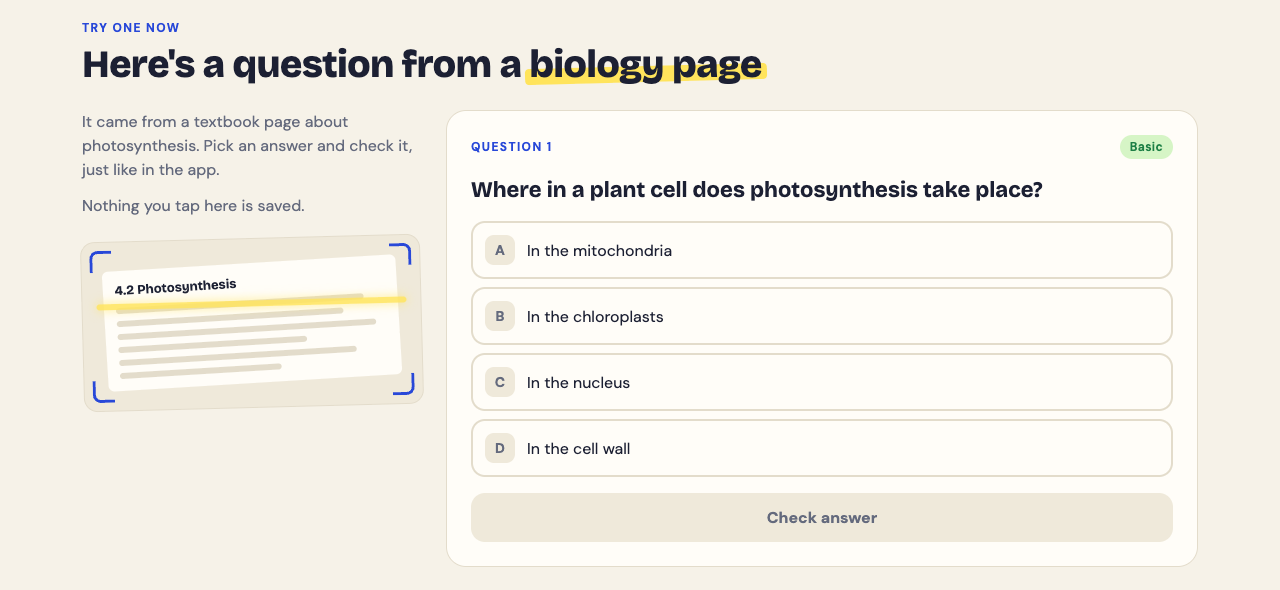
Here is one way to get that testing. Take the page in your textbook or class notes that explains chord qualities and diatonic chords. Open Study Shot in your phone's browser, tap Take photo, and hold the page flat so it fills the frame. Choose 10 questions and the Basic level, which focuses on key terms, facts and definitions. Press Create questions. You get multiple-choice questions about that page, each with four options. Answer one at a time, press Check answer, and read the short explanation whether you got it right or not. Then close the page and spell five chords on blank staff paper, because the exam asks you to write them, not only pick them.
Practice harmonic analysis and Roman numerals on real scores
Analysis means naming every chord in its key and showing its inversion. Work in this order for each chord:
- Find the key from the signature and the final cadence.
- Stack the notes in thirds to find the root.
- Name the quality and the Roman numeral.
- Look at the bass note to label the inversion: 6 or 6/4 for triads, and 7, 6/5, 4/3 or 4/2 for sevenths.
- Mark the cadence: authentic (V to I), half (ends on V), plagal (IV to I) or deceptive (V to vi).
Use real chorales and short piano pieces from your course packet, not only textbook examples. Real music has passing tones and suspensions you need to learn to ignore.
When you feel solid on the labels, photograph your notes page on cadences or inversions and choose Tiered, the default, which climbs from basic to Advanced ("Apply and predict in new situations"). The results screen gives a separate score for each level, so you can see whether your gap is the terms or the application.
Part writing: follow the voice-leading rules under time pressure
Part writing has the most rules to juggle at once. Keep a short checklist and run it on every chord you write:
- Keep each voice in its range, and keep soprano, alto and tenor within an octave of each other.
- In root position, double the root.
- Do not double the leading tone.
- Resolve the leading tone up to the tonic when it is in an outer voice.
- Resolve a chordal seventh down by step.
- Check every pair of voices for parallel fifths and octaves.
Study Shot only writes multiple-choice questions, so it will not grade your four-part writing. Use it for the rules, and do the writing on paper. Photograph the page that lists your course's voice-leading rules and quiz yourself on them. Then write a few progressions by hand with a timer and check each one against the list. Knowing the rules cold leaves your attention free for the music.
Ear training and sight singing: train daily, not the night before
Ear training needs real sound and steady practice, so plan short daily sessions rather than one long one the night before. A simple daily routine:
- Sing a major scale and its relative minor on solfège.
- Play and name ten random intervals. Link each one to a song opening you already know.
- Name the quality of five triads: major, minor, diminished, augmented.
- Sing one short melody at sight, then check it on a piano.
Study Shot works from a photo and writes text questions, so it cannot play sounds. The listening needs a piano, an app with audio, or a friend.
A 7-day music theory exam study plan
This plan follows the same structure as our 7-day plan for a world history final: build the base first, apply it, then review what you missed. Do 15 minutes of ear training every day on top of it.
- Day 1: Key signatures and scales. Write all major and minor keys from memory. Quiz yourself on your notes page.
- Day 2: Intervals and triads. Identify 30 intervals and spell 20 triads by hand.
- Day 3: Seventh chords and diatonic chords in major and minor.
- Day 4: Roman numeral analysis on two real chorales or pieces.
- Day 5: Part writing. Write five progressions under a timer and check each against the rules.
- Day 6: Mixed practice. Retake your saved quizzes. Each one sits in your library with its page photo and your best score, so you can see which topics are still weak.
- Day 7: A practice exam under real time limits, then light review only.
After each quiz, read the Look at these again list on the results screen. It shows each question you missed, your answer and the right answer. Those missed items are your study list for the next day. One caution: the questions are written by an AI model and can contain mistakes. Check anything surprising against your textbook. If a question is wrong, use Report a problem with this question under it.
Frequently asked questions
What is the best way to memorize key signatures?
Learn the order of sharps (F C G D A E B) and flats (the reverse), then use the shortcuts: the last sharp is a half step below the key, and the second to last flat is the key. Test yourself until you can name any signature in under two seconds.
How can I improve at ear training quickly?
Practise a little every day instead of cramming. Tie each interval to a song you know, and always check your answer on a real instrument.
How do I avoid parallel fifths and octaves in part writing?
After writing each chord, compare every pair of voices with the chord before it. If two voices form a fifth or octave and both move the same direction to another fifth or octave, change one voice, often by moving it in contrary motion to the bass.
Get started
Try Study Shot: it is free to start. Photograph the page you are studying tonight and get 10 practice questions on it, from basic to advanced.
Comments
No comments yet.
Sign in or make an account to comment.