How to Study for a Neuroscience Exam: Pathways, Pharmacology, Data
If you are searching for how to study for a neuroscience exam, you have probably noticed that the subject asks for three skills at once. You need to recall anatomy, follow chains of cause and effect at the synapse, and read experimental figures under time pressure. This guide gives you a method for each skill and a two-week plan that ties them together.
Why neuroscience exams feel harder than they look
Lecture slides make neuroscience look like a list of facts. The exam rarely tests the list. It tests whether you can move between levels. A question might describe a patient who lost pain and temperature sensation on the left side of the body below a certain level and ask where the lesion is. To answer it, you need the anatomy of the spinothalamic tract, where it crosses, and how that maps onto the body.
Pharmacology questions work the same way. Knowing that a drug "blocks reuptake" is not enough. You have to predict what happens to the neurotransmitter level in the cleft, what the receptors do next, and what the patient feels. Data questions add a third layer: you get a graph you have never seen and must say what it shows.
So you are not studying one thing. You are studying the links between things. Every method below is built to train those links.
Build a map of the nervous system before memorizing details
Start with a one-page map before you open any detailed notes. Draw the central nervous system and the peripheral nervous system. Split the periphery into somatic and autonomic. Split autonomic into sympathetic and parasympathetic. Then sketch the brain's major divisions: forebrain, midbrain, hindbrain, and the spinal cord below them.
Keep the map rough. Its job is to give every later fact a place to live. When you learn that the basal ganglia help select movements, you add it to the forebrain. When you learn that the cerebellum compares intended and actual movement, it goes in the hindbrain.
Redraw the map from memory every few days. Each time, add one layer: lobes, then key nuclei, then the ventricles. If a region keeps slipping, that is your first study target.
Master action potentials and synaptic transmission step by step
The action potential is a sequence, and sequences are best learned by saying them out loud in order. Write each step as a short line:
- The resting membrane sits near minus 70 mV, mostly set by potassium leak channels and the sodium potassium pump.
- A stimulus depolarizes the membrane to threshold.
- Voltage-gated sodium channels open. Sodium rushes in. The membrane depolarizes fast.
- Sodium channels inactivate. Voltage-gated potassium channels open. Potassium flows out and the membrane repolarizes.
- Potassium channels close slowly, so the membrane briefly hyperpolarizes.
- The refractory period stops the signal from running backward.
Then extend the chain to the synapse: the action potential reaches the terminal, voltage-gated calcium channels open, calcium triggers vesicle fusion, transmitter crosses the cleft, binds receptors, and is cleared by reuptake, enzymes or diffusion.
Now test yourself with "what if" questions. What happens if you block sodium channels? No action potential. What if you remove calcium from the outside solution? The action potential can still travel, but transmitter release drops. These questions are exactly how exams probe whether you understand the sequence or just recognize it. If you also study physiology for another course, the same step-by-step approach appears in our guide to studying for a sports science exam.
Learn neural pathways by drawing them from memory
Pathways combine anatomy with logic, so draw them from a blank page.
For each sensory or motor tract, draw a vertical outline of cortex, brainstem and spinal cord. Then trace the pathway and mark four things:
- Where the first neuron starts.
- Where each synapse happens.
- Where the pathway crosses the midline.
- Where it ends.
The dorsal column pathway, for example, carries fine touch and proprioception, ascends on the same side, synapses in the medulla, then crosses. The spinothalamic tract carries pain and temperature and crosses near the level of entry in the spinal cord. Put the two side by side and the classic lesion questions start answering themselves: a lesion to one half of the cord affects fine touch on the same side and pain on the opposite side.
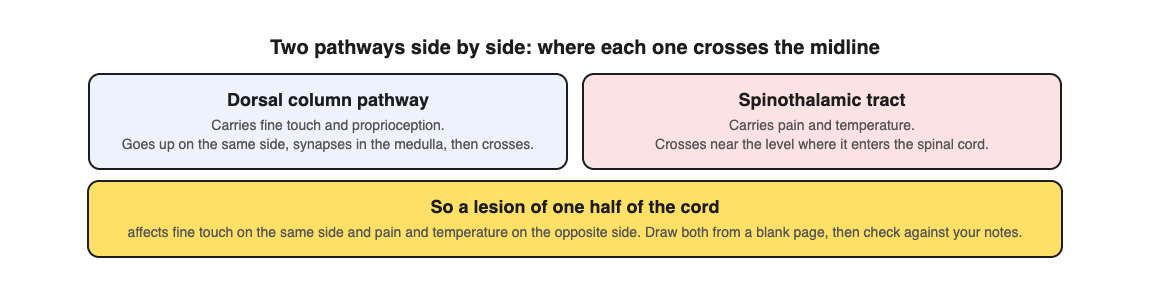
Check your drawing against your notes in a different color, and repeat until you can produce it cold. Our guide on how to study for an anatomy test uses the same blank-label method.
Tie neurotransmitters, receptors and drugs to clinical cases
Neurotransmitter tables are hard to memorize because each row looks like the others. Give each row a story instead. For each transmitter, write one card with four lines:
- Where it is made: for dopamine, the substantia nigra and the ventral tegmental area.
- Main receptors: D1-like and D2-like families.
- A drug that acts on it: L-DOPA is a precursor that raises dopamine.
- A clinical case: loss of nigral dopamine neurons in Parkinson's disease.
The case is the hook. When an exam asks why a Parkinson's patient is given L-DOPA rather than dopamine itself, you can reason from the card: dopamine does not cross the blood-brain barrier well, its precursor does. Do the same for acetylcholine (myasthenia gravis and acetylcholinesterase inhibitors), GABA (benzodiazepines increasing GABA-A receptor effects) and serotonin (reuptake inhibitors).
Your textbook and lecturer have the last word on any drug, receptor or dose. For more on learning drugs by class, see our guide on how to study for a pharmacology exam.
Practice interpreting experimental data and figures
Many neuroscience exams include a figure: a voltage trace, a firing-rate histogram, a dose-response curve or a lesion study. Read every figure with the same four questions:
- What is on each axis, and in what units?
- What was manipulated, and what was measured?
- What is the control condition?
- What is the single biggest difference between conditions?
Write one sentence that answers question four before you look at the options. For a dose-response curve, that sentence might be "Drug B needs a higher dose than drug A for the same effect, so it is less potent." Only then check what the question asks.
Practice on figures from your lecture slides and assigned papers.
How to study for a neuroscience exam in two weeks
Spaced retrieval means testing yourself on the same material several times, with gaps between. In a 2006 study by Roediger and Karpicke, students who took recall tests on a passage remembered more of it two days and one week later than students who reread it. A 2018 review of 122 experiments by Pan and Rickard found that testing helps most with application and inference questions, which suits neuroscience, and least with material you saw but never quizzed, so quiz every page, not only your favourites.
Days 1 to 4: build
Redraw the nervous system map. Write the action potential and synapse sequences. Make one card per neurotransmitter. Each evening, test yourself on that day's topic.
Days 5 to 9: pathways and drugs
Draw two pathways per day from memory. Add clinical cases to your transmitter cards. Revisit Day 1 and Day 2 topics with self-tests.
Days 10 to 14: mixed practice
Mix topics in every session. Do one figure-reading set per day. Spend the last two days only on questions you got wrong earlier.
Where Study Shot fits
Making enough practice questions is the slow part. Study Shot can help. You photograph a page from your textbook, your notes or even a whiteboard, and it writes multiple-choice questions about that page, each with four choices, then checks your answers and explains each one.
A worked example: on Day 6, photograph your hand-drawn spinothalamic and dorsal column diagram. Choose 20 questions and the Tiered level, which works like a ladder: basic questions first, then intermediate, then advanced. Press Create questions. While you answer, you can tap Show page to look back at your photo if you need it. After each answer you see Correct! or Not quite., the right answer and a short explanation.
At the end, the results screen gives you a score for each level. If you scored well on Basic but poorly on Advanced, you know the anatomy but not the application. The Look at these again list shows each missed question with your answer and the right answer. That list becomes your Day 13 review. The quiz is saved in your library with your best score, so you can retake it on Day 10 and see if the gap closed.
Two cautions. The questions are written by an AI model and can contain mistakes. Read the explanation and compare it with your notes; if a question looks wrong, use Report a problem with this question. And if you study with a group, Share this quiz makes a link; each person needs a Study Shot account and gets their own copy of the questions.
Frequently asked questions
How long should I study for a neuroscience exam?
It depends on how much is new to you. A two-week plan of short daily sessions, like the one above, lets you retest each topic several times instead of cramming once.
What is the best way to memorize brain anatomy?
Draw it from memory on a blank page, then check against your notes. Start with a rough map and add one layer of detail each time you redraw it.
How do I remember which neurotransmitter does what?
Link each transmitter to a drug and a clinical case. A story like dopamine loss in Parkinson's disease is easier to recall than a row in a table.
Get started with Study Shot
Study Shot runs in the web browser on your phone or computer, and it can write quizzes in 50 languages. Pick the page you find hardest, whether it is a synapse diagram or a drug table, and quiz yourself on it tonight.
Try Study Shot: it is free to start. Photograph the page you are studying tonight and get 10 practice questions on it, from basic to advanced.
Comments
No comments yet.
Sign in or make an account to comment.