How to Study for a Nutrition Exam: Nutrients, Metabolism, Diet Calcs
If you are wondering how to study for a nutrition exam, start with this: the course mixes three kinds of thinking. You memorize nutrients, you follow metabolic pathways, and you do arithmetic on diets. Each needs a different method. This guide gives you one for each, plus a way to turn your own notes into practice questions so you test yourself instead of rereading.
How to study for a nutrition exam: what it tests
Nutrition feels familiar. You eat every day, so the topic seems easy. Then the exam asks why a vitamin B12 deficiency causes the same type of anemia as a folate deficiency, or asks you to work out the fat percentage of a three-day food record. Familiar words hide hard questions.
Most nutrition exams test four things:
- Recall: functions, food sources and recommended intakes for each nutrient.
- Process: how the body breaks down and stores carbohydrate, fat and protein.
- Calculation: energy needs, BMI and macronutrient percentages.
- Application: case studies where you spot a problem and suggest a fix.
If you only reread your notes, you prepare for the first one at best. Testing yourself does more: a 2021 review of 222 classroom studies with over 48,000 students found that quizzing raised achievement by a medium amount. The sections below cover all four.
Build a nutrient master table: macros, vitamins, and minerals
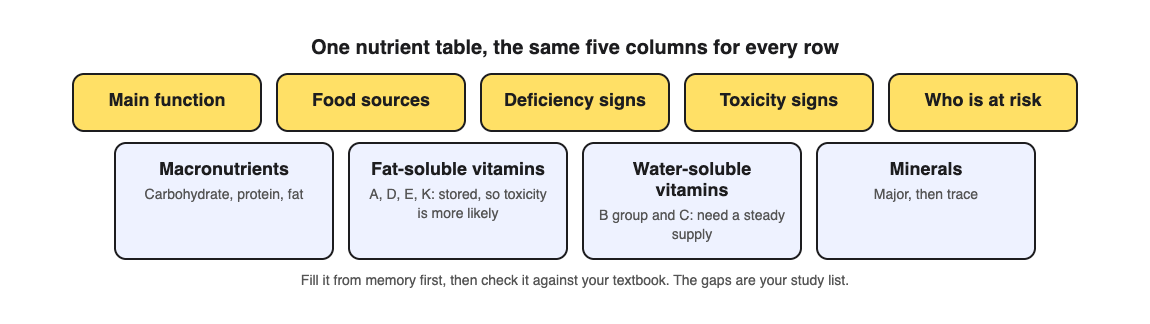
Take a large sheet of paper or a spreadsheet. Make one row per nutrient. Use the same columns every time:
- Main function
- Good food sources
- Deficiency signs
- Toxicity signs (if any)
- Who is at risk
Group rows by type: macronutrients first, then fat-soluble vitamins (A, D, E, K), then water-soluble vitamins (the B group and C), then major minerals, then trace minerals. Grouping helps because nutrients in the same group share patterns. Fat-soluble vitamins are stored in the body, so toxicity is more likely. Water-soluble vitamins are mostly excreted, so you need a steady supply.
Fill the table from memory first, then check it against your textbook. The gaps you leave are your study list. Building it is the learning. Copying a finished one is not.
Map metabolism pathways instead of memorizing them line by line
Students often try to learn glycolysis as a list of ten steps. That is slow and easy to forget. Draw a map instead. For each pathway, write four things:
- Where it happens. Glycolysis in the cytosol. The Krebs cycle in the mitochondrial matrix. The electron transport chain on the inner mitochondrial membrane.
- What goes in. Glycolysis takes one glucose.
- What comes out. Two pyruvate, a net gain of 2 ATP, and 2 NADH.
- When it runs. Fed state or fasted state, and which hormone pushes it.
Then draw arrows between maps. Pyruvate becomes acetyl-CoA, which enters the Krebs cycle. Fatty acids also become acetyl-CoA. Some amino acids enter at several points. Once you see that acetyl-CoA is the meeting point, questions about low-carbohydrate diets and ketone bodies start to make sense.
Check your understanding by explaining one path out loud with the book closed. This is the same idea as tracing code by hand, which we cover in how to study for a computer science exam: follow one input through the whole process and say what happens at each stage.
Drill the calculations: energy needs, BMI, and macronutrient percentages
Calculation questions follow set methods, so practice pays off quickly. Learn the formulas cold, then do many small problems. Your course may use a different energy equation, so use the one your lecturer gives you. The method stays the same.
BMI
BMI is weight in kilograms divided by height in meters squared. A person who weighs 70 kg and is 1.75 m tall: 1.75 times 1.75 is 3.0625, and 70 divided by 3.0625 is about 22.9.
Resting energy needs
Using the Mifflin-St Jeor equation for a 30-year-old woman who weighs 60 kg and is 165 cm tall: 10 times 60 is 600. Add 6.25 times 165, which is 1,031.25. Subtract 5 times 30, which is 150. Subtract 161. The answer is about 1,320 kcal per day. Multiply by an activity factor if the question asks for total needs.
Macronutrient percentages
Remember the energy values: carbohydrate and protein give 4 kcal per gram, fat gives 9, alcohol gives 7. Say a day's intake is 250 g carbohydrate, 80 g protein and 70 g fat.
- Carbohydrate: 250 times 4 is 1,000 kcal.
- Protein: 80 times 4 is 320 kcal.
- Fat: 70 times 9 is 630 kcal.
- Total: 1,950 kcal.
So carbohydrate is about 51%, protein about 16% and fat about 32%. Write every step on the exam, so you and the marker can follow your method.
Do five of these a day for the week before your exam. Make up the numbers yourself and check them with a calculator.
Learn deficiency and toxicity signs with active recall flashcards
Deficiency signs are classic exam questions because they are short and specific. Put the symptom on the front of a card and the nutrient on the back, and also make cards the other way round. Some pairs to start with:
- Bleeding gums, slow wound healing: vitamin C (scurvy).
- Night blindness: vitamin A.
- Soft, bowed bones in children: vitamin D (rickets).
- Dermatitis, diarrhea, dementia: niacin (pellagra).
- Small, pale red blood cells: iron.
- Large red blood cells: folate or B12. Nerve damage points to B12.
- Swollen thyroid (goiter): iodine.
Test yourself before you look. If you get a card wrong, put it back in the pile for tomorrow. If you get it right three days in a row, move it to a weekly pile.
You can also use your notes as the source for a quiz. With Study Shot, you photograph a page (your master table, a textbook page on fat-soluble vitamins, or a lecture slide) and it writes multiple-choice questions about that page. Each question has four choices, and after you press Check answer it tells you whether you were right, shows the correct answer and gives a short explanation. Choose the Basic level ("Key terms, facts and definitions.") for this stage. It fits recall work like deficiency signs.
Apply it to case studies and diet analysis questions
Case studies ask you to put everything together. The question gives you a person: age, sex, diet record, symptoms, maybe some lab values. You have to connect them. Use the same four steps every time:
- List the facts. Underline every number and symptom.
- Calculate. Work out BMI, energy needs and macro percentages if the numbers are there.
- Match. Compare symptoms to your deficiency list and intake to recommendations.
- Recommend. Suggest a specific food change and say why.
Example: a 68-year-old who lives alone, eats little meat and has tingling feet and large red blood cells. Your answer should name B12, note that older people are at higher risk because absorption can fall, and suggest the food or medical follow-up your course teaches.
Case-based reasoning works the same way in other subjects. Our guide on studying for a criminology exam uses a similar facts-then-theory approach.
For practice, photograph a case study or a diet analysis worksheet and pick the Advanced level in Study Shot ("Apply and predict in new situations."). Or pick Tiered, the default, which climbs from basic to intermediate to advanced in that order. After the quiz, the results screen shows a score for each level. If you score well on Basic but poorly on Advanced, you know the facts but not how to use them. That tells you where to spend your next hour.
Quiz yourself with past exam papers under timed conditions
About a week out, switch to past papers. Set a timer for the real exam length, close your notes and answer every question. Then mark it honestly. The step-by-step method is in how to quiz yourself with a past exam paper.
For the multiple-choice section, you can photograph a page of the paper or your revision notes and make a fresh quiz of 5, 10, 15 or 20 questions. Each quiz is saved to your library with its page photo and your best score, so you can retake it the night before. The results screen lists the questions you missed under "Look at these again", with your answer and the right one side by side.
Two things to keep in mind. Study Shot only writes multiple-choice questions, so do your calculations and essay answers on paper. And the questions come from an AI model, which can make mistakes. Read the explanation to check, and use "Report a problem with this question" if something looks wrong. On any intake, deficiency or diet advice, your textbook and instructor have the last word.

Frequently asked questions
How long should I study for a nutrition exam?
One way to plan a final: give the first week to your master table and pathway maps, the second to calculations and case studies, and the last few days to timed past papers.
What is the best way to memorize vitamins and minerals?
Build a table with the same columns for every nutrient, then test yourself from it with flashcards in both directions. Group vitamins into fat-soluble and water-soluble so you learn the shared patterns first.
How do I remember metabolic pathways like glycolysis and the Krebs cycle?
Learn where each pathway happens, what goes in, what comes out and when it runs, then link them through shared molecules like pyruvate and acetyl-CoA. Explain each map out loud with your notes closed.
Are flashcards enough to pass a nutrition exam?
No. Flashcards cover recall, but most exams also test calculations and case studies, which need worked practice. Use flashcards for facts and do problems and past papers for the rest.
Get started
Try Study Shot: it is free to start. Photograph the page you are studying tonight and get 10 practice questions on it, from basic to advanced.
Comments
No comments yet.
Sign in or make an account to comment.