How to Study for a Pathophysiology Exam: A Step-by-Step Plan
If you want to know how to study for a pathophysiology exam, start by changing the question. You are not studying a list of diseases. You are studying how normal body function breaks down, step by step, and what that breakdown looks like in a patient. This plan shows you how to do that in a week-by-week routine, with a worked example you can copy.
How to study for a pathophysiology exam: what it really tests
Pathophysiology piles up fast. Every chapter adds a new organ system, new terms and new chains of events. If you try to memorize each disease as a block of facts, the blocks blur together by week three.
Most exams do not ask you to recite a definition. They ask you to reason. A question gives you a patient, a few lab values and a symptom, and asks what is happening or what will happen next. That means the exam tests three things:
- Whether you know what normal looks like.
- Whether you can trace a cause to its effects, in order.
- Whether you can apply that chain to a new situation.
Plan your study around those three skills and the volume of content becomes easier to handle.
Start with normal physiology before the disease
You cannot explain what went wrong if you cannot explain what should happen. Before you read about heart failure, write down in a few lines how the heart normally maintains output: preload, contractility, afterload, heart rate. Before you read about diabetes, write down what insulin does and where.
Do this as a quick check, not a re-read of your whole physiology textbook. Close the book and answer these for each new unit:
- What is the normal function of this organ or system?
- What keeps it in balance (the feedback loop)?
If you cannot answer, go back and fix that gap first. If you are studying the cellular side, such as enzymes and metabolic regulation, the same logic applies in how to study for a biochemistry exam. For nervous system content, this neuroscience guide covers pathways and drug effects in the same way.
Map each disease as a cause-and-effect chain
This is the core skill. For every disease, build one chain from the trigger to the symptoms. Use arrows, short phrases, and keep it to one page.
Here is a worked example for left-sided heart failure:
- Trigger: long-standing high blood pressure or damage to the heart muscle.
- Core problem: the left ventricle pumps less blood out with each beat.
- Backup: blood pools behind the left ventricle, so pressure rises in the lungs.
- Result in the lungs: fluid leaks into the air spaces, which causes shortness of breath and crackles.
- Forward effect: less blood reaches the rest of the body, so organs such as the kidneys get less flow.
- Compensation that backfires: your textbook will name the body's responses to low flow. Trace how each one adds fluid or workload for an already weak heart.
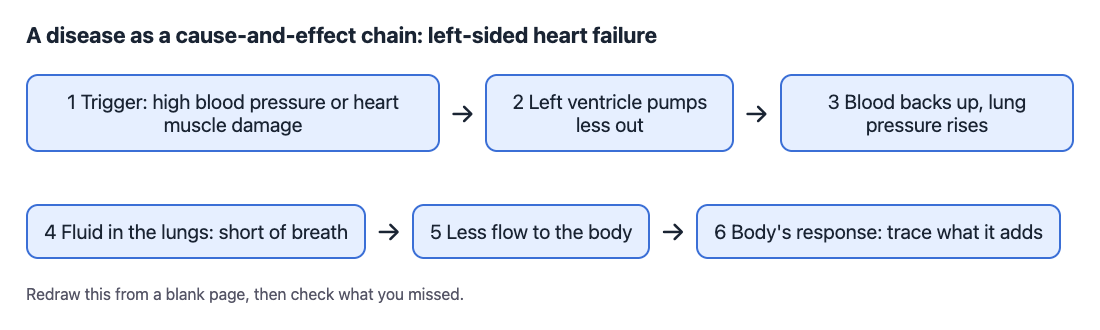
Notice that the symptoms are not a separate list. They fall out of the chain. If you understand step 3, you do not need to memorize "crackles". You can predict them. That is also why the same method works for any disease: find the trigger, find the broken step, follow the consequences, then note the body's compensation.
Analogies help when a chain feels abstract. Thinking of the failing ventricle as a pump with a clogged outlet makes the backup easy to see.
Turn mechanisms into active recall practice
Reading your chain again feels productive but teaches little. In one study (Roediger and Karpicke 2006, PubMed 16507066), students who were tested on a passage remembered more after two days and a week than students who restudied it, even though restudying made them feel more sure they would remember. Right after studying, restudying did better. So test yourself, and do it after a gap. Use these habits:
- Blank-page recall. Take a disease name, close your notes and redraw the chain from memory. Then check what you missed.
- Explain it out loud. Pretend you are teaching a classmate. Where you stumble is where you do not understand it yet.
- Ask "what if" questions. What if the left ventricle pumped normally but the lungs filled anyway? What if the trigger were different? This builds the flexible reasoning the exam wants.
You can also get practice questions from your own materials. With Study Shot, you photograph a page from your textbook, your notes or a whiteboard, and an AI model writes multiple-choice questions about it. You choose 5, 10, 15 or 20 questions (10 is the default), and each answer is checked and explained right away. Because the questions come from your own page, they match what your course covers.
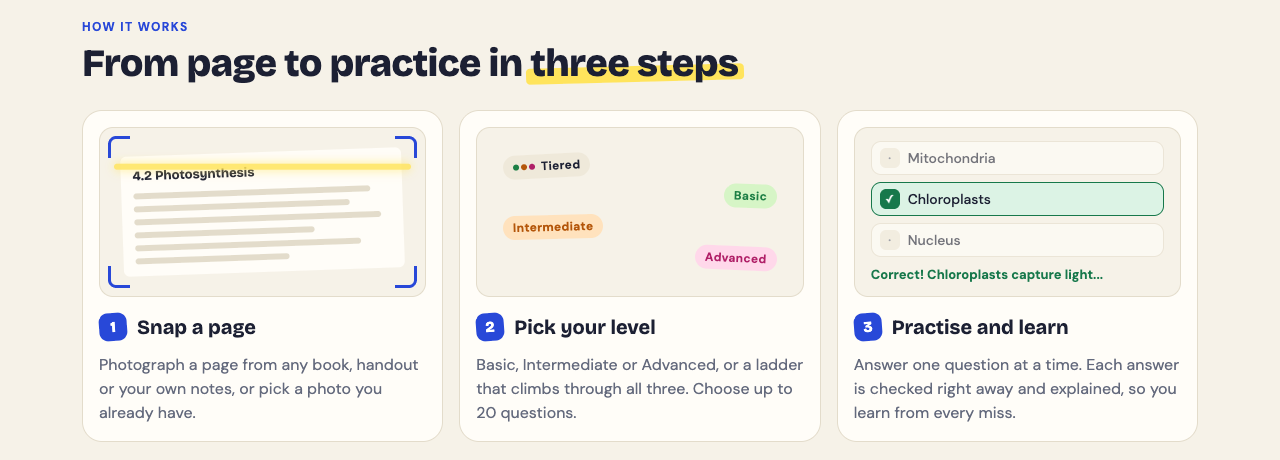
A simple workflow: after you finish your chain for heart failure, photograph your textbook page on it, pick the Intermediate level ("Explain, compare and connect ideas"), and answer the questions without looking at your notes. Anything you miss lands in the Look at these again list on the results screen, with your answer next to the right one. Use that list as your next review session.
One honest caution: the questions are written by an AI model and can contain mistakes. Treat the explanation as a way to check your thinking against your textbook, and let your textbook and instructor have the last word on any drug, dose or procedure. If a question looks wrong, you can use Report a problem with this question.
A fair limit on multiple choice: in a study of 350 medical students (Ilyas et al. 2026, PubMed 42403130), practice with short-answer questions led to higher scores on a later multiple-choice test (about 82 against 71) than practice with multiple-choice questions. So pair each quiz with a blank-page chain and short written answers. Keep lab values, calculations and care plans on paper too, since a quiz cannot check your working.
Practise with short patient case scenarios
Once the chains feel solid, move to application. Exam questions are often short patient stories. Practice reading them in a fixed order:
- Identify the system involved from the main complaint.
- Pick out the key finding (a lab value, a vital sign, a symptom).
- Ask which step in the chain that finding points to.
- Predict what else you would expect to see, then match that to the answer options.
Study Shot's level setting helps here. Basic gives key terms, facts and definitions. Intermediate asks you to explain, compare and connect. Advanced asks you to apply and predict in new situations, which is the closest match to scenario questions. The default Tiered option climbs from basic to advanced in one quiz, so it works well as a first pass on a new chapter. Closer to the exam, go straight to Advanced.
Whatever source you use for scenario questions, review the wrong answers as carefully as the right ones. Ask why each wrong option fails. That teaches you the distinctions the exam likes to test, such as acute versus chronic or left-sided versus right-sided.
Build a weekly study schedule that uses spaced repetition
Spacing helps because each review forces you to pull the chain back out of memory after a gap. Here is a simple weekly pattern you can adjust to your course:
- Day 1, learn: check normal physiology, then build the chain for the new disease.
- Day 2, recall: redraw the chain from a blank page. Take a short quiz on the material.
- Day 4, revisit: redraw it again and retake the questions you missed.
- Day 7, mix: combine it with older diseases in one scenario-style session.
- Weekend: do one longer, harder quiz that covers the whole week.
Saved quizzes make the revisit days easy. Study Shot keeps each quiz in your library with its page photo and your best score, so you can retake it any time. A grade of Mastered starts at 90%, Good at 70%, Getting there at 50%, and below that it says Needs another try. Use those grades as a rough guide to what needs another pass.
Stress can also work against you in the last days before an exam. If that sounds familiar, read what research shows about stress and memory.
Common mistakes that cost pathophysiology students points
- Memorizing symptom lists with no mechanism. You forget them, and you cannot handle a question that shows an unusual presentation.
- Skipping normal physiology. If the baseline is shaky, every chain is shaky.
- Only rereading. Recognition feels like knowing, but it is not recall.
- Ignoring compensation. Many exam questions hinge on what the body does in response, such as fluid retention or a faster heart rate.
Frequently asked questions
How many hours a day should I study for pathophysiology?
There is no single right number, because it depends on your course load and how much you already know. Shorter, focused sessions with active recall usually work better than long sessions of rereading. Pick a block you can keep up every day rather than one you drop after a week.
Should I memorize diseases or understand mechanisms?
Understand mechanisms first. A clear cause-and-effect chain lets you work out most signs and symptoms instead of memorizing them. You will still need to learn some key facts and values, but they stick better when they hang on a chain.
What is the best way to remember signs and symptoms?
Tie each one to the step in the chain that causes it. Then test yourself by redrawing the chain and predicting the symptoms before you check your notes. Practice questions on your own pages help you find the ones you still miss.
How is pathophysiology different from anatomy and physiology?
Anatomy and physiology describe how a healthy body is built and works. Pathophysiology explains what changes when disease or injury disrupts that normal function, and why the signs and symptoms appear. It builds directly on A&P, so weak basics will show up here.
Get started
Try Study Shot: it is free to start. Photograph the page you are studying tonight and get 10 practice questions on it, from basic to advanced.
Comments
No comments yet.
Sign in or make an account to comment.