How to Study for a Philosophy Exam: Arguments, Objections, Essays
If you want to know how to study for a philosophy exam, start with one fact: your professor does not care much whether you can recite what Kant said. They care whether you can lay out his argument, find its weak point, and defend a position under time pressure. This guide shows you how to study for that kind of test. You will reconstruct arguments, pin down terms, rehearse objections, and write timed essays. You will also see where a photo-to-quiz tool fits and where it does not.
Why philosophy exams test reasoning, not recall
Most philosophy exams ask some version of three questions. What is the argument? Is it any good? What do you think, and why?
Recall only gets you through the first one. You can memorize that utilitarians judge actions by their consequences. That is not the same as showing why a utilitarian must accept a troubling conclusion in a specific case, or explaining what a critic would say back.
So your study time should go to practice, not rereading. In a classic 2006 study, students who tested themselves on prose passages remembered much more a week later than students who reread them, even though rereading felt better. Every session should end with you producing something: an argument in numbered steps, a definition in your own words, an objection, or a timed paragraph. The approach in how to study for a political science exam overlaps a lot with what follows. Philosophy just puts more weight on the structure of the argument itself.
Reconstruct each argument in premise and conclusion form
Take every major argument on your syllabus and rewrite it as numbered premises leading to a conclusion. Keep each premise to one claim. Mark which premises are stated by the author and which ones you had to add to make the argument valid.
Here is a short example using an argument about eating meat:
- It is wrong to cause unnecessary suffering.
- Factory farming causes suffering.
- That suffering is unnecessary, because people can eat well without meat.
- Therefore, supporting factory farming is wrong.
Whatever you think of the conclusion, look at the structure. Premise 3 is doing most of the work, so it is the one a critic will attack, and a defender will need to support. Spotting that is the skill your exam rewards.
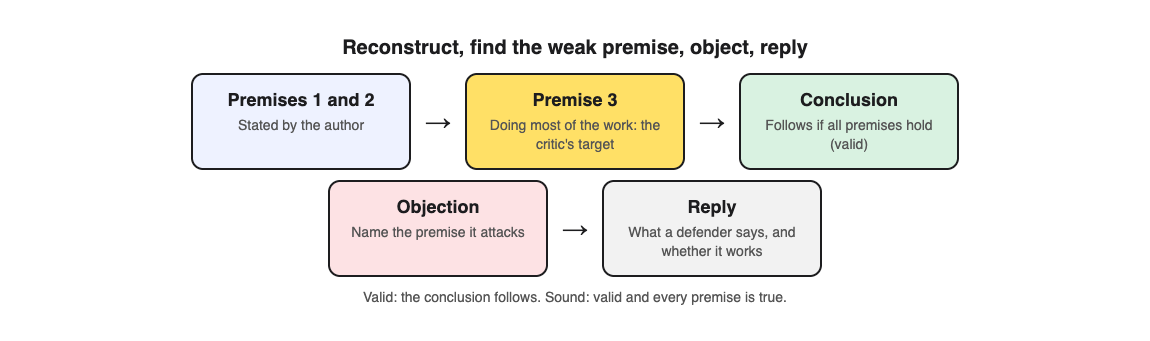
Do this on paper for every reading. By the end of the term you should have one page per argument. That stack of pages becomes your main revision material.
Learn key terms and distinctions precisely
Philosophy uses ordinary words in narrow ways. "Valid" does not mean "true." "Sound" means valid with true premises. A priori, necessary, and analytic are three different things, and examiners love to check whether you mix them up.
Make a short list of distinctions for each unit. Write each pair side by side with one example of each:
- Valid vs. sound: an argument can be valid with a false premise. It cannot be sound with one.
- Necessary vs. sufficient condition: oxygen is necessary for fire, but not sufficient.
- Act vs. rule consequentialism: judging each act, or judging the rule the act follows.
- Descriptive vs. normative claim: how things are, or how they ought to be.
This is the part of philosophy that does reward quick, repeated checking. You need these terms to come out right without thinking, so you can spend your exam time on the hard parts.
Using Study Shot for terms and argument structure
Study Shot turns a photo of a page into a multiple-choice practice quiz. You photograph a page from your textbook, your handout, or your own notes. An AI model writes questions about it, checks each answer, and explains it in one to three sentences.
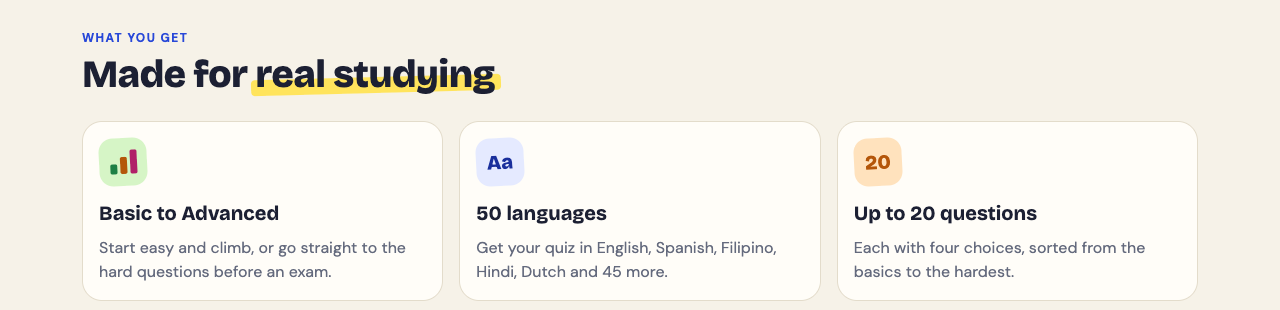
A worked example: photograph your one-page reconstruction of the meat-eating argument above. Choose 10 questions and the Tiered level, which is the default. Tiered splits the questions as evenly as possible across Basic, Intermediate and Advanced, in that order. Basic questions cover key terms and definitions. Intermediate ones ask you to explain, compare and connect ideas. Advanced ones ask you to apply and predict in new situations. Press Create questions and wait. It can take up to a minute.
A good Advanced question on that page might ask which premise a critic must reject to resist the conclusion. When you get one wrong, read the explanation before you press Continue. At the end, the results screen shows a score for each level and a Look at these again list with your answer and the right answer for every miss. If Basic is strong and Advanced is weak, you know your terms are fine but your argument analysis needs work.
Be honest about the limit. Every question is multiple choice with four options. It will not grade your essay. Use it to drill terms and structure so your essay time goes further. The questions are written by an AI model and can contain mistakes. The explanation helps you check, and if a question looks wrong you can use Report a problem with this question.
Rehearse objections and replies for every major view
A strong philosophy answer includes the best objection to the view, and a reply. It shows you understand the view from the inside.
For each position on your syllabus, write three lines:
- The view: one sentence.
- The strongest objection: name the premise it attacks.
- The best reply: what a defender would say, and whether it works.
Then argue it out loud. Pick a view you disagree with and defend it for two minutes. This is uncomfortable, and it is the fastest way to find the gaps in your own understanding.
Once you have written your objection-and-reply sheet, photograph it and make a quiz at the Advanced level, which asks you to apply ideas to new situations. A 2018 meta-analysis found practice testing carries over best to application and inference questions, though the benefit was much smaller after correcting for unpublished studies.
Practice timed essays with a clear thesis
You can know every argument and still lose marks if your essay wanders. Exam essays reward a simple shape:
- Thesis: state your answer in the first two sentences. "I will argue that X, because Y."
- Exposition: reconstruct the relevant argument, briefly.
- Objection: give the strongest case against your thesis.
- Reply: answer it, or concede what you must and explain why your thesis still holds.
- Conclusion: restate the thesis and what the reply showed.
Practise this with a timer. If your exam gives 45 minutes per essay, spend 5 planning, 35 writing, and 5 checking. Use past paper questions if you have them. If not, turn each lecture topic into a "Discuss" or "Is X right?" question.
After each timed essay, check one thing: could a reader find your thesis in the first paragraph? If not, rewrite the opening.
How to study for a philosophy exam in one week
Here is a plan you can follow if your exam is seven days away.
- Day 1: List every argument and view on the syllabus. Reconstruct the first half in premise form.
- Day 2: Reconstruct the second half. Photograph each page and take a Tiered quiz on it. Note which arguments you missed.
- Day 3: Build your distinctions list. Quiz yourself on it at the Basic level until the terms are automatic.
- Day 4: Write objection-and-reply sheets for every major view. Argue two of them out loud.
- Day 5: Write one timed essay. Mark it against the five-part shape above.
- Day 6: Retake the quizzes you scored lowest on. Write a second timed essay on a different topic.
- Day 7: Light review only. Reread your Look at these again lists and your thesis sentences. Sleep.
Your quizzes are saved to your library with the page photo and your best score, so retaking on Day 6 takes seconds. If you are in a study group, Share this quiz makes a link. Each person who opens it needs a Study Shot account and gets their own copy of the questions, without your photo.
The same rhythm of producing, checking, and retrying works in other subjects too. Compare it with how to study for a sociology exam, where theories and terms play a similar role.
Frequently asked questions
How do I study for a philosophy exam if I only have one night?
Pick the three arguments most likely to appear and reconstruct each in premise form. Write one objection and one reply for each. Then write a single thesis sentence you could defend for each topic.
Should I memorize quotes for a philosophy exam?
A few short ones can help, but examiners reward reasoning far more than quotation. Spend your time on argument structure and objections first.
Can a multiple-choice quiz help with an essay exam?
Yes, for the parts that need precision: terms, distinctions, and which premise does what. It will not replace timed essay practice, so use both.
Does Study Shot work in languages other than English?
The questions, answers and explanations can be written in 50 languages, including Spanish, Filipino, Hindi and Dutch. The app's own screens stay in English.
Get started
Try Study Shot: it is free to start. Photograph the page you are studying tonight and get 10 practice questions on it, from basic to advanced.
Comments
No comments yet.
Sign in or make an account to comment.