How to Study for a Physiology Exam: Mechanisms Over Memorizing
If you want to know how to study for a physiology exam, the short answer is this: stop memorizing lists and start tracing mechanisms. Physiology questions often skip "what is X?" and ask "X goes up, so what happens next?" This guide shows you how to build that kind of understanding, one organ system at a time, and how to test it before the exam does.
Why physiology exams feel harder than anatomy
Anatomy is mostly about structure. You learn names, locations and relationships, and labeled diagrams get you far. If you are taking both, our guide on how to study for an anatomy test covers the naming side.
Physiology is about function. Every fact sits inside a chain of causes and effects. You can know that ADH comes from the posterior pituitary and still miss a question about urine concentration in a dehydrated patient. The fact was never the problem. The chain was.
That is why rereading your notes feels productive but leaves you stuck on exam day. Physiology exams reward prediction, and you get better at prediction by practicing it.
Start with the core principles: homeostasis, gradients and feedback loops
Much of physiology is a handful of ideas applied over and over. Learn these first and every organ system gets easier.
- Homeostasis. The body holds variables like blood pressure, glucose, temperature and pH inside a range. Ask of every system: what variable does it protect?
- Gradients. Things move down concentration, pressure and electrical gradients. Ions crossing a membrane, blood moving through vessels and air moving into the lungs all follow this rule.
- Negative feedback. A change triggers a response that pushes the variable back. Most control systems work this way.
- Positive feedback. A change triggers a response that makes it bigger, until some event ends it. Oxytocin during labor is the classic example.
For every feedback loop, name four parts: the sensor, the control center, the effector and the result. If you cannot name all four, you do not know the loop yet.
Study one organ system at a time with a cause-and-effect map
Do not jump between the heart, the kidney and the lungs in one sitting. Pick one system and stay there until you can explain it out loud.
For each system, build a cause-and-effect map. Write the starting change on the left. Draw arrows to each consequence. Keep going until the system is back at its set point. Here is the baroreceptor reflex as a chain:
- Blood pressure drops.
- Baroreceptors in the carotid sinus and aortic arch fire less.
- The medulla increases sympathetic output and reduces parasympathetic output.
- Heart rate and contractility rise. Arterioles constrict.
- Blood pressure rises back toward normal.
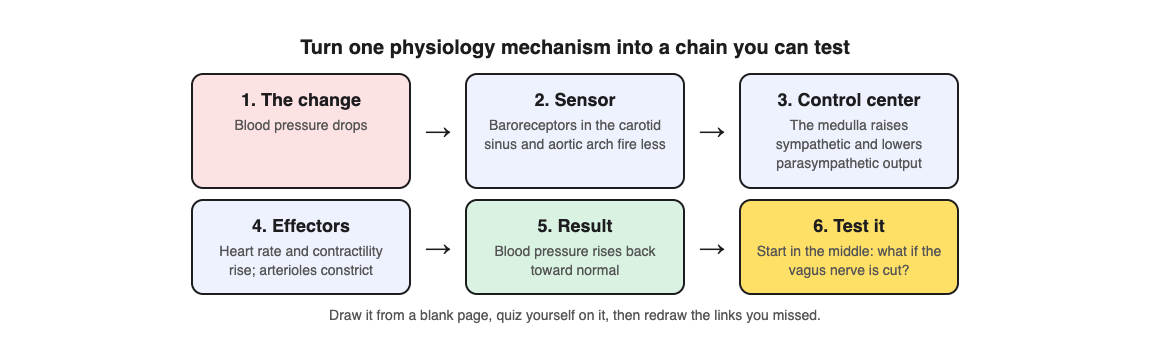
Now you have something you can test yourself on from any point in the chain.
Draw the pathways yourself: hormones, action potentials and the cardiac cycle
Looking at a textbook diagram is not the same as drawing it. When you draw from a blank page, you find the gaps right away. Three pathways are worth drawing first.
- Hormone pathways. Use one template every time: stimulus, gland, hormone, target, effect, and what shuts it off. For ADH: plasma osmolality rises, the posterior pituitary releases ADH, aquaporins are inserted in the collecting duct, more water is reabsorbed, urine becomes more concentrated, osmolality falls, and ADH release drops.
- Action potentials. Draw the voltage curve and label which channels open at each phase. Sodium rushes in during depolarization. Potassium leaves during repolarization. Then add the "why": each ion moves down its electrochemical gradient.
- The cardiac cycle. Sketch pressure in the left atrium, left ventricle and aorta on one timeline. Mark when each valve opens and closes. If you can explain why the mitral valve closes at the start of ventricular contraction, you understand the cycle.
Keep these drawings. They are about to become your practice material.
What research on physiology students shows
Physiology knowledge fades if you never pull it back out. In one study, 41 new critical care fellows took a 15-question pulmonary physiology test built from preclinical course questions, and preclinical medical students did significantly better on the same items. The authors called for retrieval practice over the years, not just before one exam.
Course studies point the same way, with limits. In a graduate physiology course run over four semesters, flipped teaching and flipped teaching with retrieval practice both beat lectures, about 93 against 89 on average, but adding retrieval practice to the flipped course made almost no extra difference. Students also said they preferred lectures, even though they scored lower with them (Gopalan, 2025). In a nursing course on anatomy, physiology and biochemistry, short team tests five days after each lecture came with more A and B grades, though students' earlier school grades also mattered (Emblemsvåg, 2024). For the general case for self-testing, see why testing yourself beats rereading your notes.
So test yourself often, and spread it out. Just do not expect a single trick to carry the exam.
Practice with "what happens if" questions
This is where many students lose points. You know the pathway in order, but the exam starts you in the middle and changes one variable. Turn each map into questions like these:
- What happens to heart rate if the vagus nerve is cut?
- What happens to resting membrane potential if extracellular potassium rises?
- What happens to urine volume if the kidney stops responding to ADH?
Answer in a chain, not a single word. "Heart rate rises, because the parasympathetic brake is gone and the SA node returns to its faster intrinsic rate."
Writing good questions for yourself is the hard part, and this is where a quiz tool helps. Photograph your hand-drawn map with Study Shot, which works in the browser on your phone or computer. Choose 10 questions and leave the level on Tiered, a ladder from basic to advanced. Press Create questions. You get multiple-choice questions about your own page, each with four choices, and every answer is checked and explained.
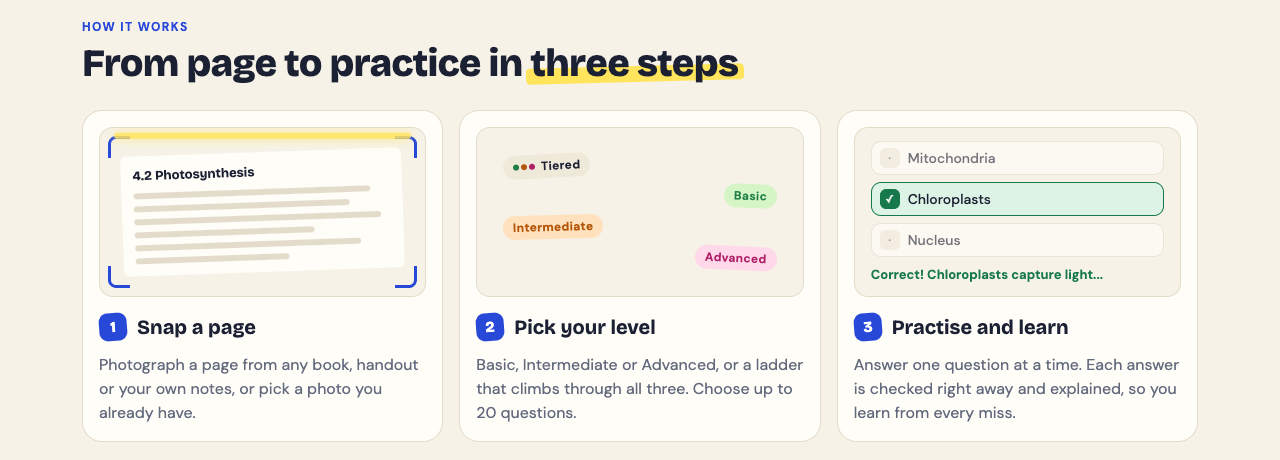
The Advanced level asks you to apply and predict in new situations. The results screen shows a separate score for each level. If you get the Basic questions right but miss the Advanced ones, you know the vocabulary but not the mechanism.
A multiple-choice quiz cannot check a drawing, so keep redrawing on paper. The questions are written by an AI model and can contain mistakes. Read each explanation against your notes, use Report a problem with this question if one looks wrong, and let your textbook and instructor have the last word.
How to study for a physiology exam in two weeks
Adjust the systems to match your syllabus. The structure is what matters.
Week one: build the maps
- Day 1: Core principles. Write out three feedback loops with all four parts.
- Day 2: Cell physiology and membrane transport. Draw the action potential from memory.
- Day 3: Cardiovascular. Draw the cardiac cycle and the baroreceptor reflex.
- Day 4: Respiratory. Map ventilation, gas exchange and how CO2 drives breathing.
- Day 5: Renal. Map filtration, reabsorption and the ADH pathway.
- Day 6: Endocrine. One template per major hormone.
- Day 7: Light review. Retake the quizzes from days 2 and 3.
At the end of each day, photograph that day's map and make a Tiered quiz from it. The quiz is saved to your library with your best score, ready to retake.
Week two: test and connect
- Days 8 to 10: Retake every quiz from week one. Open "Look at these again" on each results screen and redraw the part of the map behind each missed question.
- Days 11 and 12: Make Advanced quizzes from your weakest two systems. Write your own scenarios that cross systems, such as how dehydration affects the heart, kidney and blood pressure at once.
- Day 13: Full mixed review. Explain each major pathway out loud without notes.
- Day 14: Short review only, then sleep.
Studying with a group? Use Share this quiz to send a link. Each person who opens it needs a Study Shot account and gets their own copy of the questions, without your photo.
Frequently asked questions
How long should I study for a physiology exam?
Two weeks of short daily sessions suits a unit test or midterm, with a longer runway for a final. Spaced sessions with self-testing beat a few long nights of rereading.
Is physiology harder than anatomy?
Many students find it harder because physiology tests cause and effect, not just names and locations. Once you learn feedback loops and gradients, the systems start to follow the same logic.
What is the best way to memorize physiology?
Memorize less and trace more. Draw each pathway from a blank page, then test yourself with "what happens if" questions until you can predict the result of any change.
How do I study physiology for a nursing or pharmacology course?
Tie every mechanism to a patient or a drug, because that is how those exams ask about it. See our guides on studying for a nursing exam and studying for a pharmacology exam.
Get started
Take the pathway you drew today, whether it is the cardiac cycle, an action potential or a hormone loop. Photograph it, pick Tiered, and see whether you can climb from the basic questions to the advanced ones.
Try Study Shot: it is free to start. Photograph the page you are studying tonight and get 10 practice questions on it, from basic to advanced.
Comments
No comments yet.
Sign in or make an account to comment.