How to Study for a Political Science Exam: Concepts, Cases, Essays
If you are figuring out how to study for a political science exam, start with this: the exam rarely asks you to repeat a definition and stop. It asks you to define a concept, show it working in a real case, and then argue about it under time pressure. This guide walks you through each of those layers, with a worked example and a 7-day plan you can follow.
How to study for a political science exam: know what it will actually test
Before you open your notes, find out the format. Check the syllabus, past papers, and anything your instructor said in the last two weeks of class. Most political science exams use some mix of these:
- ID terms or short answers. Define a term and explain why it matters. "Federalism" is not enough. You need a sentence on its significance.
- Multiple choice. Common in intro courses on American government or comparative politics.
- Essays. Usually a question with a debatable claim, such as "Are presidential systems more stable than parliamentary ones?"
Write the format at the top of a blank page. Then list the units covered. That page tells you where to spend your hours. If essays are worth 60 percent of the grade, do not spend 80 percent of your time on flashcards.
Build a concept map of theories, institutions, and key terms
Political science is a web of connected ideas. A list of terms hides those connections. A concept map shows them.
Take one large sheet per unit. Put the big theme in the middle, for example "Democratic institutions." Branch out to the main categories:
- Theories: realism, liberalism, pluralism, elite theory, rational choice.
- Institutions: legislatures, executives, courts, electoral systems, parties.
- Key terms: sovereignty, legitimacy, separation of powers, checks and balances.
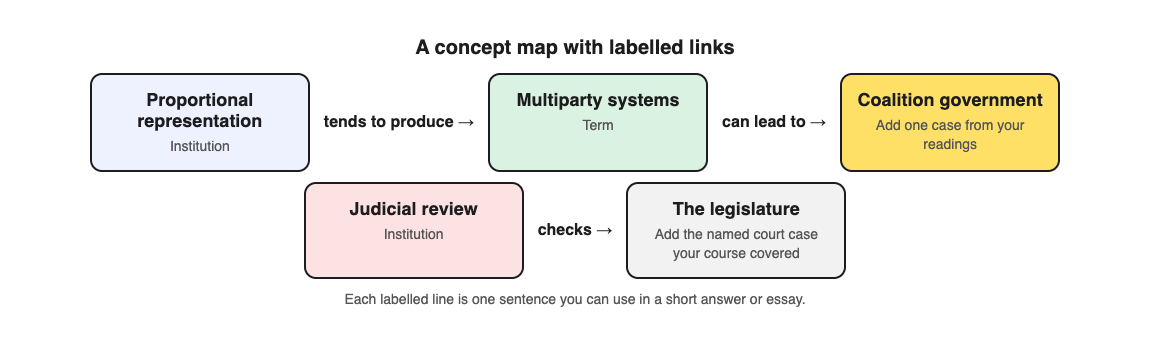
Then draw lines between items and label each line with a verb. "Proportional representation tends to produce multiparty systems." "Judicial review checks the legislature." Those labeled lines are the raw material for short answers and essay paragraphs.
For thinkers, add one line under each name: the core claim, in your words. Hobbes: people give up some freedom to a strong sovereign to escape a violent state of nature. Locke: government exists to protect natural rights and can be replaced if it fails. If you cannot write that line, you do not know the thinker yet.
The approach overlaps a lot with how you would prepare for a sociology exam built on theories, terms, and examples, so if you take both subjects, you can reuse the same map habit.
Tie every concept to a real case or current event
Graders reward examples. A concept with no case is a weak answer. A concept with a precise case is a strong one.
Go back to your map and add at least one case to every key term. Use cases from your readings and lectures first, since those are the ones your instructor expects. Keep each case short and specific:
- Federalism: a specific policy area where states or provinces took different paths from the national government.
- Coalition government: a parliamentary country from your readings where no single party won a majority.
- Judicial review: a named court case your course covered.
Write each case as one sentence: what happened, and which concept it shows. "In case X, the court struck down Y, which shows judicial review limiting the legislature." That sentence is ready to drop into an essay.
Practice short answers and ID terms with active recall
Rereading your notes mostly builds familiarity. Close the book and make yourself produce the answer. Quizzing on course material has held up in real classrooms: in a sixth grade social studies class, short multiple-choice quizzes raised scores on the actual chapter and semester exams, including short-answer tests.
Here is a simple drill for ID terms:
- Cover your concept map.
- Pick a term and say out loud: what it means, one case, and why it matters.
- Uncover the map and check. Mark any term you missed or fumbled.
- Repeat the marked ones tomorrow.
Saying answers aloud can help. There is more on that in what the research says about reading out loud.
A worked example with Study Shot
You can also turn your reading into practice questions. Study Shot is a web app that writes a multiple-choice quiz from a photo of a page. Say you have a textbook page on separation of powers. Here is the workflow:
- Open Study Shot in your phone or computer browser, go to Make a new quiz, and choose Take photo. Hold the page flat and fill the frame. Your own handwritten concept map works too.
- Pick 15 questions.
- Leave the level on Tiered. It splits the questions across Basic (key terms, facts, definitions), Intermediate (explain, compare, connect ideas), and Advanced (apply and predict in new situations), in that order.
- Press Create questions. It can take up to a minute.
Each question has four choices. After you press Check answer, you see whether you were right, the correct answer, and a short explanation. At the end, the results screen shows your score for each level. If you got every Basic question right but missed half the Advanced ones, you know the terms but cannot yet apply them, which is the gap essays expose. A 2018 meta-analysis found practice testing carries over best to application questions, so the Advanced questions are worth the effort. A quiz cannot mark an essay, though, so the essay practice below stays on paper.
The Look at these again list on the results screen shows each missed question with your answer and the right one. Copy those into your "marked" list for tomorrow. The quiz is saved to your library, so you can press Retake quiz later in the week.
One caution. The questions are written by an AI model and can contain mistakes. Read the explanation and check it against your textbook. If a question is wrong, use Report a problem with this question.
Plan and write timed essay arguments from evidence
Essays are where most points are won and lost. The fix is practice under real conditions.
Predict the questions
Look at past prompts and the big debates in your course. Write five likely essay questions. They usually take the form "Assess," "To what extent," or "Compare."
Outline in 10 minutes
For each predicted question, write a plan, not a full essay:
- Thesis: one sentence that takes a side. "Presidential systems are less stable than parliamentary systems, but mainly in countries with weak parties."
- Three body points: each with a concept and a case from your map.
- Counterargument: the best case against you, and your reply.
Write one full essay timed
Pick one outline and write it in the time the exam allows. No notes. Then grade yourself: Did the thesis answer the question? Did every paragraph use a named case? Did you define terms the first time you used them?
If your course uses data, such as polling or regression results in a research methods unit, practice those problems separately. The approach in studying for a statistics exam with practice problems first applies.
A 7-day political science exam study schedule
- Day 1: Confirm the format. List the units. Start one concept map per unit.
- Day 2: Finish the maps. Add a one-line core claim for every thinker and theory.
- Day 3: Add a case to every key term. Photograph your hardest textbook pages and run a Tiered quiz on each.
- Day 4: ID term recall drill. Retake yesterday's quizzes and focus on the questions you missed.
- Day 5: Write five predicted essay questions and outline all five.
- Day 6: Write one full timed essay. Grade it. Run an Advanced-level quiz on your weakest unit.
- Day 7: Light review only. Go through your marked terms and essay outlines. Sleep early.
If you study with classmates, you can use Share this quiz to send a link. Each person who opens it needs a Study Shot account and gets their own copy of the questions, without your photo.
Frequently asked questions
How long should I study for a political science exam?
For a midterm or final, plan on about a week of short daily sessions rather than one long night. Spread recall and essay practice across those days so you review each topic more than once.
How do I memorize political theories and thinkers?
Write each thinker's core claim in one sentence in your own words, then pair it with a case that shows the idea. Test yourself by covering your notes and saying the claim and case out loud.
Should I use current events in my exam answers?
Yes, if they clearly illustrate the concept and you know the facts well. Lead with cases from your course readings, since those are what your instructor expects, and add a current event as extra support.
What is the best way to study for a multiple-choice political science test?
Practice with multiple-choice questions that go beyond definitions and ask you to apply ideas. Study Shot can turn a photo of your textbook page into four-choice questions from basic to advanced, with an explanation for each answer.
Get started
Try Study Shot: it is free to start. Photograph the page you are studying tonight and get 10 practice questions on it, from basic to advanced.
Comments
No comments yet.
Sign in or make an account to comment.