How to Study for a Public Health Exam: A Practical Plan
If you are working out how to study for a public health exam, start by accepting that the subject is broad. One week you are reading a 2x2 table, the next you are comparing policy models or explaining why a behavior change program failed. A plan that treats every topic the same way will leave gaps. This guide gives you a plan that matches the method to the kind of material.
How to study for a public health exam: what is actually tested
Most public health exams mix three kinds of questions. Some ask you to recall a definition, such as the difference between incidence and prevalence. Some ask you to calculate or interpret a number, such as a relative risk or a confidence interval. Others hand you a short scenario and ask what you would do, or which principle applies.
Each kind needs different practice. Definitions need recall. Calculations need repetition on fresh numbers. Scenarios need you to name the framework before you pick an answer. If you only reread notes, you train recognition, and the exam asks for more than that.
If you are sitting a certification or a course exam, get the official content outline or syllabus first. Use it as your source of truth for what counts.
Map the exam by core domain
Public health courses usually cover a similar set of areas. Check your syllabus, but expect something like this:
- Epidemiology and study design
- Biostatistics
- Health policy and management
- Ethics and law
- Social and behavioral science
- Environmental and occupational health
Write each domain on a page and rate yourself from 1 to 3. A 1 means you could not explain it to a friend. A 3 means you could teach it. Be honest. It is easy to rate the topics you like as 3 and avoid the rest, so check each 3 by explaining it out loud.
Then list the subtopics under each domain. Under epidemiology, for example: measures of frequency, measures of association, bias and confounding, screening tests, outbreak investigation. This list becomes your checklist for the whole plan.
If your course leans on disease mechanisms, our pathophysiology study plan shows how to break that kind of material into steps. For environmental health, the cycles and models approach in our ecology exam guide carries over well.
Build a study schedule that works backward from exam day
Count the days until the exam. Subtract the last three days for mixed practice and rest. Split the remaining days across your domains, giving more days to the ones you rated 1.
A simple shape for each week:
- Two sessions on your weakest domain.
- One session on a middle domain.
- One short review session covering older domains, so they do not fade.
- One practice session where you answer questions without notes.
Keep sessions to 45 or 60 minutes with a clear target, such as "bias and confounding, then 10 questions." Vague goals like "study epi" lead to rereading.
Also plan for stress. It affects how you perform on the day, and it helps to know what the research says. Our post on stress before an exam and memory covers it.
Master epidemiology and biostatistics with worked problems
You cannot learn these by reading. You learn them by working problems until the setup is automatic.
Take a cohort example. You follow 100 exposed people and 200 unexposed people. Among the exposed, 30 get sick. Among the unexposed, 20 get sick.
- Risk in exposed: 30 / 100 = 0.30
- Risk in unexposed: 20 / 200 = 0.10
- Relative risk: 0.30 / 0.10 = 3.0
- Risk difference: 0.30 minus 0.10 = 0.20
Now say it in words: the exposed group had three times the risk, and 20 extra cases per 100 people. If you can state the result in a sentence, you can answer interpretation questions.
Next, compute the odds ratio from the same counts: the odds in the exposed group are 30 / 70, the odds in the unexposed group are 20 / 180, and the ratio is about 3.86. Notice that it differs from the relative risk of 3.0. Exam questions often ask you to tell the two apart, and to say which one a given study design allows.
For each formula, keep a short card with three parts: what it measures, how to compute it, and when it is the wrong choice. For biostatistics, add what a p-value and a confidence interval do and do not tell you.
Turn your own worked pages into quizzes
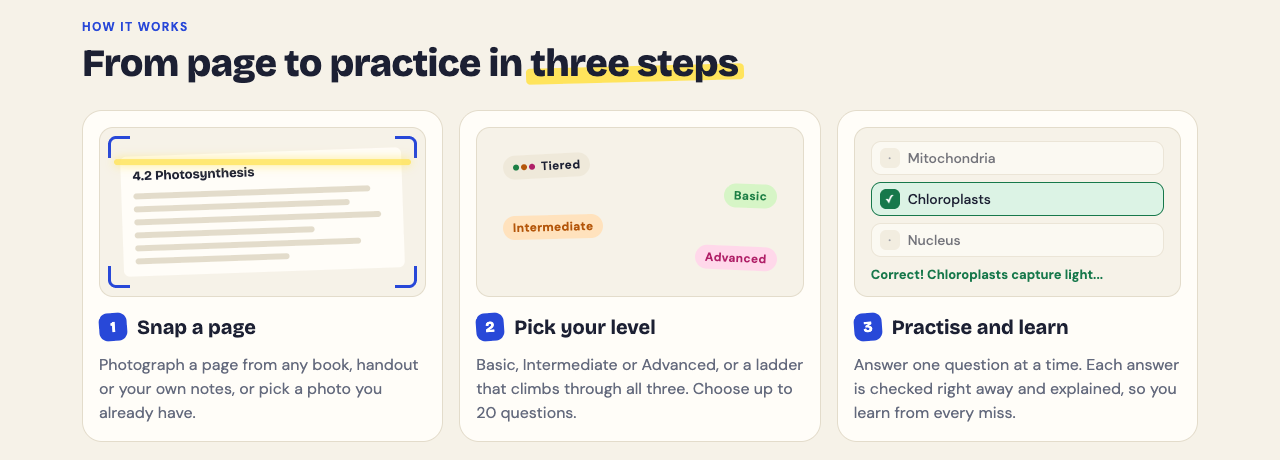
The three steps on the Study Shot home page.
Once you have a page of worked problems or a summary table in your notes, you can photograph it in Study Shot and have it write multiple choice questions about it. Choose the Advanced level, which is described as "Apply and predict in new situations." That suits interpretation questions better than the Basic level, which covers key terms, facts and definitions.
Be clear about the limit. The quizzes are multiple choice only, so they will not replace working through calculations by hand. Use them to test whether you can pick the right measure and read a result, and keep doing the arithmetic on paper.
Learn policy, ethics, and health behavior with frameworks and cases
These domains are less about numbers and more about naming the right idea. A question might describe a vaccination campaign with low uptake and ask which barrier or model explains it. Memorizing a list of theories will not help unless you can apply each one.
For every framework, build a small set of notes:
- The core idea in one sentence.
- The parts or levels it contains.
- One real or invented example you can attach it to.
- One situation where it does not fit.
For ethics, learn the main principles and practice naming which one is in tension in a case. Often two principles conflict, such as individual autonomy and community protection. The best answer usually acknowledges which one wins and why.
For policy, practice tracing a chain: problem, intervention, who pays, who is affected, how you would measure success. This chain turns vague policy reading into something you can answer from.
Use active recall and spaced repetition for definitions and concepts
Public health has a lot of vocabulary: sensitivity, specificity, herd immunity, social determinants, primary prevention, and many more. Close your notes and write the definition from memory. Then check. Do this on day one, day three, a week later, and again before the exam.
Mix near neighbors on purpose. Quiz yourself on sensitivity and specificity together, or on primary, secondary and tertiary prevention together. Pairs that are easy to confuse are worth practicing together.
The same method works for dense material in other sciences. Our guides to cell biology and biochemistry show how to break large topics into recall units.
Practice with past questions and case scenarios
In the last two weeks, shift most of your time to questions. Use past papers or practice sets from your instructor if you have them. Then fill gaps with your own material.
Here is a workflow with Study Shot:
- Photograph a page of notes or a textbook section on the domain you rated lowest. Hold the page flat and fill the frame.
- Pick 10 questions, or up to 20 for a longer session.
- Choose Tiered if you want a ladder from basic to advanced, or Advanced if you already know the terms.
- Answer one question at a time. After each Check answer, read the explanation, even when you were right.
- At the end, open Look at these again to see the questions you missed, with your answer next to the right one.
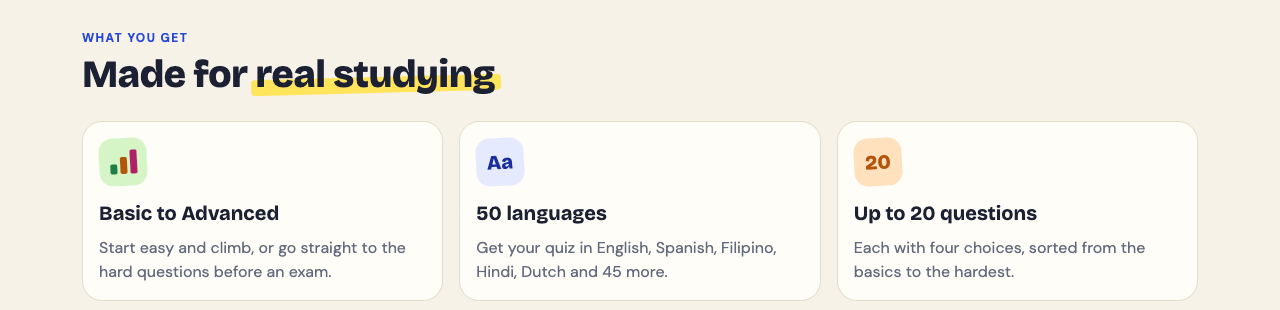
The home page lists levels, languages and up to 20 questions per quiz.
The results screen also shows a score for each level, so you can see whether you lose points on definitions or on application. Quizzes are saved in your library, so you can retake the same one a few days later and compare your best score.
The questions are written by an AI model and can contain mistakes. The explanation helps you check the reasoning against your course notes, and if a question looks wrong you can use Report a problem with this question. When something conflicts with your textbook, trust your textbook and your instructor.
If your study group is covering the same chapter, you can use Share this quiz to send a link. Each person needs a Study Shot account and gets their own copy of the questions, without your photo.
Frequently asked questions
How long should I study for a public health exam?
It depends on your starting point and the exam, but a plan of several weeks with short, regular sessions works better than a few long ones. Work backward from the exam date and give extra days to your weakest domains.
What is the hardest part of public health to study?
For many students it is epidemiology and biostatistics, because they require working problems, not just reading. Practice with fresh numbers until you can choose the right measure and explain the result in a sentence.
Can I use a photo of my notes to make practice questions?
Yes. In Study Shot you photograph a page of notes, a textbook or a whiteboard, and it writes multiple choice questions with explanations. Check them against your course material, since an AI model can make mistakes.
Should I memorize frameworks or practice cases?
Do both, but weight cases more as the exam gets closer. A framework is only useful if you can match it to a scenario and say why it fits.
Get started
Try Study Shot: it is free to start. Photograph the page you are studying tonight and get 10 practice questions on it, from basic to advanced.
Comments
No comments yet.
Sign in or make an account to comment.