How to Study for a Sociology Exam: Theories, Terms, and Examples
If you want to know how to study for a sociology exam, start with this: your teacher is rarely checking whether you can recite a definition. They want to see whether you can take a theory or a term and use it to explain something real, like why people follow dress codes or why some neighborhoods get better schools. This guide shows you how to build that skill with a theory map, example-based flashcards, short notes on key thinkers, and timed practice. It ends with a 7-day plan.
Why sociology exams test application, not memorization
Most sociology questions have two layers. The first layer asks what a concept means. The second asks you to apply it. "Define anomie" is the first layer. "Explain how anomie might rise in a town after its main factory closes" is the second.
Students who only memorize do fine on the first layer and stall on the second. The fix is to practice the second layer from day one. Every time you learn a term, attach a situation to it. Every time you learn a theory, ask what it would say about something in the news or in your own school.
Practice that asks you to apply helps most here. A 2018 meta-analysis found that testing yourself carries over best to application and inference questions, though the benefit shrank a lot once the authors corrected for studies that were never published. And in a sixth grade social studies class, short multiple-choice quizzes on course material raised scores on the real chapter and semester exams, including short-answer tests.
Build a theory map: functionalism, conflict theory, and symbolic interactionism
Almost every intro sociology course is built on three perspectives. Put them on one page, side by side, so you can compare them at a glance.
Functionalism
Society is like a body. Each part (family, school, religion, law) does a job that keeps the whole stable. Key names: Émile Durkheim, Talcott Parsons, Robert Merton. Key terms: social solidarity, manifest and latent functions, dysfunction, anomie.
Conflict theory
Society is shaped by groups competing for scarce resources like money, power, and status. Those with more power set the rules. Key names: Karl Marx, and later thinkers who extended his ideas to race and gender. Key terms: bourgeoisie, proletariat, class consciousness, stratification.
Symbolic interactionism
Society is built in small, everyday interactions. People act based on the meanings they give to things, and those meanings are learned. Key names: George Herbert Mead, Charles Horton Cooley, Herbert Blumer, Erving Goffman. Key terms: the self, looking-glass self, dramaturgy, labeling.
Add one row that ties them together
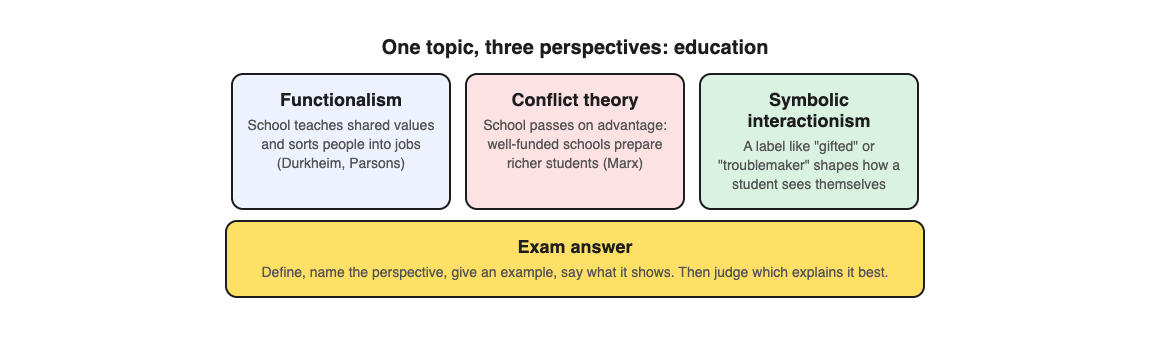
Pick a single topic, such as education, and write one sentence for each perspective. Functionalism: school teaches shared values and sorts people into jobs. Conflict theory: school passes on advantage, since well-funded schools prepare richer kids for better jobs. Symbolic interactionism: a teacher's label of "gifted" or "troublemaker" can shape how a student sees themselves. Do this for two or three topics (family, crime, religion) and you have most of an essay plan before the exam.
Turn key terms into flashcards with your own real-world examples
A flashcard with just a term and a definition trains the first layer only. Add a third line: an example from your own life or the news.
- Front: Latent function
- Back: An unintended, often unnoticed result of a social pattern.
- Your example: College is meant to give you a degree. A latent function is that many people meet their future partners there.
Write the example yourself. It makes you use the idea, not just recognise it, and it trains you to spot sociology outside the book.
Group cards by perspective, not by chapter. When "labeling" sits next to "looking-glass self" and "dramaturgy," you see why they belong to the same family of ideas. For more on cards, see are flashcards a good way to study.
Link each sociologist to one big idea you can explain
You do not need a biography for every name. You need one idea per person that you can explain in two sentences and apply to a case.
- Durkheim: anomie. When norms break down, people lose direction, and problems like deviance can rise.
- Marx: class conflict. Owners and workers have opposed interests, and that tension drives social change.
- Max Weber: rationalization. Modern life is organized more and more by rules, efficiency, and bureaucracy.
- C. Wright Mills: the sociological imagination. Personal troubles, like losing a job, often connect to public issues, like an economic downturn.
- Cooley: the looking-glass self. You build your self-image from how you think others see you.
- Goffman: dramaturgy. Daily life is like a stage, with a front stage where we perform and a backstage where we relax.
Test yourself by covering the right side and explaining each idea out loud with a new example. If you can only say the label, you are not ready yet.
Practice short-answer and essay questions under timed conditions
Short answers and essays reward structure. A reliable pattern for a short answer is: define the term, name the perspective it comes from, give a concrete example, and say what it shows. Four sentences, done.
For essays, use your theory map. Open with a clear claim. Then give one paragraph per perspective, each with an example and a key thinker. Close by saying which perspective explains your example best and why. That last step is where many students lose marks, because it is where you show judgment.
Set a timer that matches your real exam, then grade yourself: did you define, apply, and evaluate? Rewrite your weakest paragraph once. A multiple-choice quiz cannot mark an essay, so this part always stays on paper.
Use quick quizzes to find gaps fast
Before you spend time on essays, find out which concepts are shaky. One way is Study Shot, a web app that turns a photo of a page into a multiple-choice quiz. Here is a workflow that fits sociology well:
- Photograph your theory map page or a textbook page on the three perspectives. Hold the page flat and fill the frame. Handwritten notes work too.
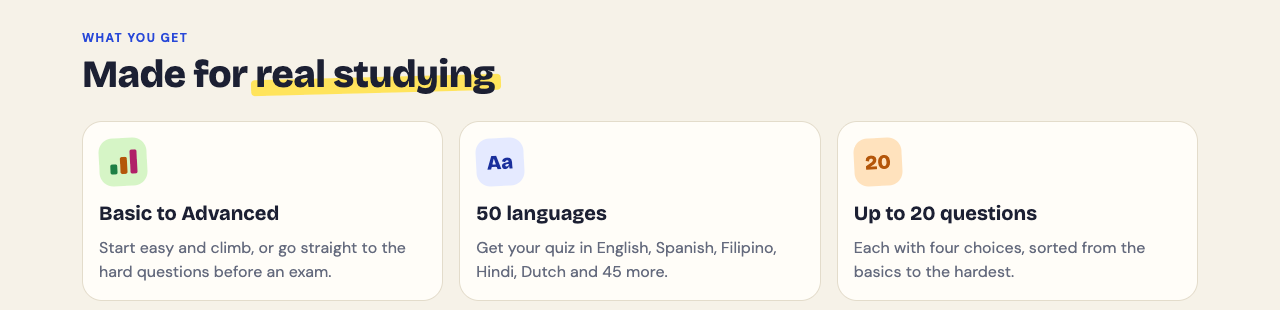
- Choose 15 questions and leave the level on Tiered. Tiered climbs from Basic (key terms and definitions) through Intermediate (explain, compare, connect) to Advanced (apply and predict in new situations), split as evenly as possible, so about five of each.
- Press Create questions. Each question has four choices. After you pick one and press Check answer, you see whether you were right, the correct answer, and a short explanation.
- On the results screen, check your score for each level. A high Basic score and a low Advanced score is the classic sociology gap: you know the words but struggle to apply them. That tells you to spend your next session on examples.
- Read the Look at these again list, which shows each missed question with your answer and the right one. Turn every miss into a new flashcard with your own example.
The questions are written by an AI model and can contain mistakes. Read the explanation to check the reasoning against your notes, and use Report a problem under a question if something looks wrong. The quiz is saved in your library with your best score, so you can retake it later and see if you improved.
A 7-day plan: how to study for a sociology exam
- Day 1: Build your theory map. Fill in the three perspectives and add one topic row, like education.
- Day 2: Make flashcards for every key term, each with your own example. Group them by perspective.
- Day 3: Write your one-idea list for each sociologist. Explain each out loud with a fresh example.
- Day 4: Quiz yourself on your notes. Note which level you miss most and rewrite those cards.
- Day 5: Write two timed short answers and one timed essay. Grade them with the define, apply, evaluate check.
- Day 6: Add two more topic rows to your theory map (family and crime are common). Retake your quiz and compare scores.
- Day 7: Light review only. Read your theory map, flip through missed cards, and sleep well.
If you are in a study group, Study Shot's Share this quiz button makes a link. Each person who opens it needs their own account and gets their own copy of the questions, without your photo. Comparing who missed what is a quick way to start a useful discussion.
Frequently asked questions
How long should I study for a sociology exam?
Spread your work over about a week, with short daily sessions instead of one long night. Daily practice lets you spot weak concepts early and fix them before the exam.
What is the best way to memorize sociology theories?
Compare them side by side on one page and apply all three to the same topic, such as education or crime. Linking each theory to examples is easier to remember than a list of definitions.
How do I write a strong sociology essay answer?
Make a clear claim, then use one paragraph per perspective, each with a key thinker and a concrete example. Finish by judging which perspective explains your example best and why.
Are multiple-choice sociology questions harder than essays?
They test different things. Multiple-choice questions often check whether you can tell similar terms apart, while essays check whether you can build an argument, so practice both.
Get started
Try Study Shot: it is free to start. Photograph the page you are studying tonight and get 10 practice questions on it, from basic to advanced.
Comments
No comments yet.
Sign in or make an account to comment.