How to Study for a Sports Science Exam: Physiology and Biomechanics
If you are working out how to study for a sports science exam, start with one fact: the paper tests three different skills at once. You need to recall physiology, you need to calculate biomechanics, and you need to read data from fitness tests and studies. Rereading your notes is the weakest way to practise any of them. This guide shows you how to practise each skill, and how to turn your own pages into quizzes so you test yourself instead of just reading.
What a sports science exam actually tests: recall, application, and data
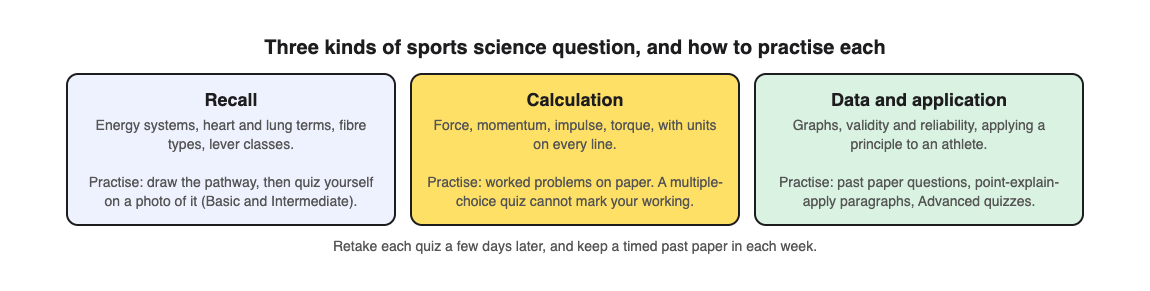
Look at any past paper and sort the questions into three piles.
- Recall. Name the energy system. Define stroke volume. Label the phases of a sprint start.
- Application. Explain why a 400m runner tires in the final 100m. Calculate the impulse on a jumper at take off.
- Data. Read a graph of heart rate during exercise. Judge whether a fitness test is valid or reliable.
Recall is the easiest pile to revise, so it is easy to spend all your time there. Check how your own past papers split their marks, and plan your time so each pile gets real practice.
Map exercise physiology as pathways: energy systems, heart, lungs, muscles
Physiology is easier to remember as a chain of cause and effect than as a list of facts. Draw each system as a pathway.
Energy systems
Draw three boxes in a row: ATP-PC, anaerobic glycolysis, aerobic. Under each, write the same four headings: fuel, duration it dominates, by-products, and a sport example. A 100m sprint draws heavily on the first two boxes. A 1500m race draws on glycolysis and aerobic energy together. A marathon is mostly aerobic. When every box has the same headings, you can compare them in an exam answer without hunting for details.
Heart and lungs
Write the key equation and then a story. Cardiac output equals stroke volume times heart rate. Now tell the story of a training effect: endurance training increases stroke volume, so resting heart rate can drop while cardiac output stays the same.
Muscles
Link fibre types to sports. Slow twitch fibres resist fatigue and suit endurance events. Fast twitch fibres produce force quickly and suit power events. Then link them back to energy systems, because applied questions often ask you to.
Drill biomechanics with worked problems: forces, levers, momentum, units
Biomechanics is a calculation subject. You learn it by doing problems, not by reading them. The habits are close to those in an engineering course, and our guide on how to study for an engineering exam covers the same discipline with formulas and units.
Keep a formula sheet with every symbol and unit spelled out:
- Force equals mass times acceleration, in newtons (N).
- Momentum equals mass times velocity, in kilogram metres per second (kg m/s).
- Impulse equals force times time, in newton seconds (N s), and it equals the change in momentum.
- Torque equals force times perpendicular distance from the pivot, in newton metres (N m).
Here is a worked example. A 70 kg sprinter leaves the blocks and reaches 3 m/s. Their momentum is 70 times 3, which is 210 kg m/s. If the push lasted 0.5 seconds, the average net horizontal force was 210 divided by 0.5, which is 420 N. Write every step, with units on every line.
For levers, learn the order of fulcrum, effort, and load for first, second, and third class levers. Then attach one body example to each. Third class levers, like the elbow during a bicep curl, are the most common in the body. Be ready to explain the trade off: a lever can favour force or range and speed, not both.
Read fitness test and research data: graphs, tables, and validity questions
Data questions reward a fixed routine. Use the same one every time:
- Read the axis labels and units before you look at the line.
- Describe the overall trend in one sentence.
- Quote two specific values with units.
- Explain the trend with physiology or biomechanics.
- Comment on the method: sample size, controls, and whether the test measures what it claims.
Learn the difference between validity and reliability in plain words. Valid means the test measures the thing it says it measures. Reliable means you get similar results when you repeat it under the same conditions. A test can be reliable without being valid.
The heart, lung and muscle questions overlap with a physiology course, and our guide on how to study for a physiology exam goes deeper on learning mechanisms rather than lists.
Answer applied questions: link theory to an athlete, sport, or training plan
Applied questions ask you to take a principle and place it inside a sport. A simple structure works: point, explain, apply.
- Point: name the concept. "A rugby prop relies heavily on the ATP-PC system."
- Explain: say how it works. "It resynthesises ATP quickly for maximal efforts of a few seconds."
- Apply: tie it to the athlete. "This powers the explosive drive in a scrum, so the prop should train with short maximal efforts and full recovery."
Practise this with three sports you know well. Write one paragraph per sport for each major topic. Your course textbook and your teacher have the last word on how your exam board wants these answers set out.
Use active recall and spaced quizzes instead of rereading your notes
Rereading feels easy because the page is in front of you. In the exam, it is not. In a 2006 study by Roediger and Karpicke, students who took recall tests on a passage remembered more of it two days and one week later than students who reread it, even though rereading made them feel more confident. Spaced practice means you come back to the same material over several days.
One limit matters for this subject. A 2018 review of 122 experiments by Pan and Rickard found that practice tests help you answer new questions too, but that this transfer is weakest for problems with worked solutions. So keep biomechanics calculations on paper, and use quizzes for the ideas behind them: what impulse means, which lever class an elbow is, why stroke volume rises with training.
Study Shot makes the quiz part quick. It is a web app: you photograph a page from your textbook, your notes, or a whiteboard, and it writes multiple choice questions about it, each with four options. You answer one at a time. Each answer is checked straight away and explained in one to three sentences, so a wrong answer becomes a short lesson.
Here is a workflow for the energy systems pathway you drew earlier:
- Hold the page flat and fill the frame. Diagrams work, so a hand drawn pathway is fine.
- Choose 10 questions, which is the default. You can pick 5, 10, 15, or 20.
- Leave the level on Tiered. It works as a ladder: basic questions first, then intermediate, then advanced, split as evenly as it can.
- Press Create questions. It can take up to a minute.
The levels match the three piles from earlier. Basic covers key terms, facts, and definitions. Intermediate asks you to explain, compare, and connect ideas. Advanced asks you to apply and predict in new situations. That last level is the closest match to applied exam questions.
The results screen shows your score for each level and a Look at these again list of missed questions with your answer and the right answer. High Basic and low Advanced scores mean your recall is fine and your application needs work.
Every quiz is saved to your library with its page photo and your best score, so you can retake it two days later for spaced practice. A multiple-choice quiz cannot mark your working, so it is no substitute for the paper problems. The questions are written by an AI model and can contain mistakes. Read the explanation and compare it with your notes and textbook. If a question looks wrong, use Report a problem with this question under it.
How to study for a sports science exam in two weeks: a revision plan with timed practice papers
Two weeks is enough if you mix the three skills every day.
Week one: build and test
- Days 1 to 2: draw your physiology pathways, photograph each page and take a Tiered quiz.
- Days 3 to 4: formula sheet, then 10 worked problems a day on paper.
- Day 5: data questions from past papers with the five step routine.
- Days 6 to 7: retake the quizzes and write point, explain, apply paragraphs.
Week two: pressure and gaps
- Days 8 to 9: one timed practice paper a day, marked honestly.
- Days 10 to 11: Advanced quizzes on the pages behind your weakest topics.
- Days 12 to 13: another timed paper, then retake any quiz not yet at Mastered (90% and up).
- Day 14: light review of your Look at these again lists.
Frequently asked questions
How long should I study for a sports science exam?
It depends on how much of the course is new to you. If you have kept up, a two-week plan that mixes recall, calculations and data reading every day, like the one above, is a fair start.
What is the best way to memorise energy systems?
Draw the three systems side by side with the same headings: fuel, duration, by-products, and a sport example. Then test yourself on the page instead of rereading it.
How do I answer 'apply to a sport' exam questions?
Use point, explain, apply: name the concept, say how it works, then link it to a specific action in the named sport. Practise with three sports so the pattern becomes automatic.
Get started: turn your sports science notes into quizzes with Study Shot
Study Shot runs in the web browser on your phone or computer, and you create a free account to use it. Pick one page tonight, such as your energy systems diagram or your biomechanics formula sheet, and quiz yourself on it.
Try Study Shot: it is free to start. Photograph the page you are studying tonight and get 10 practice questions on it, from basic to advanced.
Comments
No comments yet.
Sign in or make an account to comment.