How to Study for a Statistics Exam: Practice Problems First
If you are figuring out how to study for a statistics exam, start with this: statistics tests two different skills. One is choosing the right method for a question. The other is carrying it out and saying what the result means. Most study habits practise only the second, or neither. This guide shows how to practise both, with problems on paper and a quick quiz on the ideas, plus a two-week plan.
Why statistics exams feel harder than they look
In class, each method arrives on its own: this week a t test, next week chi-square. On the exam, the questions are mixed, and the hard part is often deciding which method a question calls for. A student who can run every calculation can still lose marks by running the wrong one.
Statistics also brings its own nerves. In one survey of students, more negative attitudes towards statistics went with more anxiety, more putting work off, and lower marks. Another study of 202 psychology students found that anxiety went with lower predictions of their own marks, but higher actual scores, which the authors read as a possible "right amount" of worry. Both are surveys, so they show links, not causes. The practical lesson from both: start early, in small pieces, so avoidance never gets a hold.
Start with a map of the course
Before you practise anything, sort your course into three parts on one page:
- Describing data: mean, median, spread, graphs.
- Probability: the rules, distributions, the normal curve.
- Inference: confidence intervals and hypothesis tests.
List each method under its part. This page becomes your study checklist and, later, something to quiz yourself on.
How to study for a statistics exam: learn to choose the method first
Write a short decision path and practise it until it feels automatic:
- Is the variable categorical (groups, yes or no) or quantitative (a measured number)?
- How many groups or samples: one, two, or more?
- If two, are they paired (the same people measured twice) or independent?
- Are you estimating a value (an interval) or testing a claim (a test)?
Then drill it. Take ten old problems, cover the solutions, and for each one write only the name of the method and one sentence of reasoning. Do not calculate. For example, "the same 20 students, scored before and after tutoring" points to a paired t test, not a two-sample one. Any method you keep confusing goes on a list for tomorrow.
Work problems on paper, mixed
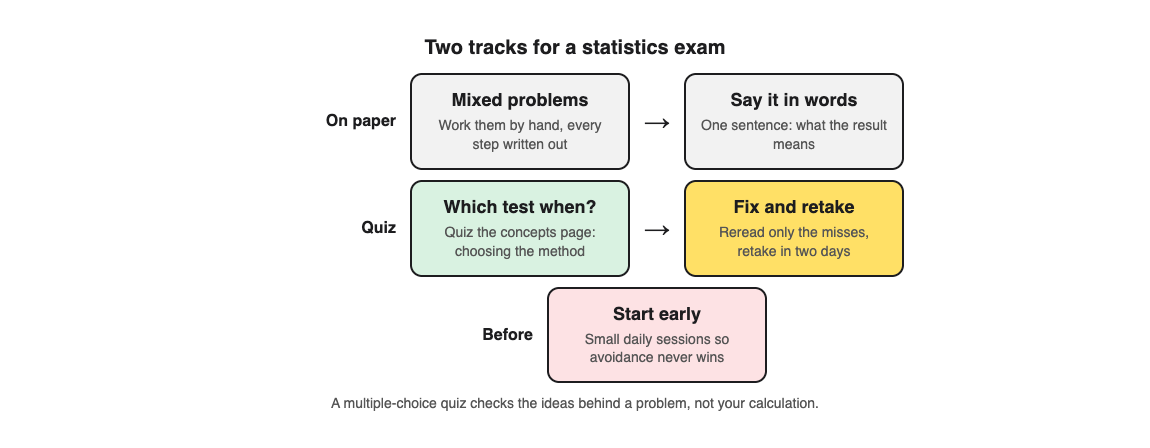
Practice problems are the centre of statistics revision, and they belong on paper with every step written out. Build a set from homework, the textbook and any past exams, and mix the methods together rather than doing ten of one kind in a row. Our post on interleaving practice explains why mixing helps.
After each problem, write one sentence in plain words: what the result means for the question. "We are 95% confident the average lies between 12 and 15 minutes" is a mark-earning sentence. A number with no sentence often is not.
If your course uses software, practise reading its output too. Take a printed table of results, cover the labels you already know, and say what each number is: the test statistic, the degrees of freedom, the p-value, the interval. Then write the one-sentence conclusion. Exams often hand you output and ask only for that sentence.
Quiz yourself on the ideas, not the arithmetic
Here is the limit to know. A large review of practice testing, Pan and Rickard (2018), found that testing yourself helps most with application and inference questions, and least with worked problems and with material you never quizzed. So a quiz is for the ideas: which method fits, what a p-value means, why sample size matters. The calculations stay on paper.
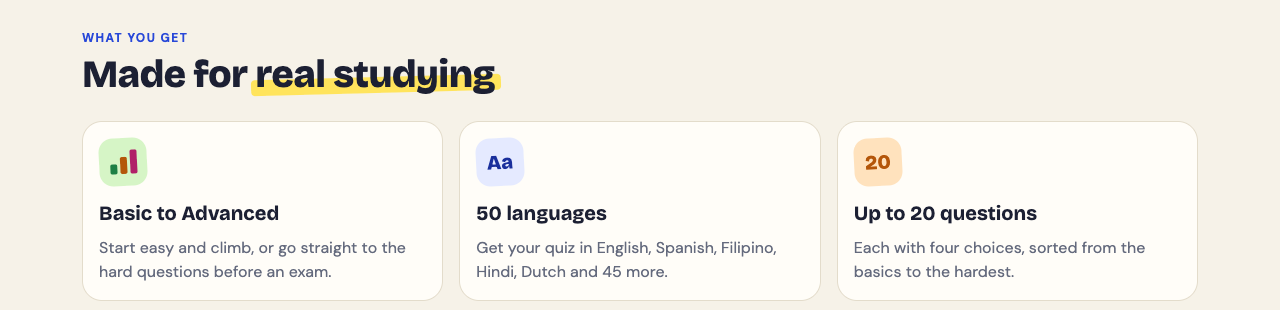
Photograph the page that explains the ideas, such as your decision path, a textbook page on hypothesis tests, or your course map. Open Study Shot in your browser, tap Make a new quiz, then Take photo, and hold the page flat to fill the frame. Choose 10 questions and the Intermediate level, which asks you to explain, compare and connect ideas, or Advanced, which asks you to apply and predict in new situations. Press Create questions.
Answer one at a time and press Check answer to see the right answer and a short explanation. The questions are written by an AI model and can contain mistakes, especially on a page full of symbols. Check each explanation against your textbook, and use Report a problem with this question if one is wrong.
A two-week statistics exam plan
- Days 1 and 2: make the course map and the decision path. Quiz yourself on both.
- Days 3 to 6: one block of mixed problems on paper each day, 20 to 40 minutes, each ending with a plain-words sentence.
- Day 7: the method-choosing drill on ten new problems. Retake your quizzes from your library, where each is saved with its page photo and best score.
- Days 8 to 11: more mixed problems, weighted towards the methods on your confusion list. Use the Look at these again list after each retake to find what to reread.
- Days 12 and 13: a timed past paper on paper, then mark it and redo every wrong question.
- Day 14: a short retake of your weakest quiz, your formula sheet, and an early night.
For more on problem practice, see how to study for a math test with practice problems.
Frequently asked questions
How do I know which statistical test to use?
Ask in order: what type of variable, how many groups, paired or independent, and estimating or testing. Practise naming the method for old problems without calculating until it is quick.
Should I memorise formulas for a statistics exam?
Check whether your exam gives a formula sheet. Either way, make sure you know what each formula is for and what each symbol means; that is what lets you choose and use it.
Can a multiple-choice quiz help with statistics?
Yes, for the ideas: choosing methods, reading results, and what terms mean. It cannot check your working, so keep calculations on paper.
What if statistics makes me anxious?
Start early and keep sessions short, so the work never piles up. Some worry may even help, but if it stops you starting, talk to your instructor or a study support service.
Get started
Tonight, write your decision path on one page, quiz yourself on it, and name the method for five old problems without calculating.
Try Study Shot: it is free to start. Photograph the page you are studying tonight and get 10 practice questions on it, from basic to advanced.
Comments
No comments yet.
Sign in or make an account to comment.