How to Study for a World History Final: A 7-Day Plan
If you are trying to figure out how to study for a world history final, the hard part is usually not effort. It is the size of the course. You covered thousands of years and every continent, and now you have a week. This plan breaks that week into seven days with one clear job each. You map the course, connect it, drill the facts, practice documents, and then write. By the end you should be able to place any event in time, explain why it mattered, and back up a claim with evidence.
Why world history finals feel impossible (and what they actually test)
World history feels impossible because it looks like a list of everything. Rome, the Song dynasty, the Mali Empire, the Columbian Exchange, two world wars. Nobody can memorize all of it, and your teacher knows that.
Most finals test three skills, not every fact:
- Placement. Can you put an event in the right era and region?
- Connection. Can you compare two societies or trace a change over time?
- Argument. Can you make a claim and support it with evidence, often from documents?
Facts still matter. But they matter as tools for those three skills. So study the facts in a way that also trains placement, connection and argument. That is what each step below does.
Step 1: Map the course on one timeline of eras and regions
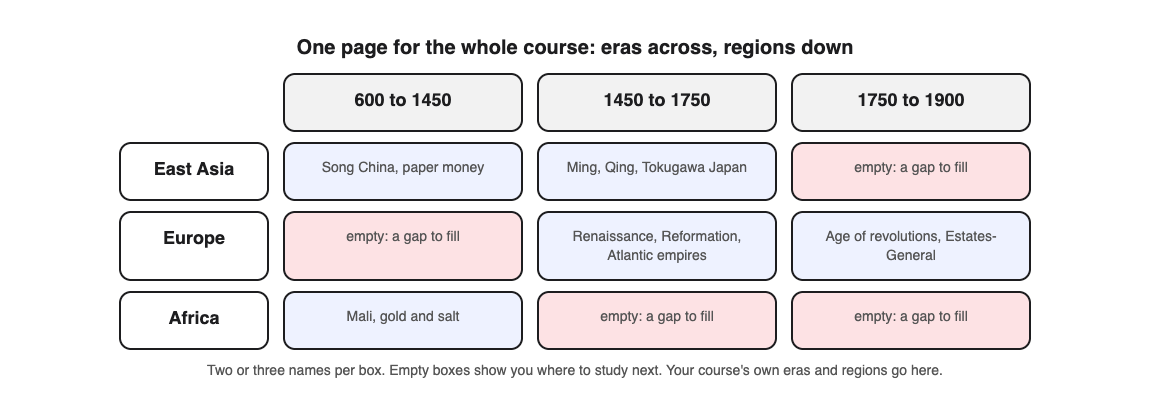
Take one sheet of paper. Turn it sideways. Across the top, write the eras your course used. Your textbook's unit titles are a good guide. Down the left side, write the regions: for example East Asia, South Asia, the Middle East, Africa, Europe, the Americas.
Now fill in the boxes with only the biggest names. Two or three per box. For the box where Europe meets 1450 to 1750, you might write "Renaissance, Reformation, Atlantic empires." For East Asia in the same era, "Ming, Qing, Tokugawa Japan."
Leave empty boxes empty. They show you exactly where your gaps are. This one page becomes your map for the week. When you study anything later, ask: which box does this go in?
Step 2: Build theme charts that connect civilizations across time
Finals love comparison questions. "Compare the role of religion in two empires." "Explain how trade changed between 1200 and 1750." Theme charts get you ready for these.
Pick five themes your course used. A common set is politics, economy, religion and ideas, social structure, and technology. Make a small chart for each theme. Down the side, list four or five societies from your timeline. In each cell, write one sentence.
Here is an example for the economy theme:
- Abbasid Caliphate: Iraq traded across the wider Indian Ocean world.
- Song China: The first state to issue true paper money, printed in government factories.
- Mali: Taxed the gold, copper and salt that entered its borders.
Then write one comparison sentence under the chart. "Both the Abbasids and Mali drew wealth from trade that crossed their lands." That sentence is the start of an essay paragraph. If an idea will not fit in one clear sentence, say what it is, then why it matters.
Step 3: Turn vocabulary and key events into active recall questions
Rereading feels productive, but on a test you have to pull the answer out of your head. That is active recall. In a 2006 study, students who tested themselves on a passage remembered much more two days and a week later than students who reread it, even though rereading made them feel more confident.
Start on paper. Cover your timeline and write the main events of one unit from memory, then check. Then move to questions.
Go through your notes and review sheets one unit at a time. For each key term or event, you want a question that makes you retrieve it, not just see it. You can write these by hand. You can also use Study Shot, which turns a photo of a page into a multiple-choice practice quiz.
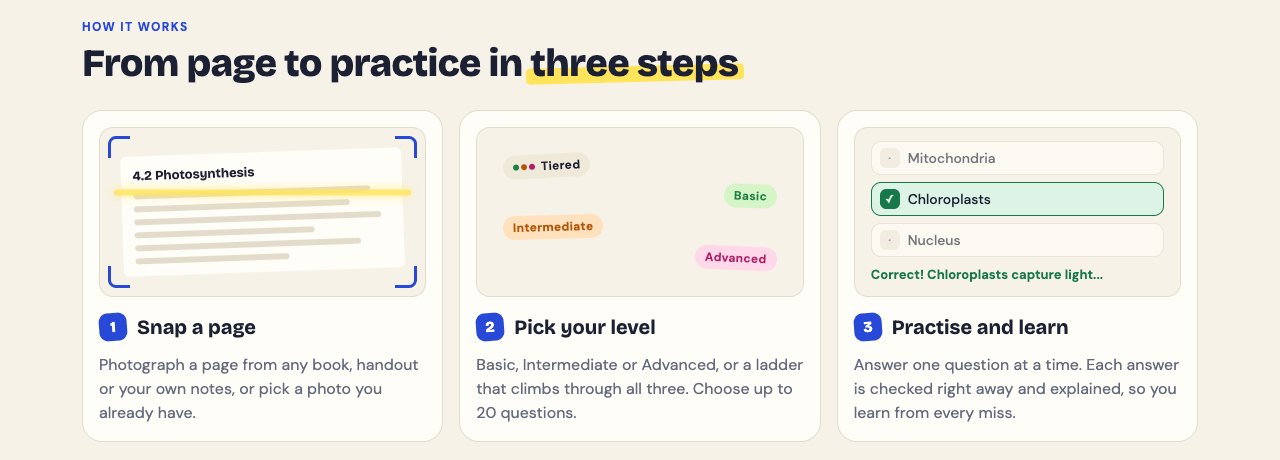
A worked example. Say your teacher handed out a review sheet for the unit on the age of revolutions. You open Study Shot in your phone's browser, choose Make a new quiz, and pick Take photo. Hold the page flat and fill the frame. Then you choose:
- Number of questions: 5, 10, 15 or 20. Pick 15 for a dense review sheet.
- Level: Tiered is the default. It works as a ladder, splitting the questions across Basic, Intermediate and Advanced, in that order.
Press Create questions. Each question has four choices. You answer one at a time, press Check answer, and see whether you were right, the correct answer, and a short explanation.
The level split is useful for history. Basic questions cover key terms, facts and definitions, like what the Estates-General was. Intermediate questions ask you to explain, compare and connect ideas. Advanced questions ask you to apply and predict in new situations. When you finish, the results screen shows your score for each level. If you got every Basic question right but missed most of the Advanced ones, you know the facts but need to work on connections. Go back to Step 2.
The questions are written by an AI model, so they can contain mistakes. Read each explanation and check it against your notes. If a question is wrong or unclear, use Report a problem with this question under it.
Step 4: Quiz yourself on primary sources and document questions
Many world history finals include document questions. You read a short source and answer questions about who wrote it, why, and what it shows. This is a separate skill from memorizing events, so practice it on its own day.
Gather the primary sources from your course packet: an excerpt from the Code of Hammurabi, a letter from a Spanish conquistador, a speech from a decolonization leader. For each one, ask:
- Who wrote this, and when?
- Who was the intended audience?
- What was the purpose?
- What does it tell us, and what does it leave out?
You can also photograph a source page and make a quiz on it. During the quiz, Show page brings back your photo, so you can look at the text while you answer, just like on a real document question. For a full method, see how to quiz yourself on a primary source for history class.
Step 5: Practice essay prompts by building arguments from evidence
The essay is often worth the most points, and it is the part students practice least. Do not wait for test day to write your first one.
Find old prompts from your teacher or textbook. For each one, spend 15 minutes on an outline, not a full essay:
- Write a one-sentence thesis that takes a position.
- List three pieces of evidence. Pull them from your theme charts and documents.
- For each piece, write one sentence explaining how it supports the thesis.
Then write one full essay under timed conditions. Compare it to the outline. Did every paragraph tie back to your claim? Mark any paragraph that only tells the story without using it as evidence.
How to study for a world history final in 7 days: a schedule you can copy
Plan for about 60 to 90 minutes a day. Adjust to your course.
- Day 1: Map. Build your era and region timeline. Mark the empty boxes.
- Day 2: Connect. Make theme charts for politics and economy. Write a comparison sentence for each.
- Day 3: Connect and recall. Finish the other theme charts. Make a quiz from your first two units and take it.
- Day 4: Recall. Quiz yourself on the remaining units. On the results screen, read the Look at these again list of missed questions and fix those gaps in your notes.
- Day 5: Documents. Work through three or four primary sources with the four questions from Step 4.
- Day 6: Essays. Outline three prompts. Write one full essay under a timer.
- Day 7: Review. Retake your weakest quizzes from your library. Look at your timeline one last time. Sleep.
Your quizzes are saved in your library with your best score, so on Day 7 you can see which units still need work and use Retake quiz. If you study with friends, Share this quiz makes a link. Each person who opens it needs a Study Shot account and gets their own copy of the questions, without your photo.
Frequently asked questions
How many days before a world history final should I start studying?
This plan uses seven days, so you can map, connect, test, practise documents and write with one job per day. If you have less time, keep the timeline, the unit quizzes and one essay outline.
What is the fastest way to memorize world history dates and events?
Attach each date to a place on a single era and region timeline, then test yourself with recall questions instead of rereading. Dates stick better when you know what came before and after them.
How do I study for the essay or DBQ part of a world history final?
Practice outlining old prompts: one thesis, three pieces of evidence, and one sentence linking each piece to your claim. Then write at least one full essay under a timer before test day.
Should I reread my notes or use flashcards for world history?
Use active recall, like flashcards or practice quizzes, because a test asks you to retrieve answers, not recognize them. Reread only to fix the gaps your quizzes reveal.
Get started
Try Study Shot: it is free to start. Photograph the page you are studying tonight and get 10 practice questions on it, from basic to advanced.
Comments
No comments yet.
Sign in or make an account to comment.