How to Study for an Accounting Exam: Paper Entries, Quizzed Rules
If you are working out how to study for an accounting exam, start with one fact about the subject: accounting is a skill you do, not a set of facts you read. Most exam marks come from recording transactions correctly, adjusting accounts at the end of a period and building statements that balance. Rereading the chapter will not train that. This guide gives you a plan that keeps the problems on paper and uses quizzes for the ideas behind them.
How to study for an accounting exam: what the exam tests
An introductory financial accounting exam usually mixes three kinds of question:
- Procedure: journal entries, T-accounts, adjusting entries, a trial balance and simple statements.
- Concepts: why a rule exists, which account a transaction touches, and what happens to the statements when one figure changes.
- Terms: the vocabulary of the course, such as accrual, deferral, contra account and normal balance.
Each kind needs a different kind of practice. Procedure needs worked problems, written out by hand and checked line by line. Concepts and terms are where self-testing helps most. In a well-known study, students who took recall tests remembered far more after two days and after a week than students who restudied, even though the restudy group felt more confident.
Start with the accounting equation and normal balances
Everything else rests on one line: assets = liabilities + equity. Every transaction has a debit and a credit, and total debits always equal total credits, so the equation stays in balance. You can check this against the accounting equation in any reference.
Next, learn which side makes each type of account go up. Assets and expenses rise with a debit. Liabilities, equity and revenue rise with a credit. If you are unsure about a rule, the debits and credits page gives the standard example: a rent payment is a debit to rent expense and a credit to the bank account.
Test this before you go further. Take a blank page and write the five account types. Next to each, write "debit" or "credit" for its increase side, and one example account. Then check. If you miss one, every entry built on it will be wrong, so fix it now.
Practise journal entries on paper, then check every line
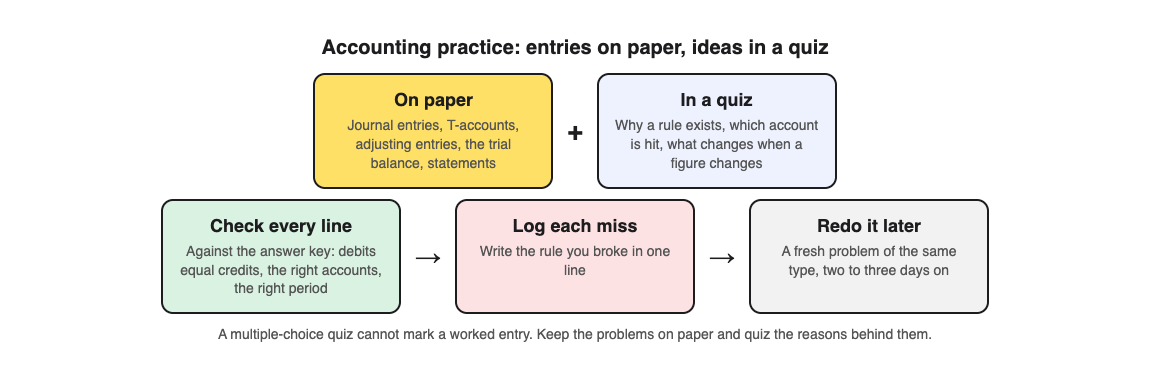
This is the core of your study time. Take the end-of-chapter problems and work them by hand, with the answers covered. For each transaction, write the date, the accounts, the debit and the credit.
Here is a short set to try. A small business:
- Pays 500 in cash for this month's rent.
- Buys equipment for 2,000 on credit.
- Pays 1,200 on 1 January for a year of insurance.
The entries are: debit rent expense 500, credit cash 500; debit equipment 2,000, credit accounts payable 2,000; debit prepaid insurance 1,200, credit cash 1,200. Now the adjusting entry at the end of January: one month of insurance has been used, so debit insurance expense 100 and credit prepaid insurance 100.
That last step is where many students slip. Adjusting entries put income and expenses in the period they belong to. Practise each type (prepaid expenses, unearned revenue, accrued expenses, accrued revenue, depreciation) until you can write one without looking.
Keep an error log for every miss
When you check your work, do not just tick and cross. For each mistake, write one line naming the rule you broke. For example: "Unearned revenue is a liability until the work is done." Or: "Depreciation is credited to accumulated depreciation, not to the asset."
After a few sessions, the log shows a pattern. Most students repeat the same three or four errors. Those lines are your real study list. Two or three days later, do a fresh problem of the same type and see if the error comes back.
Build a trial balance at the end of each practice set. If debits and credits do not match, find the error yourself before you look at the key. That search is good practice for the exam, where nobody tells you which line is wrong.
Quiz yourself on the ideas, not the arithmetic
Be clear about what a multiple-choice quiz can and cannot do. It cannot mark a journal entry you wrote out, and it cannot check a statement you built. A large review of 122 experiments on testing found that practice tests carry over best to application and inference questions, and least to problems built on worked examples. So keep the problems on paper.
Where a quiz does help is the layer above the arithmetic. Questions such as "Which account increases when a customer pays in advance?" or "What happens to net income if an accrued expense is not recorded?" test whether you understand the rules. That understanding is what lets you handle a problem you have not seen before.
A worked example: one chapter in one evening
Say your next chapter is adjusting entries. Here is one evening, in about 90 minutes.
- Recall (10 minutes). Close the book. On a blank page, list the types of adjusting entry and write one example entry for each.
- Check (10 minutes). Open the chapter and mark what you missed or got wrong. Add each miss to your error log.
- Problems (40 minutes). Work four end-of-chapter problems by hand, then check every line against the key.
- Quiz (15 minutes). Photograph the chapter's summary page with Study Shot. Choose 10 questions at the Tiered level, which starts with basic terms and climbs to advanced questions that ask you to apply the rules. Answer each one, press Check answer, and read the explanation even when you were right.
- Review (15 minutes). The results screen lists your misses under Look at these again. Copy each into your error log, then go back to the page for the rule behind it.
Two days later, press Retake quiz from your library and do one fresh problem of each type. Spacing your practice like this works better than one long session the night before. Our guide to spaced repetition for exams gives a simple schedule.
The questions are written by an AI model and can contain mistakes. The explanation helps you check, and your textbook and instructor have the last word on any rule or format.
The last week before the exam
In the final week, switch from chapter practice to mixed practice. Pick problems from several chapters at random, so you have to decide which rule applies before you apply it. That decision is part of what the exam tests.
Then sit at least one past paper or full practice exam under timed conditions. Mark it honestly and add every error to your log. Our guide on how to quiz yourself with a past exam paper shows the full method. If your course also covers business statistics, the same paper-first approach is in how to study for a statistics exam.
The night before, read your error log once and stop. Sleep will do more for you than another hour of problems.
Frequently asked questions
How many practice problems should I do for an accounting exam?
Enough that each type of entry feels routine, which for most students means several problems per chapter. Stop counting when you can do a fresh problem with no errors from your log.
Is it better to read the textbook or do problems?
Read once to understand the rule, then spend most of your time on problems. Rereading feels productive, but testing yourself leads to better recall days later.
Can a multiple-choice quiz help with accounting?
Yes, for concepts and terms, such as which account is affected and why. It cannot check a worked entry or statement, so those stay on paper.
What is the most common mistake on accounting exams?
It differs from student to student, which is why an error log helps. Many introductory students find adjusting entries and the debit or credit side of an account the hardest parts.
Get started
Try Study Shot: it is free to start. Photograph tonight's chapter page and get 10 practice questions on the ideas behind your entries.
Comments
No comments yet.
Sign in or make an account to comment.