How to Study for an Art History Exam: Slides, Dates, Essays
If you are wondering how to study for an art history exam, start with one fact: you will be shown images and asked to do something with them. You will name them, date them, describe them, and argue about them, often under a timer. Reading the textbook twice will not get you there. This guide gives you a slide ID system, a looking routine, a way to tie each work to its world, essay practice, and a 7-day plan.
What an art history exam actually tests
Most art history exams mix three kinds of tasks.
- Slide identification. An image appears. You write the artist, title, date, medium, and location. Some instructors also ask for the period or style.
- Short answers. You explain a term like contrapposto or chiaroscuro, or say why one work matters.
- Comparison essays. Two images side by side. You have 10 to 20 minutes to compare form, meaning, and context.
Look at your syllabus and past exams to see the weight of each. If the essays are worth half the grade, half your time goes to essay practice, not flashcards. The exam rewards recall and argument together, so practise both.
Build a slide ID deck: artist, title, date, medium, location
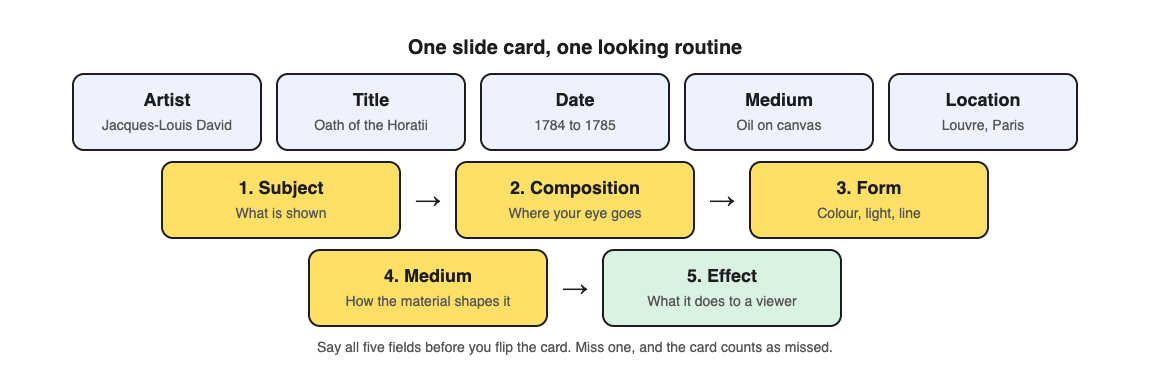
Your slide list is the core of the exam. Make one entry per work with the same five fields every time:
- Artist: Jacques-Louis David
- Title: Oath of the Horatii
- Date: 1784 to 1785
- Medium: oil on canvas
- Location: Louvre, Paris
Put the image on one side and the five fields on the other. Keep the fields in the same order so your memory builds a fixed slot for each one. When you test yourself, say all five out loud before you flip the card. If you miss one field, the card counts as missed.
Add a sixth line with one sentence on why the work matters. For the David: "A Neoclassical call to civic duty, painted before the French Revolution." That one line becomes the seed of every essay paragraph you write about it.
Learn to look: a 5-step visual analysis routine
When you freeze on an image, a routine gets you moving. Use these five steps in order, every time, until they become automatic.
- Subject. What is shown? Who, what, where. Describe it plainly.
- Composition. Where does your eye go first? Look for lines, grouping, symmetry, and the point of focus.
- Form. Color, light, line, texture, scale. Is the surface smooth or rough? Is the light even or dramatic?
- Technique and medium. Fresco, oil, marble, bronze, woodblock. How does the material shape the result?
- Effect. What does all of this do to a viewer? Calm, tension, awe, intimacy.
Practice on one work a day in writing, five sentences, one per step. In the Oath of the Horatii, three arches frame three groups. The men are rigid and lit sharply. The grieving women slump to the right. The effect is a clear split between duty and feeling. That is a paragraph you can reuse.
Connect each work to its context, patron, and period
Form tells you what a work looks like. Context tells you why. For each work on your list, answer three questions:
- Who paid for it? A church, a ruler, a guild, a private collector.
- Where was it meant to be seen? A chapel, a public square, a palace room.
- What was happening then? A war, a reform, a new trade route, a new technology.
Take two marble statues of the same hero. Michelangelo's David (1501 to 1504) was commissioned for the roofline of Florence Cathedral, but was placed instead in the city's main public square, in front of the seat of government. Bernini's David (1623 to 1624) was made for Cardinal Scipione Borghese and is still in the Galleria Borghese in Rome. Same subject, very different patrons and settings. That difference explains a lot about how each one looks.
Treat each artwork like a document. The approach in quizzing yourself on a primary source works well here: who made it, for whom, and what it was meant to do.
Practice compare-and-contrast essays with unknown images
Many exams include an "unknown" image: a work you have not studied. You are expected to place it by style and period and compare it to a work you know. Here is a structure that fits in 15 minutes.
- Thesis (1 minute). One sentence that names both works and the main difference. "Both Davids show the same hero, but Michelangelo's waits in calm before the fight while Bernini's is caught mid-throw."
- Form paragraph (4 minutes). Pose, movement, surface, how the viewer moves around the work.
- Context paragraph (4 minutes). Patron, setting, period. Renaissance balance versus Baroque drama.
- Meaning paragraph (4 minutes). What each choice says about its time.
- Close (1 minute). Restate the difference and why it matters.
For the unknown work, use evidence from the image. "The twisting pose and strong diagonal suggest the Baroque period." Name your clues, so the grader can follow your reasoning even if your date is off. The same claim and evidence habit shows up in studying for a philosophy exam, where you defend a position under time pressure.
Practice by pairing two works from your list at random and writing the essay with a timer. Do at least three before exam day.
Quiz yourself with spaced repetition the week before
Rereading your slide list feels like progress, but testing does more. In a 2006 study, students who tested themselves on a passage remembered much more two days and a week later than students who reread it. So spread your self-tests across the week, and make testing easy enough that you actually do it.
This is where Study Shot helps. You take a photo of a page, and it writes multiple-choice questions about that page, checks your answers, and explains each one. Here is a workflow for your slide list:
- Before the quiz, cover the answers and say all five fields for each work on the page. Then print or write out one page of your slide list with the five fields and the one-line "why it matters" for 6 to 10 works. A textbook page with images and captions also works.
- Open Study Shot, choose Make a new quiz, then Take photo or Choose photo. Hold the page flat and fill the frame.
- Pick 15 or 20 questions. Leave the level on Tiered, which starts with basic recall and climbs to advanced questions that ask you to apply ideas.
- Press Create questions. It can take up to a minute.
- Answer one question at a time. After each one you see whether you were right, the correct answer, and a short explanation.
The results screen shows a score for each level, so you can see if you know the dates but miss the connections. A Look at these again list shows each question you missed, with your answer and the right one. Each quiz is saved in your library with its photo and your best score, so you can retake it on day 2, day 4, and day 6. Aim for a Mastered grade, which means 90% or higher.
Two cautions. The questions are written by an AI model, so they can contain mistakes. Check anything odd against your notes, and use Report a problem with this question if a question is wrong. Also, the questions are multiple choice. They test recognition. Pair them with your own five-field recall and timed essays, which test production.
How to study for an art history exam in 7 days: a study plan
- Day 1. Finish your slide ID deck. Every work gets five fields plus one line on why it matters. Photograph the first page of your list and make a Tiered quiz.
- Day 2. Do the 5-step looking routine on three works. Retake yesterday's quiz. Make a quiz for the next page of your list.
- Day 3. Write context notes: patron, setting, period, for every work. Quiz the newest page. Write one timed comparison essay.
- Day 4. Retake every quiz in your library. When each one ends, read the Look at these again list on the results screen and fix your notes for the works you missed.
- Day 5. Unknown image practice. Find works by artists on your list that you did not study and try to place them. Write a second timed essay.
- Day 6. Full slide ID run: cover every card and say all five fields. Retake any quiz below 90%.
- Day 7. Light review only. Reread the notes you fixed on day 4. One short essay outline. Sleep.
If your course covers a lot of theory and terms as well as images, the layered approach in studying for a sociology exam pairs well with this plan.
Frequently asked questions
How many slides should I learn per day?
Divide your total list by the days you have left, minus one day for review. Keep retesting the works from earlier days as you add new ones.
How do I identify an artwork I have never seen?
Run the 5-step looking routine and match what you see to the styles you know. Name your evidence, such as pose, light, or medium, and explain why it points to a period.
Should I memorize exact dates?
Ask your instructor, since rules vary between courses. Learning the exact date for each work on your list is the safest choice.
How do I write a strong slide comparison essay in 15 minutes?
Write a one-sentence thesis naming the main difference, then one paragraph each on form, context, and meaning. Spend about four minutes per paragraph and finish with a one-sentence close.
Get started
Try Study Shot: it is free to start. Photograph the page you are studying tonight and get 10 practice questions on it, from basic to advanced.
Comments
No comments yet.
Sign in or make an account to comment.