How to Study for an Astronomy Test: A Step-by-Step Plan
If you are wondering how to study for an astronomy test, the short answer is this: sort the material into a few big topics, learn the handful of formulas and diagrams that carry most of the points, and test yourself instead of rereading. This post gives you a step-by-step plan, a way to practise with the numbers and pictures astronomy throws at you, and a 5-day schedule for the week before the test.
Why astronomy tests feel harder than they are
Astronomy mixes three kinds of thinking in one exam. You need vocabulary (what a red giant is). You need pictures in your head (why the Moon looks like a crescent). And you need some light math (how far away a star is if its parallax is 0.1 arcseconds).
It is easy to study only the first kind: reread notes, highlight terms, feel ready. Then the test asks you to explain why we have seasons.
The good news: an intro course is mostly a few big topics, a few formulas and a few diagrams, repeated in different forms.
Map what your test covers: the sky, light, the solar system, stars, and the universe
Before you study anything, make a one-page map. Take your syllabus or the chapter list and sort every topic into five buckets:
- The sky: celestial sphere, constellations, Moon phases, eclipses, seasons, the Earth's tilt.
- Light: the electromagnetic spectrum, wavelength and temperature, spectra and spectral lines, the Doppler effect, telescopes.
- The solar system: the planets, Kepler's laws, gravity, how the solar system formed, small bodies like comets and asteroids.
- Stars: the Sun, star brightness and distance, spectral types, the H-R diagram, how stars are born and die.
- The universe: galaxies, the expansion of the universe, the Big Bang, dark matter and dark energy.
Your test may cover only two or three of these. Cross out what is not on it. Then mark each remaining topic with a quick rating: know it, shaky, or lost. That rating decides where your time goes. If you have used the plan in how to study for an Earth science test, this step will feel familiar, and the overlap is real: seasons and Moon phases show up in both courses.
Get comfortable with scale, units, and the key formulas
Units trip people up as often as ideas do. Learn these distance units cold:
- Astronomical unit (AU): the average Earth to Sun distance, about 150 million km.
- Light year: the distance light travels in a year, about 9.46 trillion km.
- Parsec: about 3.26 light years.
Then learn the few formulas your course actually uses. Most intro courses lean on these:
- Kepler's third law:
P² = a³, with P in years and a in AU. A planet at 4 AU has P² = 64, so P = 8 years. - Parallax distance:
d = 1 / p, with d in parsecs and p in arcseconds. A parallax of 0.1 arcseconds means 10 parsecs. - Wien's law: hotter objects peak at shorter wavelengths. Your course may give it as
peak wavelength = 2.9 × 10^-3 m K / T, or just ask you to compare a blue star and a red star. - Inverse square law: brightness drops with the square of distance. Twice as far means one quarter as bright.
For each formula, write one sentence in plain words next to it. "Farther planets take much longer to orbit" sticks better than the symbols alone. Many test questions are really asking for that sentence, not a calculation.
Learn diagrams by redrawing them: moon phases, seasons, the H-R diagram, and the life cycle of stars
Looking at a diagram feels like learning. It is not. Close the book and draw it from memory, then compare. The gaps you find are exactly what you need to study.
Four diagrams are worth this effort:
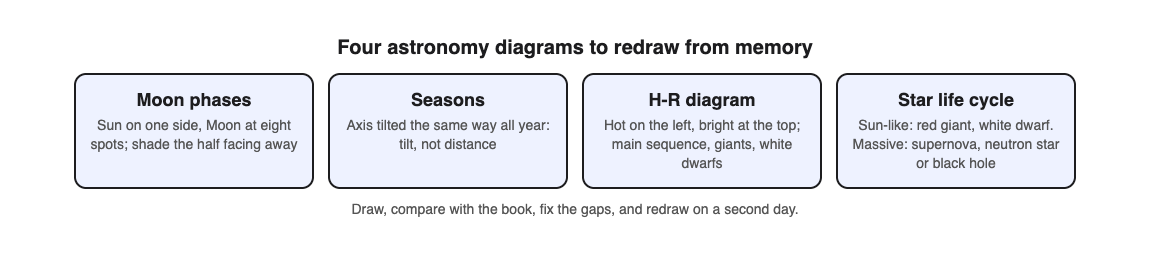
- Moon phases. Draw the Sun on one side, Earth in the middle, and the Moon at eight spots around it. Shade the half facing away from the Sun. Then label what someone on Earth sees at each spot.
- Seasons. Draw Earth at two sides of its orbit with the axis tilted the same way both times. Show which hemisphere leans toward the Sun. Write "tilt, not distance" in the margin, because distance is the tempting wrong answer.
- The H-R diagram. Temperature runs along the bottom, hot on the left. Brightness runs up the side. Place the main sequence, giants, supergiants and white dwarfs. Mark where the Sun sits.
- The life cycle of stars. Draw two paths from a nebula: one for Sun-like stars (red giant, planetary nebula, white dwarf) and one for massive stars (supergiant, supernova, neutron star or black hole).
Redraw each one on two different days. By the second time, you should be able to do it without peeking.
Use active recall and spaced practice instead of rereading
Active recall means pulling the answer out of your head before you look. In a 2006 study, students who tested themselves on a passage remembered much more two days and a week later than students who reread it, even though the rereaders felt more confident. Recall feels harder, which is the point.
Here is a simple way to do it with astronomy notes. Cover the right half of your page. Read each term or question on the left. Say the answer out loud. Uncover and check. Put a small mark next to anything you missed, and start the next session with those.
Mix question types as you go. Do not do all the vocabulary, then all the math. A real test jumps from "What causes a solar eclipse?" to "Which star is hotter?" to a parallax problem. Your practice should jump too.
Work practice problems and track where you got stuck
Do the practice problems from your textbook or past quizzes. When you get one wrong, do not just read the right answer and move on. Write one line about where you got stuck. Was it the unit? The formula? Misreading the question? Not knowing the term?
After ten or fifteen problems, a pattern shows up. Maybe you always mix up apparent and absolute magnitude. Maybe you forget that the parallax formula needs arcseconds. That pattern is your study list for the next day.
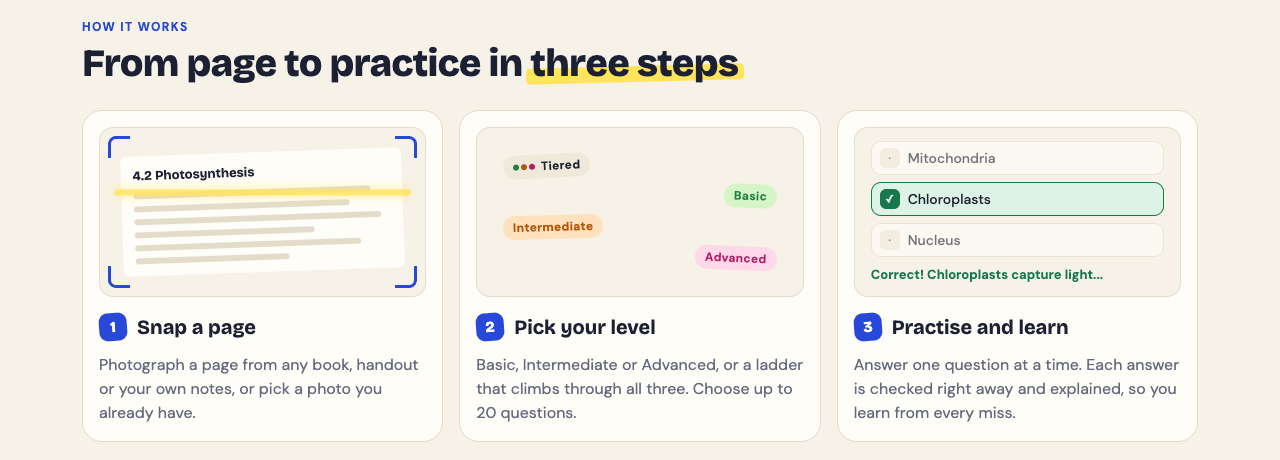
You can also make practice questions from your own notes. With Study Shot, you take a photo of a page from your textbook, notes or a whiteboard, and it writes multiple-choice questions about it, 10 by default and up to 20, each with four choices. After you pick an answer and press Check answer, you see whether you were right and a short explanation. At the end, a Look at these again list shows each question you missed, with your answer and the right one. That list is a ready-made "where I got stuck" record.
A worked example: photograph your textbook page on the life cycle of stars. Hold the page flat and fill the frame. Choose 10 questions and the Tiered level, which starts with basic questions, then intermediate, then advanced. The results screen shows a score for each level, so you can see whether you missed the definitions or the harder "what happens next" questions. The questions are written by an AI model and can contain mistakes, so read the explanation to check, and use Report a problem under any question that looks wrong. A multiple-choice quiz checks the ideas; keep working the calculations on paper.
How to study for an astronomy test in 5 days
This plan assumes about 45 minutes a day. Stretch it if you have more time.
- Day 1: Map and sort. Make your one-page topic map. Rate each topic. Spend the rest of the session on your weakest bucket.
- Day 2: Formulas and units. Write each formula with its plain-language sentence. Work five problems for each. Note where you got stuck.
- Day 3: Diagrams. Redraw Moon phases, seasons, the H-R diagram and the star life cycle from memory. Fix the gaps. Quiz yourself on the pages behind them.
- Day 4: Mixed practice. Do a mixed set of questions from every topic. Redraw any diagram you struggled with on Day 3. Retake any quiz where you scored under 70%.
- Day 5: Light review. Go only through what you missed this week. Do one last quick round of recall. Stop early and sleep well.
On test day, read each question twice and check the units before you calculate. If a question asks "why," the answer is usually one of your diagrams in words.
Frequently asked questions
How long should I study for an astronomy test?
The plan above uses about 45 minutes a day for five days for a unit test. For a final, give each topic bucket its own day before you begin mixed review.
What is the best way to memorize astronomy terms?
Test yourself on them instead of rereading. Cover the definitions, say each one out loud, and come back to the ones you miss a day later.
Do I need to be good at math to pass astronomy?
Most intro courses use only a few formulas and simple algebra. If you learn what each formula means in plain words and watch your units, you can handle the math questions.
How do I remember the order of planets and star types?
Use a sentence: "My Very Educated Mother Just Served Us Nachos" for Mercury to Neptune, and "Oh Be A Fine Guy, Kiss Me" for star types O, B, A, F, G, K, M, hottest to coolest. Then redraw the H-R diagram so the letters connect to a picture.
Get started
Try Study Shot: it is free to start. Photograph the page you are studying tonight and get 10 practice questions on it, from basic to advanced.
Comments
No comments yet.
Sign in or make an account to comment.