How to Study for an Earth Science Test: A 5-Day Plan
If you are searching for how to study for an earth science test, you probably have a stack of notes, a few lab sheets, and a test date that is closer than you would like. Earth science covers a lot of ground: rocks, plates, water, weather, and space. The good news is that most tests reward the same few skills. You need to know the big systems, read diagrams, and pull answers out of data. This 5-day plan walks you through each one, with a quiz-yourself step at the end so you know what you actually remember.
How to study for an earth science test: why it feels harder than it looks
Earth science looks like a memory subject. Learn the vocabulary and you are done, right? Not quite. Most questions ask you to use what you know. You might get a cross-section of rock layers and need to put events in order. You might get a weather map and need to predict wind direction. You might get a graph of temperature and depth and need to name the layer.
That means two things. First, you need the terms. Second, you need practice applying them to pictures and numbers you have not seen before. Students who only reread notes often know every definition and still lose points on the diagram questions.
Start with your notes, labs and the unit review sheet
Before Day 1, gather three things:
- Your class notes for every unit on the test.
- Your lab sheets. Labs often turn into test questions, especially ones with measurements or graphs.
- The unit review sheet or study guide, if your teacher gave one. This is your best clue to what will be asked.
Go through the review sheet and mark each topic as green (I could explain this), yellow (sort of), or red (no idea). Spend most of your five days on yellow and red. The same sort-first approach works in studying for a geography test from your notes.
Day 1-2: Learn the big systems (rocks, plates, water, atmosphere)
Earth science is a set of connected systems. Learn each one as a process, not a word list.
Rocks and the rock cycle
Know the three rock types and how each forms. Igneous rock forms when magma or lava cools. Sedimentary rock forms when sediment is deposited, compacted and cemented. Metamorphic rock forms when heat and pressure change existing rock. Then trace the arrows: any rock can become any other type through melting, weathering, or heat and pressure.
Plate tectonics
Learn the three boundary types: divergent, convergent and transform. For each, know what features form (ridges, trenches, mountains, faults) and what hazards come with them (earthquakes, volcanoes).
The water cycle
Know evaporation, condensation, precipitation, infiltration and runoff. Be ready to explain what changes the balance, like steep slopes causing more runoff.
Atmosphere and weather
Learn the layers of the atmosphere, how air pressure relates to weather, and how fronts work. Practice explaining why warm air rises and what happens when it cools.
At the end of each day, close your notes and explain one system out loud in under a minute. If you stall, that is a yellow or red spot.
Day 3: Master the diagrams, maps and cross-sections
Day 3 is for pictures. Pull every diagram from your notes and labs: rock layer cross-sections, topographic maps, weather maps, the rock cycle chart, plate boundary drawings.
Test yourself on them rather than just looking. In a 2007 study, people who learned a map by seeing it with one feature missing and recalling it drew the map better half an hour later than people who spent the same time studying it. You can do the same: cover one label or one layer and say what goes there.
For each one, ask yourself three questions:
- What is this diagram showing?
- What would a test question ask about it?
- Can I answer that question without looking at my notes?
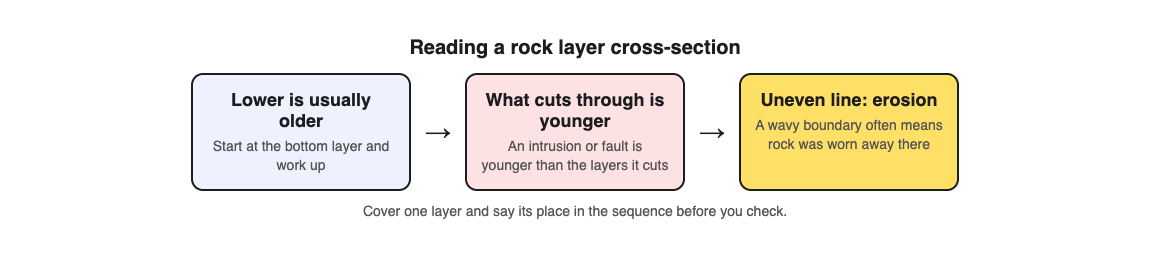
For cross-sections, practice the core rules: lower layers are usually older, a rock that cuts through layers is younger than the layers it cuts, and an uneven line between layers often means erosion happened there. For topographic maps, practice reading contour lines and finding the steepest slope, where lines are closest together.
Day 4: Practice reading data tables, graphs and reference charts
Many earth science questions give you the answer inside a chart. You just have to find it. Day 4 is for building that skill.
- Take each graph from your labs and describe the trend in one sentence. For example, "As depth increases, temperature increases."
- If your class uses a reference chart or reference table, practice looking things up quickly. Time yourself.
- Read the axis labels and units every time. Many lost points come from reading the wrong axis.
The same graph habits show up in this plan for an economics test.
Day 5: Quiz yourself with active recall and past questions
On Day 5, test yourself. Active recall means pulling the answer out of your head before you check it. It also helps with the diagram and data questions: a 2018 meta-analysis found practice testing carries over best to application and inference questions, though less to material you saw but never quizzed yourself on. So quiz every unit, not only your favourites.
If your teacher shared past tests or practice questions, do them under time pressure. Then turn your own notes into questions. This is where Study Shot helps.
A worked example with Study Shot
Say your weakest topic is the cross-section diagram from your rock layers lab. Here is how to turn that page into a practice quiz:
- Open Study Shot in your phone or computer browser and log in. Every screen needs an account.
- Tap Make a new quiz, then Take photo. Hold the page flat and fill the frame. Diagrams, notes and whiteboards all work.
- Choose 15 questions. You can pick 5, 10, 15 or 20.
- Pick a level. Tiered is the default. It is a ladder that splits the questions as evenly as it can across Basic, Intermediate and Advanced, in that order. If you already know the terms and want test-style questions, pick Advanced, which asks you to apply and predict in new situations.
- Tap Create questions. It can take up to a minute.
Each question has four choices, A to D. Pick one and press Check answer. You see whether you got it, the correct answer, and a short explanation. If you need to look at the diagram again mid-quiz, tap Show page to see your photo.
When you finish, the results screen shows your score for each level and a Look at these again list with your answer next to the right one. That list is your study plan for the evening. Fix those gaps, then tap Retake quiz. A grade of Mastered means 90% and up. Good is 70% and up.

Questions are written by an AI model and can contain mistakes. Read the explanation to check each one against your notes. If a question looks wrong, use Report a problem with this question under it.
Studying with a friend? Use Share this quiz to send a link. They need their own Study Shot account and get their own copy of the questions, without your photo.
Common mistakes that cost points on earth science tests
- Memorizing terms without using them. Know what "subduction" means and also where it happens and what it creates.
- Skipping the labs. Lab data often shows up on tests with new numbers.
- Misreading graphs. Check the axis, the units and the scale before you answer.
- Getting the order wrong on cross-sections. Start from the bottom and work up, then place any intrusions or faults.
- Not checking the reference chart. If you are allowed a reference sheet, the answer might be printed right there.
- Cramming the night before. Five short days give you time to retake quizzes; see spaced repetition for exams.
Frequently asked questions
How long should I study for an earth science test?
For a unit test, about five days of 30 to 45 minute sessions works well. For a bigger final exam, start two to three weeks out and cycle through each unit.
What is the fastest way to memorize the rock cycle?
Draw it from memory, then check it against your notes and fix what you missed. Repeat until you can draw every arrow and label the process on it, like melting, cooling, or heat and pressure.
How do I study for an earth science Regents exam?
Practice with past exams and get fast at using the reference tables your class uses, since many questions depend on them. Ask your teacher about the current format, including any lab portion, so your practice matches the real test.
Can I make practice questions from my own notes?
Yes. Write your own questions on index cards, or photograph a page with Study Shot and get multiple-choice questions on it with an explanation for every answer. Quizzes are saved to your library so you can retake them before the test.
Get started
Try Study Shot: it is free to start. Photograph the page you are studying tonight and get 10 practice questions on it, from basic to advanced.
Comments
No comments yet.
Sign in or make an account to comment.