How to Study for an Economics Test: A 7-Day Plan
If you are wondering how to study for an economics test, start with this: rereading your notes will not get you there. Economics exams ask you to use ideas, not recite them. You need to know the terms, draw the graphs, and explain what happens when something changes. This guide gives you a method for each of those skills and a 7-day plan that puts them in order.
What an economics test actually checks: concepts, graphs, and reasoning
Most economics tests, whether micro or macro, check three layers at once.
- Concepts. Can you define opportunity cost, elasticity, marginal cost, GDP, or the money multiplier without mixing them up?
- Graphs. Can you draw supply and demand, cost curves, or aggregate demand and aggregate supply, label the axes, and shift the right curve in the right direction?
- Reasoning. Can you walk through a chain of cause and effect? For example: the central bank raises interest rates, borrowing falls, investment drops, aggregate demand shifts left, output and the price level fall.
A student who only memorizes definitions gets the first layer and loses points on the other two. Your plan has to train all three.
Build a one-page map of every model and formula on the syllabus
Take your syllabus or the list of chapters the test covers. On one sheet of paper, write every model and formula you are expected to know. Group them by topic.
A micro map might include:
- Supply and demand, equilibrium, surplus and shortage
- Price elasticity of demand: percent change in quantity divided by percent change in price
- Consumer and producer surplus
- Cost curves: fixed, variable, average, and marginal cost
- Profit maximization where marginal revenue equals marginal cost
- Market structures: perfect competition, monopoly, oligopoly, monopolistic competition
A macro map might include GDP and its parts (consumption, investment, government spending, net exports), inflation and unemployment measures, AD and AS, fiscal policy, monetary policy, and the money multiplier.
Next to each item, write one line: what it shows and what makes it move. This page is your checklist for the week. Anything you hesitate on gets a mark, and those marks decide where your time goes.
Draw the graphs from memory until shifts feel automatic
Looking at a graph in your textbook is not practice. Drawing it on a blank page is. In an eye-tracking study of economics and physics graph tasks, students who got the answer wrong kept jumping between the question and the graph and often struggled to turn the words of the question into what the graph shows. Practising that step, from a sentence to a shift, is what this routine trains.
Use this routine for each graph on your map:
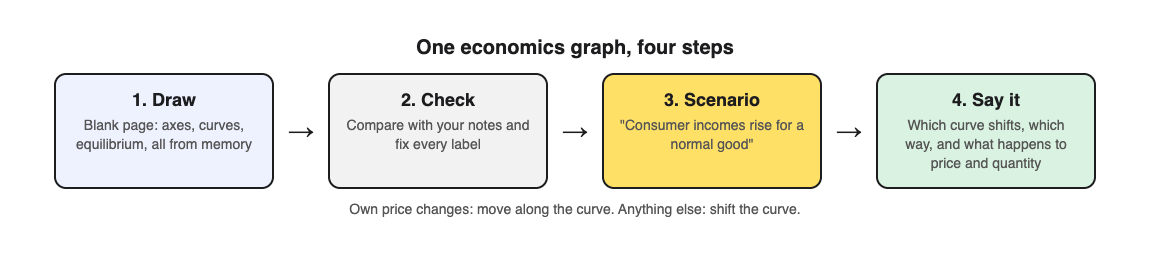
- Draw it from memory. Label both axes, every curve, and the equilibrium point.
- Check it against your notes. Fix any wrong label.
- Pick a scenario and shift it. "A new tax on producers." "Consumer incomes rise for a normal good." "The government increases spending."
- Say out loud which curve moves, which direction, and what happens to price and quantity (or price level and output).
The most common mistake is confusing a shift of a curve with a movement along it. A change in the good's own price moves you along the demand curve. A change in anything else (income, tastes, the price of a related good, expectations) shifts the whole curve. Drill that distinction until you never pause on it.
Do five graphs a day, twice each.
Work practice problems the way the exam asks them
Find out the format before you study. Is it multiple choice, short answer, graph questions, calculations, or a mix? Then practice in that format.
For calculation questions, do the problem on paper without the worked solution in view. Elasticity, GDP totals, and multiplier problems all reward speed, and speed only comes from repetition. For short answers, write full cause and effect chains, not single words. For multiple choice, practice spotting the trap answer: often it is the option that shifts the wrong curve or reverses a direction.
When you get a problem wrong, write down why. "I used the wrong formula" needs a different fix than "I shifted supply instead of demand."
Use active recall and spaced review instead of rereading notes
Active recall means pulling an answer out of your head before you see it. Spaced review means coming back to the same material over several days. In a classic 2006 study, students who tested themselves on prose passages remembered much more two days and a week later than students who reread, even though rereading made them more confident. For more, see why testing yourself beats rereading.
Simple ways to do it:
- Cover your one-page map and recite each line.
- Write a question on one side of a card and the answer on the other.
- Quiz yourself on a chapter, then quiz yourself again two days later.
Writing your own questions takes time, though. One shortcut is to turn your notes straight into a quiz. With Study Shot, you photograph a page from your textbook, your notes, or a whiteboard, and an AI model writes multiple-choice questions about it. Each question has four choices, and after you press Check answer it shows whether you were right, the correct answer, and a short explanation.
Here is how that fits an economics chapter. Say you photograph your notes on elasticity. You choose 15 questions and the Tiered level, which works as a ladder: basic questions first (key terms and definitions), then intermediate (explain, compare, connect), then advanced (apply and predict in new situations). That maps well onto the three layers an economics test checks. Your results show a right and total score for each level, so you can see whether you are weak on terms or on applying them. A section called Look at these again lists the questions you missed with your answer and the right answer.
The quiz is saved in your library with the page photo and your best score, so you can retake it two days later for spaced review. If you are studying with friends, Share this quiz gives you a link; each person needs a Study Shot account and gets their own copy of the questions. Since the questions come from an AI model, they can contain mistakes. Read the explanation to check, and use Report a problem under any question that looks wrong.
Know what a quiz can and cannot do. A 2018 meta-analysis found practice testing carries over best to application questions and worst to worked problems. A multiple-choice quiz cannot check your elasticity calculation or your graph, so keep those on paper and use the quiz for the ideas behind them.
How to study for an economics test in 7 days
This plan assumes about an hour to ninety minutes a day. Shorten or stretch each day to fit your schedule.
Day 1: Map and diagnose
Build your one-page map. Recite each line and mark anything shaky. Do a quick self-quiz on the first two chapters to find your weak spots.
Day 2: First half of the concepts
Work through the first half of your map. Draw each related graph from memory twice. Quiz yourself on these chapters at the Basic level to lock in the vocabulary.
Day 3: Second half of the concepts
Same routine for the second half. At the end of the day, recite the whole map from memory.
Day 4: Graphs and shifts
Spend the full session on graphs. Run ten shift scenarios across different models. Say the cause and effect chain out loud each time.
Day 5: Practice problems in exam format
Do problems that match your test format. Time yourself. Log every miss with its reason.
Day 6: Spaced review and hard questions
Retake the quizzes from days 2 and 3. Then switch to Advanced questions on your weakest topics. Those test whether you can apply a model to a situation you have not seen.
Day 7: Light review and a practice run
Do one mixed practice set under exam conditions. Review only your log of mistakes and your map. Stop early and sleep.
Frequently asked questions
How long should I study for an economics test?
For a unit test, about an hour a day for a week is a solid target. For a final, start two weeks out and repeat the plan above, giving each half of the course its own week.
How do I memorize economics graphs fast?
Draw each one from memory on a blank page, check it, then shift it with a scenario and explain the result out loud. Doing this five graphs at a time, every day, builds speed quickly.
What is the best way to study for a multiple choice economics exam?
Practice with multiple choice questions that make you apply ideas, not just define them. Read the explanation for every miss, and watch for answer choices that shift the wrong curve or reverse a direction.
Should I study micro and macro differently?
Micro leans on individual markets, cost curves, and firm decisions, so focus on supply and demand shifts and profit maximization. Macro leans on the whole economy and policy, so spend more time on AD and AS graphs and on cause and effect chains for fiscal and monetary policy.
Get started
Try Study Shot: it is free to start. Photograph the page you are studying tonight and get 10 practice questions on it, from basic to advanced.
Comments
No comments yet.
Sign in or make an account to comment.