How to Study for an Engineering Exam: Problems, Formulas, Units
If you want to know how to study for an engineering exam, start with this: remembering equations is only the base. Most questions ask you to take a situation you have not seen, pick the right model, and carry it through to a number with correct units. This guide shows you how to build that skill in the weeks before the exam: what to memorize, how to work problems, how to catch your own errors, and how to quiz yourself on the reasoning behind each equation.
How to study for an engineering exam: what it tests
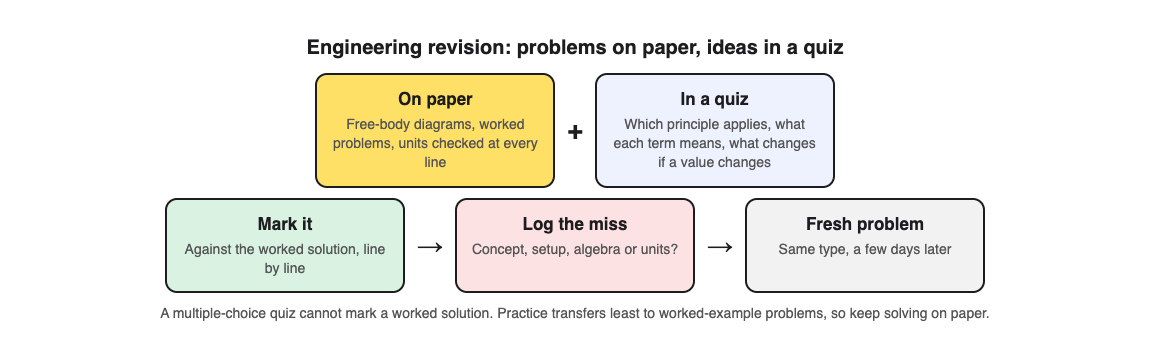
Engineering exam questions often look new. The beam has a different support, or the circuit has one extra resistor. Rereading worked examples helps you recognize the topic, but not set up a new problem. A review of 122 experiments found that practice tests carry over least to problems built on worked examples, which is why problem practice has to stay on paper.
A full answer usually has three parts:
- Setup. Drawing the system, naming the knowns and unknowns, and stating assumptions.
- Method. Choosing the governing equation and knowing why it applies here.
- Execution. Algebra, units, and a final answer that makes physical sense.
Memory still matters, but only as a base. You need the formulas in your head so your working memory is free for the hard part, which is deciding what to do. This is similar to how law students learn rules so they can spend exam time on analysis, which we cover in how to study for a law exam.
Build a formula and concept sheet you can recall cold
Make one sheet per course. Write it yourself, by hand if you can. For each equation, include four things:
- The equation itself, with every symbol defined.
- The units of each symbol.
- The conditions under which it holds. For example, the common form of Bernoulli's equation needs steady, incompressible, inviscid flow along a streamline.
- One line on when you would reach for it.
The third item is easy to skip. Two students can both write the same equation, but only one knows it breaks down when friction in the pipe is significant.
Test the sheet by covering it and writing it out from memory on a blank page. Mark what you missed. Repeat every two or three days until you can produce the whole thing in a few minutes.
Work problems by hand before looking at solutions
Reading a solution feels like learning, but it is mostly recognition. In a classic study, restudying raised students' confidence, while testing themselves gave far better recall days later. Try each problem cold.
Use this routine for each practice problem:
- Read the problem and close the textbook.
- Sketch the system and list knowns, unknowns, and assumptions.
- Write the governing equation before plugging in any numbers.
- Solve symbolically as far as you can, then substitute values.
- Only now open the solution and compare step by step.
If you get stuck, give it a real attempt first. When you do look, read only the next step, close the solution, and continue on your own.
Keep a mistake log. One line per error: the problem, what you did, what was right, and why. Patterns show up quickly.
Check units, assumptions, and free body diagrams every time
These three checks cost little once they become automatic.
Units
Carry units through every line, not just the final answer. If you add a term in newtons to a term in newton meters, you know immediately something is wrong. Convert everything to one consistent system at the start. Watch for kilo and mega prefixes, degrees versus radians, and gauge versus absolute pressure.
Assumptions
Write your assumptions in a short list at the top of your working. "Steady state. Neglect air resistance. Rigid body." This helps the grader give you method marks, and it forces you to notice when an assumption does not fit the problem.
Free body diagrams
Draw one for every statics or dynamics problem, even easy ones. Isolate the body, show every force and moment with a direction, and label the coordinate axes. A missing or misdrawn force is an easy way to get a sign wrong. After solving, ask whether the answer makes physical sense. A support reaction larger than the total load on a simple beam should make you look again.
Quiz yourself on derivations and when each equation applies
Here you train the decision making: questions that ask why and when, not just what. For example:
- Which assumption in this derivation fails for compressible flow?
- If the beam were fixed at both ends instead of simply supported, what changes in the deflection result?
- Why does this step drop the second order term?
Writing good questions like that takes time. Study Shot can draft them from a photo of your notes. You take a photo of a page from your textbook, your lecture notes, or a whiteboard, and an AI model writes multiple choice questions about it, then checks your answers and explains each one.
Here is a worked example. Say you have a page of notes deriving Bernoulli's equation from an energy balance.
- Open Study Shot in your phone or computer browser and choose Make a new quiz, then Take photo. Hold the page flat and fill the frame.
- Pick 15 questions. You can choose 5, 10, 15 or 20.
- Leave the level on Tiered. It splits the questions as evenly as it can across Basic, Intermediate and Advanced, in that order, so 15 questions gives you five of each. Basic covers key terms and definitions. Intermediate asks you to explain, compare and connect ideas. Advanced asks you to apply and predict in new situations, which is the closest match to exam style.
- Press Create questions. It can take up to a minute.
Answer one question at a time. After each one you see whether you were right, the correct answer, and a short explanation. If you forget what the page said, Show page brings your photo back up. At the end you get a score for each level, so you can see whether you know the definitions but struggle with application. The Look at these again list shows every question you missed with your answer next to the right one.
Two honest limits. First, the questions are multiple choice only, so this does not replace working full numerical problems by hand. Use it for concepts, assumptions, and conditions. Second, the questions are written by an AI model and can contain mistakes. Read the explanation and check it against your notes. If a question looks wrong, use Report a problem with this question under it.
The app accepts JPEG, PNG, WebP or GIF photos up to 5 MB. If it cannot write questions from a photo, it will tell you to try a different page.
Practice past papers under real time limits
Once you know the material, train for exam conditions. Get past papers from your department or course page. Then:
- Set a timer for the real exam length.
- Use only what you are allowed: the official formula sheet, your calculator, nothing else.
- Do not stop to look things up. Mark the gap and move on.
- Grade yourself strictly against the marking scheme afterward.
Pay attention to time per mark. If a question is worth a quarter of the paper, it should get about a quarter of your time. Do not spend so long perfecting one problem that another is left blank.
A two week engineering exam study plan
Adjust this to your course, but keep the shape: foundations first, mixed practice in the middle, full papers at the end.
Days 1 to 3: map the course
- List every topic from the syllabus and past papers.
- Build your formula and concept sheet.
- Photograph your key derivation pages and run a Basic quiz on each to find weak definitions.
Days 4 to 8: topic by topic problem work
- Pick one or two topics a day.
- Work 5 to 10 problems per topic by hand, from easy to hard.
- Update your mistake log every session.
- End each day with an Advanced quiz on that topic's notes, focused on when equations apply.
- Rewrite your formula sheet from memory every other day.
Days 9 to 11: mixed practice
- Shuffle problems from different topics so you practise choosing the method, not just executing it.
- Retake saved quizzes from your library. Each one keeps your best score, so you can see what has stuck.
Days 12 to 14: full papers
- One full timed past paper per day.
- Spend as long reviewing as you spent writing.
- The night before, read your mistake log and formula sheet, then sleep.
Frequently asked questions
How many practice problems should I do for an engineering exam?
There is no fixed number, but aim for enough that you can solve each problem type without looking anything up. For most topics that means several problems of rising difficulty, plus at least two or three full timed past papers.
Should I memorize formulas if I get a formula sheet?
Yes, at least the main ones. Knowing them by heart saves time and frees your attention for setup, and the sheet usually does not tell you when each formula applies.
How do I study for an open book engineering exam?
Study as if it were closed book, then build a tabbed index so you can find any method in seconds. You will not have time to look up every step.
What is the best way to fix mistakes on practice problems?
Log each mistake with its cause, then redo the problem from scratch a few days later without looking at your old work. If the same error type keeps appearing, practice a short set of problems that target only that step.

Problems by hand build your execution; quizzing on assumptions and conditions builds your judgment about which method to use.
Get started
Try Study Shot: it is free to start. Photograph the page you are studying tonight and get 10 practice questions on it, from basic to advanced.
Comments
No comments yet.
Sign in or make an account to comment.