How to Study for an Environmental Science Test: 6 Steps
If you want to know how to study for an environmental science test, start with this: the test is rarely about memorizing a list of words. It asks you to explain how systems connect, read data, and predict what happens when people change something. This guide gives you six steps that match how these tests are actually written, plus a way to turn your own notes into practice questions.
How to study for an environmental science test: what it asks
Look at any old test or review sheet from your class. You will usually see four kinds of tasks:
- Define and identify. What is eutrophication? What is a carbon sink?
- Explain a process. How does nitrogen move from the air into a plant?
- Read data. A graph shows dissolved oxygen in a lake over a year. When did the algae bloom die off?
- Connect cause and effect. A farm adds fertilizer upstream. What happens to fish populations downstream, and why?
Only the first task rewards plain memorization. The other three reward understanding. So your study time should move from facts toward connections, and then toward applying those connections to new situations.
Step 1: Map the big systems first (biogeochemical cycles, energy flow, ecosystems)
Most of the course hangs on a few systems. Before you review any details, draw each one from memory on a blank page:
- The carbon cycle
- The nitrogen cycle
- The phosphorus cycle
- The water cycle
- Energy flow through a food web, including the rough rule that only about 10 percent of the energy passes from one trophic level to the next
For each cycle, label the reservoirs (where the element sits) and the processes (how it moves). Then mark every spot where humans speed something up or block it. Burning fossil fuels moves carbon from rock to air. Fertilizer adds nitrogen and phosphorus to soil and water. Deforestation removes a carbon sink.
When you finish, compare your drawing to your notes. The gaps are your study list. This is the same approach that works for an earth science test, since the two subjects share many of the same cycles.
Step 2: Turn vocabulary into connected concepts, not flashcard islands
A flashcard that says "eutrophication: excess nutrients in water" is fine, but it sits alone. On the test, you will need to know what causes it, what it leads to, and how you would measure it.
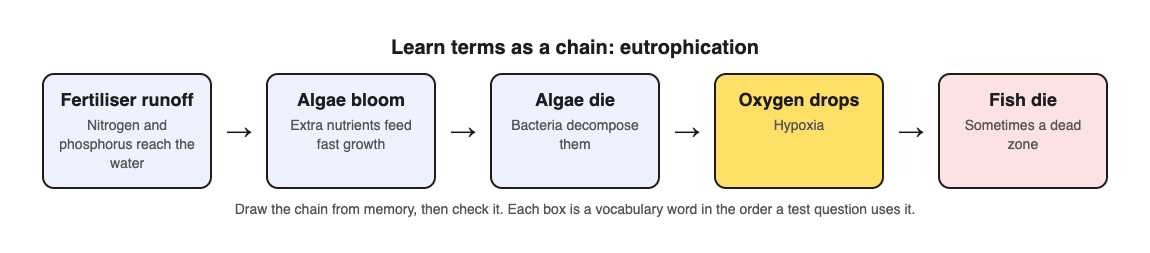
Try building short chains instead of single cards. Here is one:
Fertilizer runoff, then excess nitrogen and phosphorus, then algae bloom, then algae die, then bacteria decompose them, then oxygen drops, then fish die (hypoxia, sometimes a dead zone).
Each term in that chain is a vocabulary word. Now you know them as a sequence, which is how a test question will use them. Do the same for biomagnification, ozone depletion, acid rain, and the greenhouse effect.
Say each chain out loud once you write it. Explaining it in your own voice exposes the link you skipped.
Step 3: Learn case studies and real-world examples you can cite
Teachers love asking you to "give an example." A specific, named case shows you understand the idea and earns points on short answers. Keep a one page sheet with a few cases from your class, each in this format:
- What happened: one sentence.
- The concept it shows: one or two terms.
- Cause and effect: one chain like the ones in Step 2.
- Solution or response: a law, treaty, or practice.
Use the cases your textbook and teacher actually covered. Those are the ones the test will reward. If your class touches on where things happen on a map, the method in how to study for a geography test from your notes pairs well with this step.
Step 4: Practice graphs, data tables, and calculation questions
Data questions scare people, but they follow patterns. For every graph you practice, ask yourself the same four things:
- What are the axes and units?
- What is the overall trend?
- Where does the trend change, and what could cause that change?
- What would happen next if the trend continued?
Calculations are usually simple math with confusing units. Common ones include percent change, population growth rate, doubling time (the rule of 70), and energy lost between trophic levels. Write every unit on every line, so a dropped unit or a missed conversion shows up before it costs you.
Do at least five data problems before the test on paper. Reading worked solutions does not count. You have to produce the answer yourself. A practice quiz will not replace this: a 2018 review found testing transfers least to problems with worked examples.
Step 5: Quiz yourself with active recall and spaced review
Rereading your notes feels productive. In a 2006 study, students who tested themselves on a passage remembered much more two days and a week later than students who reread it. So pull answers out of memory, and spread that practice over several days.
A simple plan for the week before the test:
- Day 1: Quiz yourself on each unit. Mark what you miss.
- Day 3: Quiz again, only on the misses plus one new unit.
- Day 5: Full mixed quiz across everything.
- Night before: Short review of your weakest chains, then sleep.
That last line matters. In one study, students remembered vocabulary better when sleep came within a few hours of learning. The details are in does sleeping after studying help you remember.
A worked example with your own notes
Writing your own quiz questions takes time. Here is a faster way using Study Shot, which turns a photo of a page into multiple-choice practice questions.
Say your textbook page on the nitrogen cycle is open in front of you. You would:
- Open Study Shot in your phone or computer browser and choose Make a new quiz, then Take photo. Hold the page flat and fill the frame. Diagrams and handwritten notes work too.
- Pick 10 questions (you can choose 5, 10, 15 or 20).
- Leave the level on Tiered. That gives you a ladder: basic questions on key terms first, then intermediate questions that ask you to explain and connect, then advanced questions that ask you to apply ideas to new situations.
- Press Create questions. It can take up to a minute.
Each question has four choices. After you press Check answer, you see whether you got it right, the correct answer, and a short explanation. At the end, the results screen shows your score for each level. If you got every basic question right but missed most of the advanced ones, you know your facts are solid and your connections need work. Go back to Step 2.
The Look at these again list on the results screen shows each question you missed, with your answer next to the right one. That list is your Day 3 review. The quiz is saved to your library with your best score, so you can retake it on Day 5 and see if you improved.

One honest note: an AI model writes the questions, so a question can occasionally be wrong. Read the explanation and check it against your textbook. If something looks off, use Report a problem with this question under it.
Step 6: Write practice FRQs and short answers that explain cause and effect
Multiple-choice practice builds recall. Written answers are a separate skill, and you need to practice them separately. Most environmental science free response questions ask you to identify, describe, explain, or propose. Each verb wants something different:
- Identify: name it. One word or phrase is enough.
- Describe: say what it is or what happens.
- Explain: say why or how. Use "because" and "which leads to."
- Propose: give a specific solution and say how it fixes the cause.
Practice with this template for any explain question: [Cause] leads to [first effect], which causes [second effect], resulting in [final outcome]. That sentence is basically one of your Step 2 chains written out.
Take two old questions from your class, set a timer, and write full answers. Then grade them against the scoring guide or your notes. If your class also has essay tests in other subjects, the essay approach in how to study for a political science exam uses the same idea of tying every claim to a specific case.
Frequently asked questions
How long should I study for an environmental science test?
The plan above uses about a week of short sessions instead of one long night, with sleep in between. If you have less time, keep the cycle drawings, one quiz per unit and two written answers.
What is the hardest part of environmental science tests?
For most students, it is explaining cause and effect and reading data, not the vocabulary. Practice writing chains like "runoff leads to algae bloom, which lowers oxygen" and work through graph questions out loud.
Can I make practice quizzes from my own class notes?
Yes. With Study Shot you photograph a page of your notes or textbook and get multiple-choice questions on it, from basic to advanced, with each answer explained. It is free to start and runs in your web browser.
Should I memorize every case study?
No. Know a few well, the ones your teacher covered, and be able to explain what happened, which concept it shows, and what was done about it. Depth beats a long list you only half remember.
Get started
Try Study Shot: it is free to start. Photograph the page you are studying tonight and get 10 practice questions on it, from basic to advanced.
Comments
No comments yet.
Sign in or make an account to comment.