How to Study for an Immunology Exam: Cells, Pathways, Cases
If you are wondering how to study for an immunology exam, start with this: immunology is less about memorizing hundreds of names and more about knowing which cell does what, which signal tells it to act, and what goes wrong when one piece breaks. This guide gives you a way to organize cells, pathways, and clinical cases so the details stick. It also shows how to turn your own notes into daily practice questions.
Why immunology exams feel overwhelming (and what they actually test)
Immunology throws a lot of vocabulary at you at once. CD numbers, interleukins, complement proteins, MHC classes, antibody isotypes. Each one looks like a separate fact. That is why the subject feels endless.
But most exam questions test three skills:
- Recall. What does IL-5 do? Which cells carry CD8?
- Connection. Why does a helper T cell need CD40 ligand to make a B cell switch to IgE?
- Application. A boy has recurrent bacterial infections and almost no B cells. What is the defect?
If you study only at the recall level, you will freeze on the application questions. So build your study around all three, in that order.
Build a one-page map of innate and adaptive immunity
Before you memorize anything, draw one page that splits the immune system into two halves.
On the left, put innate immunity: barriers, neutrophils, macrophages, dendritic cells, NK cells, mast cells, eosinophils, complement, and pattern recognition receptors like the Toll-like receptors. Write "fast, not specific, no memory" at the top.
On the right, put adaptive immunity: B cells, CD4 T cells, CD8 T cells, antibodies, and memory cells. Write "slow on first exposure, specific, has memory."
Then draw the bridges. The most important one is the dendritic cell, which picks up antigen in the tissue and carries it to the lymph node to present to T cells. Complement is another bridge, since antibodies trigger the classical pathway.
Learn immune cells by function: markers, signals, and outputs
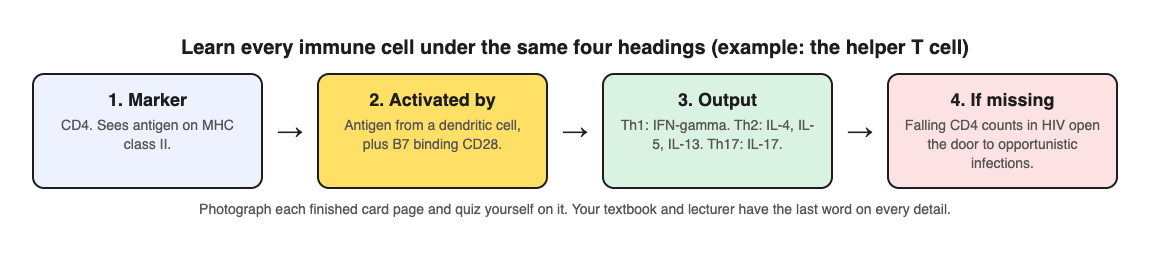
Do not learn cells as a list of names. Learn each one with the same four headings:
- Marker: how you identify it.
- Activated by: what signal turns it on.
- Output: what it releases or does.
- If missing: what disease or infection pattern results.
Here is the helper T cell as an example. Marker: CD4, recognizes antigen on MHC class II. Activated by: antigen presented by a dendritic cell plus a costimulatory signal (B7 binding CD28). Output: depends on subset. Th1 makes IFN-gamma and activates macrophages. Th2 makes IL-4, IL-5, and IL-13 and drives IgE and eosinophils. Th17 makes IL-17 and recruits neutrophils. If missing: think of HIV, where falling CD4 counts open the door to opportunistic infections.
Do the same for CD8 T cells (MHC class I, kill infected cells with perforin and granzymes), NK cells (CD16 and CD56, kill cells that have lost MHC class I), and B cells (CD19, CD20, CD21, become plasma cells that make antibody).
Turn cytokines, CD markers, and complement into self-quizzing
Rereading a cytokine chart feels productive, but in a 2006 study by Roediger and Karpicke, students who took recall tests on a passage remembered more of it two days and one week later than students who reread it, even though rereading made them feel more confident.
So turn your notes into questions. One way is to photograph them. Study Shot is a web app that takes a photo of a page from your textbook, your notes, or a whiteboard and writes multiple-choice questions about it, each with four choices and one right answer. Every answer is checked right away and explained in one to three sentences.
Here is a worked example. Say you have one handwritten page on complement:
- Classical pathway starts when C1q binds antibody on a surface.
- Lectin pathway starts with mannose-binding lectin.
- Alternative pathway is always ticking over on microbe surfaces.
- C3b opsonizes. C3a and C5a recruit and activate inflammatory cells.
- C5b to C9 form the membrane attack complex.
- Late complement deficiency means recurrent Neisseria infections. C1 esterase inhibitor deficiency causes hereditary angioedema.
Hold the page flat, fill the frame, and take the photo in the app. Choose 10 questions and leave the level on Tiered, which climbs from basic to intermediate to advanced. The basic questions ask things like which protein acts as an opsonin. The intermediate ones ask you to explain or compare, like how the classical and alternative pathways differ in what starts them. The advanced ones ask you to apply and predict, like which infection to expect in a patient missing C7.
At the end you get a score for each level. If you got 4 of 4 basic but 1 of 3 advanced, you know the facts but cannot use them yet. The results screen also lists every missed question under Look at these again, with your answer next to the right one.
The questions are written by an AI model, so they can contain mistakes. Your textbook and your lecturer have the last word on every cell, cytokine and disease. Read the explanation and check it against your notes, and if a question looks wrong, use Report a problem with this question under it.
Multiple choice asks you to recognise an answer. Keep writing pathways out from memory on paper, as in the next section, for the recall half.
Trace pathways step by step: antigen presentation to antibody class switching
Pathways are where immunology exams separate students. Write each one as a numbered chain, one step per line, then try to rewrite it from memory.
Here is the chain from infection to an IgE response:
- A dendritic cell takes up an allergen and migrates to the lymph node.
- It presents peptide on MHC class II to a naive CD4 T cell.
- B7 on the dendritic cell binds CD28 on the T cell as the second signal.
- IL-4 in the environment pushes the T cell toward Th2.
- A B cell that recognized the same antigen presents it to the Th2 cell.
- CD40 ligand on the T cell binds CD40 on the B cell.
- IL-4 from the T cell tells the B cell to switch from IgM to IgE.
- IgE binds mast cells, ready to degranulate on the next exposure.
Now ask "what if" at each step. What if CD40 ligand is defective? The B cell cannot switch, so the patient has high IgM and low IgG, IgA, and IgE. That is hyper-IgM syndrome. Swap the cytokine in step 7 and you get a different isotype: TGF-beta favors IgA, and IFN-gamma favors certain IgG subclasses. Our guide on how to study for a physiology exam uses the same "break one step" method for body systems.
Practice with clinical cases: hypersensitivity, immunodeficiency, and autoimmunity
Clinical vignettes reward pattern recognition. Build three short reference pages.
Hypersensitivity
- Type I: IgE and mast cells, minutes. Anaphylaxis, allergic asthma.
- Type II: antibody against a cell or tissue antigen. Goodpasture syndrome, myasthenia gravis, Graves disease.
- Type III: immune complexes deposit in tissue. Lupus, serum sickness, post-streptococcal glomerulonephritis.
- Type IV: T cells, delayed by days. Contact dermatitis, the tuberculin skin test.
Immunodeficiency
Match the infection pattern to the broken part. Recurrent bacterial infections after maternal antibody fades, with very low B cells, points to X-linked agammaglobulinemia. Fungal and viral infections plus low calcium point to DiGeorge syndrome and an absent thymus. Infections with catalase-positive organisms point to chronic granulomatous disease and a faulty NADPH oxidase.
Autoimmunity
Link each disease to its key antibody or HLA association and its hypersensitivity type. That way one fact pulls in three others.
For case practice in Study Shot, photograph your case page and pick the Advanced level, described in the app as "Apply and predict in new situations." That skips straight to the hard questions. The organisms behind the infection patterns are covered in our guide on how to study for a microbiology exam.
How to study for an immunology exam in 7 days
- Day 1: Draw your one-page innate and adaptive map. Make a quiz from it with 10 Tiered questions.
- Day 2: Fill in marker, signal, output, and "if missing" for every major cell. Quiz each page.
- Day 3: Cytokines and CD markers. Quiz on Basic until you score in the 90s, which the app grades as Mastered.
- Day 4: Complement and antigen presentation. Write each pathway from memory, then quiz on Intermediate.
- Day 5: Class switching, MHC, and hypersensitivity. Quiz each page with Tiered and look at your advanced score.
- Day 6: Immunodeficiency and autoimmunity cases. Quiz on Advanced with 20 questions.
- Day 7: Open your library and retake every quiz that is not yet Mastered. Go through each Look at these again list.
Studying with classmates? You can share a quiz by link. Each person needs their own account and gets their own copy of the questions, without your photo.
Frequently asked questions
How long does it take to study for an immunology exam?
For a single unit exam, a focused week of daily sessions is usually enough if you have kept up with lectures. A cumulative final needs longer, so start two to three weeks out and cycle back to earlier topics.
What is the best way to memorize CD markers and cytokines?
Group them by cell and by job instead of learning them as a list. Then test yourself with questions, not rereading, and retake the ones you miss until you get them right without hesitating.
How do I answer immunology clinical vignette questions?
Find the infection pattern, the timing, and any lab clue first. Then ask which cell, antibody, or pathway is broken, and pick the answer that explains all three clues.
Get started: turn your immunology notes into daily quizzes with Study Shot
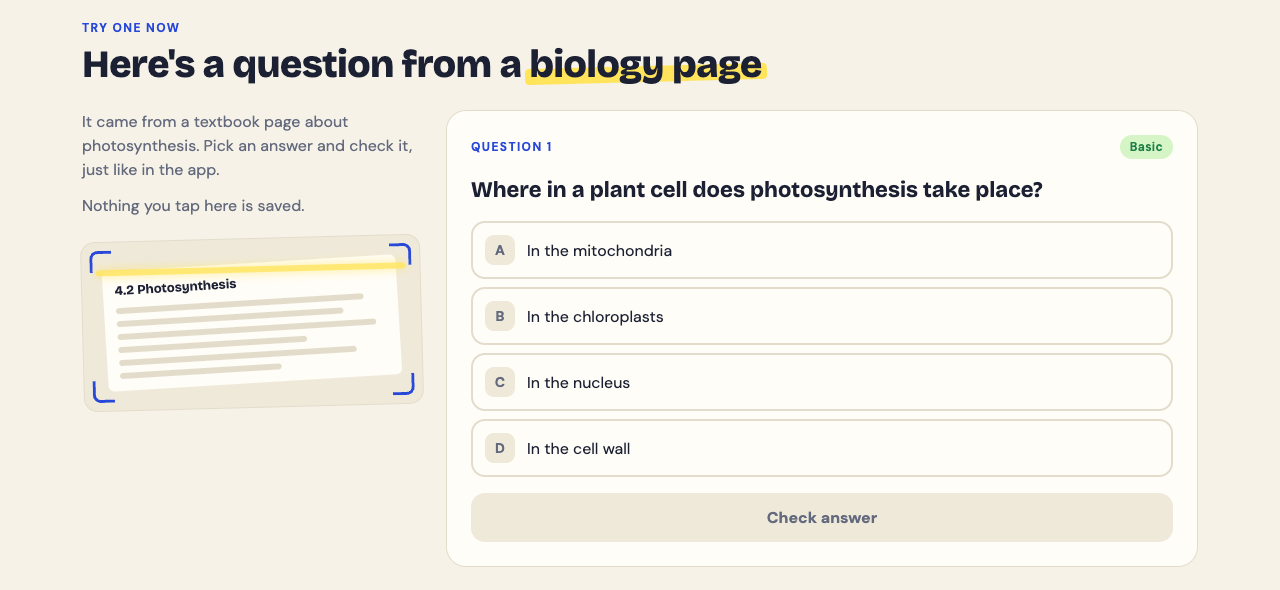
Study Shot runs in the web browser on your phone or computer. Each quiz is saved in your library with its page photo and your best score, so you can retake it any time before the exam.
Try Study Shot: it is free to start. Photograph the page you are studying tonight and get 10 practice questions on it, from basic to advanced.
Comments
No comments yet.
Sign in or make an account to comment.