How to Study for an Organic Chemistry Exam: Mechanisms and Reactions
If you want to know how to study for an organic chemistry exam, start by accepting one thing: you cannot memorize your way through it. Orgo rewards people who can predict what a molecule will do, and that skill comes from understanding electron flow, then drilling reactions until you can recall them without notes. This guide walks you through the fundamentals, mechanisms, reaction maps, synthesis practice, and a two week plan you can actually follow.
Why organic chemistry exams feel different from other science tests
Most science exams ask you to recall a fact or apply a formula. Organic chemistry exams ask you to reason through a molecule you have never seen before. A question might give you a starting material and a reagent and ask for the product. Or it might give you a product and ask how to make it.
That means the exam tests three things at once:
- Recall. You need to know what each reagent does.
- Reasoning. You need to know why it does it, so you can handle a new substrate.
- Planning. You need to chain several reactions together in the right order.
Study only one of these and the exam can expose the gap: product tables alone leave you stuck on a new substrate, and mechanisms without drilled reagents are slow. You need both.
Start with the fundamentals: structure, bonding, acidity and electron flow
Almost every reaction in your course follows from a handful of ideas from the first few weeks. If those are shaky, everything later feels random.
Make sure you can do these without hesitation:
- Draw correct Lewis structures and assign formal charges.
- Identify hybridization and geometry of each atom.
- Draw resonance structures and pick the major contributor.
- Rank acids by stability of the conjugate base, using atom, resonance, induction and orbital.
- Spot nucleophiles (electron rich) and electrophiles (electron poor) in any structure.
The last point is the key. Most mechanisms in a first course are built from a few moves: a nucleophile attacking an electrophile, a leaving group departing, or a proton moving. If you can label the electron rich and electron poor sites on a molecule, you can usually guess the first step of a reaction you have never studied.
Learn mechanisms, not just products: push arrows until it is automatic
Arrow pushing is the language of organic chemistry. Each curved arrow starts at electrons (a lone pair or a bond) and points to where those electrons go. That is the whole rule. The hard part is doing it fast and correctly under pressure.
Here is a practice routine that works:
- Pick one mechanism, for example acid catalyzed hydration of an alkene.
- Write it out from memory on a blank sheet, every arrow and every intermediate.
- Compare to your textbook. Circle every mistake.
- Wait a day. Do it again on a blank sheet.
- Once it is clean twice in a row, change the substrate. Use a more substituted alkene and predict where the carbocation forms.
Step 5 is where real understanding shows up. If you can apply the same mechanism to a new molecule and predict regiochemistry and stereochemistry, you own it. This is the same move biochemistry students make when they trace a pathway step by step instead of memorizing the end product, which we cover in how to study for a biochemistry exam.
Group mechanisms by pattern, not by chapter. SN1, E1 and acid catalyzed hydration all share a carbocation step. SN2 and E2 are both single, concerted steps. Seeing those families cuts the amount you need to memorize.
Build a reaction map that links functional groups and reagents
A reaction map is a single page where each functional group is a box and each reaction is an arrow labeled with its reagents and conditions. Alkene to alcohol. Alcohol to alkyl halide. Alkyl halide to nitrile. Nitrile to carboxylic acid.
Build it by hand. The act of drawing it is half the value. As you go, note on each arrow:
- The reagents and solvent.
- Regiochemistry (Markovnikov or anti Markovnikov).
- Stereochemistry (syn, anti, inversion, racemic).
- Whether the carbon chain grows, shrinks or stays the same.
That last note matters for synthesis. When a problem asks you to add two carbons, you can scan your map for arrows that build carbon to carbon bonds.
Your map will also show you where you have more than one route between two groups. Keep those alternatives visible: retrosynthesis often has more than one right answer.
Practice synthesis and retrosynthesis problems under timed conditions
Synthesis problems combine everything else, so they are often the hardest part of the paper. Retrosynthesis means working backward: look at the target, ask "What reaction could make this bond?", then repeat on the precursor until you reach the allowed starting material.
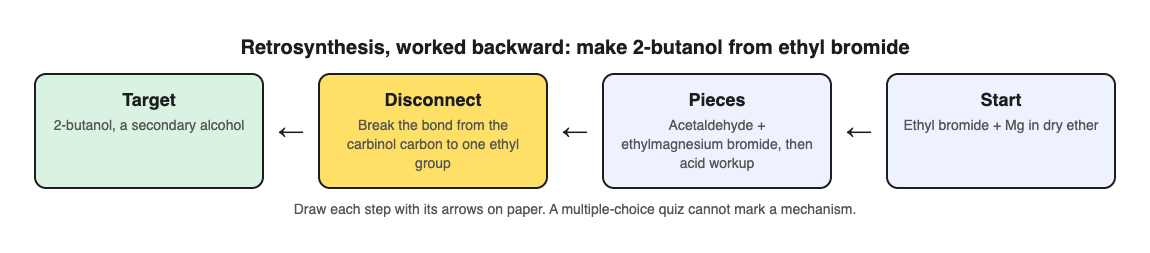
A worked example. Target: 2 butanol. Starting material: ethyl bromide and any other reagents.
- 2 butanol is a secondary alcohol. Secondary alcohols come from a Grignard adding to an aldehyde.
- Break the bond between the carbinol carbon and one ethyl group. That leaves acetaldehyde plus an ethyl Grignard.
- Ethyl Grignard comes from ethyl bromide and magnesium in dry ether. Add it to acetaldehyde, then an acid workup gives the alcohol.
Now do problems like this with a timer. Give yourself the same time per question your exam will. Speed matters, and you only build it by practicing under the clock. After each set, write down which step you got stuck on. That list tells you which part of your reaction map needs more drilling.
Use active recall and spaced repetition for reagents and conditions
Rereading your notes feels productive, but in a 2006 study by Roediger and Karpicke, students who took recall tests on a passage remembered more of it two days and one week later than students who reread it. Active recall means forcing yourself to pull information out of memory, then checking. Spaced repetition means returning to the same material over days, with growing gaps.
For orgo, a few formats work well:
- Reagent prompts. "What does PCC do to a primary alcohol?" Answer before you look.
- Product prompts. Given a substrate and reagent, name the product and its stereochemistry.
- Reverse prompts. Given a product, name the reagent that made it.
- Mechanism prompts. "What is the rate determining step in SN1?"
This is where Study Shot fits. You take a photo of a page, such as your reaction map, a page of lecture notes, or a whiteboard from a study group, and it writes multiple choice questions about that page. Each question has four choices and one right answer. You check your answer, see right away if it is correct, and read a short explanation.
Pick the level to match where you are. Basic covers key terms and facts. Intermediate asks you to explain, compare and connect ideas. Advanced asks you to apply and predict in new situations. The default, Tiered, climbs from basic to advanced in one quiz. For orgo, Tiered is a good start: the basic questions confirm you know the reagents, and the advanced ones push toward the "new substrate" thinking your exam demands.
Be honest about what this does and does not cover. It is multiple choice, so it cannot mark arrows you draw by hand. Keep your blank sheet mechanism practice for that: a 2018 review of 122 experiments by Pan and Rickard found that practice tests transfer least to problems involving worked solutions. And the questions are written by an AI model, so they can contain mistakes, especially with dense structures. Read the explanation to check the logic, and if a question is wrong, use Report a problem with this question under it. Your textbook and instructor have the last word.
Every quiz is saved to your library with its page photo and your best score, so you can retake it on day 3, day 7 and day 12. The results screen shows your score for each level and a Look at these again list of the questions you missed. That list is your next study session.
How to study for an organic chemistry exam in two weeks
Adjust the days to your schedule, but keep the order.
Days 1 to 3: Fundamentals
- Review structure, resonance, acidity and nucleophile/electrophile labeling.
- Photograph your fundamentals notes and run a 10 question Basic quiz on each page.
Days 4 to 7: Mechanisms
- Write two or three mechanisms from memory each day on blank paper.
- Redo any you got wrong the next day, then change the substrate.
Days 8 to 9: Reaction map
- Draw your full map by hand.
- Photograph it in sections, holding the page flat and filling the frame, and run a Tiered quiz on each.
Days 10 to 12: Synthesis
- Do timed retrosynthesis sets every day.
- Retake your saved quizzes and work through each Look at these again list.
Days 13 to 14: Exam simulation
- Take a full practice exam under real time limits.
- Run Advanced quizzes on your weakest pages. Sleep the night before.
The same spaced structure works for other mechanism heavy courses, like neuroscience and immunology.
Frequently asked questions
How many hours should I study for an organic chemistry exam?
There is no set number. Spreading the work over one to two weeks, with active practice each day, lets you come back to each reaction several times instead of cramming once.
Should I memorize reactions or understand mechanisms?
Both. Understand mechanisms so you can handle new molecules, then memorize reagents and conditions so you can answer quickly. Mechanisms make the memorizing easier because reactions fall into a few patterns.
What is the best way to practice organic chemistry problems?
Draw mechanisms from memory on blank paper, do timed synthesis problems, and quiz yourself on reagents with active recall. Track which steps you miss and drill those first.
Get started: turn your orgo notes into daily recall with Study Shot
Photograph your reaction map tonight and see which reagents you really know. Study Shot runs in the web browser on your phone or computer.
Try Study Shot: it is free to start. Photograph the page you are studying tonight and get 10 practice questions on it, from basic to advanced.
Comments
No comments yet.
Sign in or make an account to comment.