How to study vocabulary from a textbook page
Every subject has its own words. Biology has producer and decomposer, geography has erosion and delta, physics has velocity and inertia. If you do not know the words, you cannot follow the rest of the chapter, and a test question can be lost on a single term. This guide shows how to study vocabulary from a textbook page so the words stay with you: what the research says, a simple routine, and one worked example you can copy tonight.
Why rereading the word list does not stick
Most textbook pages put the key terms in bold, or list them in a box at the end of the section. The natural thing to do is read that list a few times until it feels familiar. The trouble is that familiar is not the same as remembered. When you read a definition, the answer is already in front of you, so you never find out whether you could have produced it yourself.
A large review by Dunlosky and colleagues (2013) rated ten common study techniques. Rereading and highlighting were rated low, and the authors suggest practice testing in their place. Practice testing was one of only two techniques rated high, along with spreading your study out over time.
What the research says about learning new words
One of the clearest studies on this used vocabulary. Karpicke and Roediger (2008) had students learn foreign language words. Once a student could recall a word, it was either studied again and again, or tested again and again. More studying after that point had no effect on recall at a later test. More testing had a large positive effect. The students' own predictions of how well they would do did not match how they actually did.
So the key move is to test yourself on the words, and to keep testing after you first get them right. The format of the test matters too:
- Recall and recognition are different. Recognising a word among four choices is easier than writing it from memory. Halamish and Bjork (2011) note that the benefit of testing over restudying tends to show up after a long delay, or when the final test asks you to recall rather than recognise.
- Good multiple-choice questions still make you think. Little and colleagues (2012) found that multiple-choice tests with plausible wrong answers made people retrieve why the right answer was right and why the others were wrong. They also helped people later recall facts about the wrong answers, which the short-answer tests in the study did not.
The practical answer is to use both: a multiple-choice quiz to cover every term and learn from the explanations, then recall on paper, in both directions, for the words you must write on the test.
Memory tricks: the evidence is mixed
A popular trick for vocabulary is the keyword mnemonic: you link a new word to a familiar word that sounds like it, and picture the two together. The research does not agree on how much it helps.
The Dunlosky review rated it low. It found the trick hard to use in some situations, and its benefit limited to some kinds of material and to short delays. A more recent study by Qu and colleagues (2024) tested 110 college students learning English words. When self-testing was limited to two tries, testing alone did no better than restudying, but testing combined with a keyword trick did better than restudying.
If a trick helps you with a hard word, use it alongside testing, not instead of it.
How to study vocabulary from a textbook page, step by step
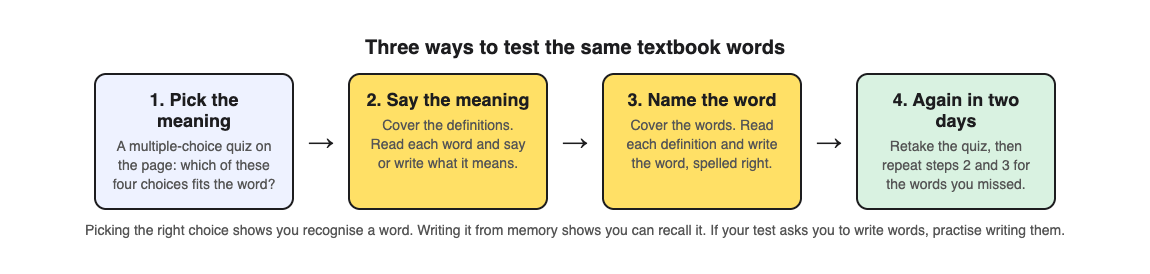
- Find the words. List the bold terms on the page, plus any word you could not explain to a friend.
- Take a quiz on the page. Answer multiple-choice questions on the terms and read the explanation for every answer, right or wrong.
- Say the meaning. Cover the definitions, read each word, and say or write what it means. Check each one.
- Name the word. Cover the words, read each definition, and write the word, spelled right. Swapping the direction matters: knowing what "decomposer" means does not mean you can produce "decomposer" when you see its definition.
- Come back in two days. Retake the quiz before you look at the page, then repeat steps 3 and 4 for the words you missed.
Worked example: the key terms on an ecology page
Say your biology chapter has a page on food webs, with eight terms in bold: producer, consumer, herbivore, carnivore, decomposer, food chain, food web and energy pyramid. Here is how to study them with Study Shot, which takes a photo of a page from your textbook, notes or worksheet and writes multiple-choice questions about it, explaining every answer.
- Photograph the page. Hold the page flat and fill the frame, so the bold terms and their sentences are readable.
- Choose Basic and 10 questions. Basic questions are on key terms, facts and definitions, which is what you want first. Each question has four choices. Read all four before you pick, and ask yourself why each wrong one is wrong; that is the kind of thinking the Little study found useful.
- Answer and read every explanation. Press Check answer after each question. You see Correct! or Not quite., the correct answer, and a short explanation. If you guessed right, read the explanation anyway.
- Use the results. Look at these again lists every question you missed, with your answer and the right one. Those words go to the top of your paper list for steps 3 and 4 above.
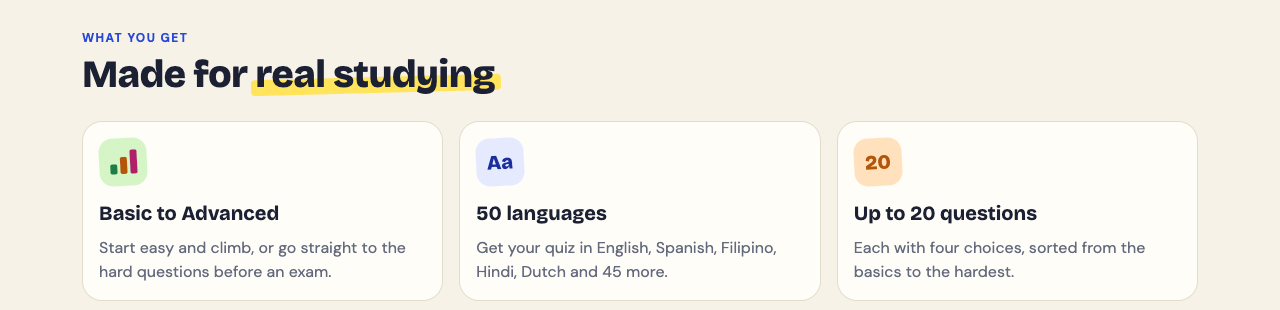
- Climb a level. Once Basic feels easy, make a second quiz on the same page with Tiered, which starts with basic questions and climbs to Intermediate (explain and connect ideas) and Advanced (apply them in a new situation). A question like "What would happen to the herbivores if a disease killed most of the producers?" checks that you understand the word, not just its definition.
- Retake in two days. Your quiz is saved in your library, so press Retake quiz before you open the book again.
For more on the general method, see practice questions from a textbook page, and our spaced repetition schedule for when to come back.
If you study the words in another language
If your textbook is in English but you think in another language, you can have the quiz in your own language. Study Shot writes the questions, answers and explanations in any of 50 languages, while the app's own screens stay in English. Your test will probably use the English terms, so do the "name the word" step in English. Our post on studying in your own language from an English textbook covers this in more detail.
One more limit: the questions are written by an AI model and can contain mistakes. If a definition in a question does not match your textbook, trust the textbook, and use Report a problem under the question.
Frequently asked questions
How many vocabulary words should I study at once?
One textbook page at a time works well, usually five to ten bold terms. That fits one 10-question quiz and a short paper list.
Is a multiple-choice quiz enough to learn vocabulary?
It is a good start, because it covers every word and explains each answer. If your test asks you to write the words or their meanings, also practise recalling them on paper.
Should I learn the word from the definition or the definition from the word?
Both. Test the word to its meaning and the meaning to the word, because being able to do one does not guarantee the other.
When should I review the words again?
Two days later, then a few days after that. Spreading practice out was the other technique the Dunlosky review rated high.
Get started
Try Study Shot: it is free to start and works on your phone and computer. Open your textbook to the page with tonight's key terms, photograph it, and take 10 Basic questions. Then cover the definitions and see how many words you can explain on your own.
Comments
No comments yet.
Sign in or make an account to comment.